
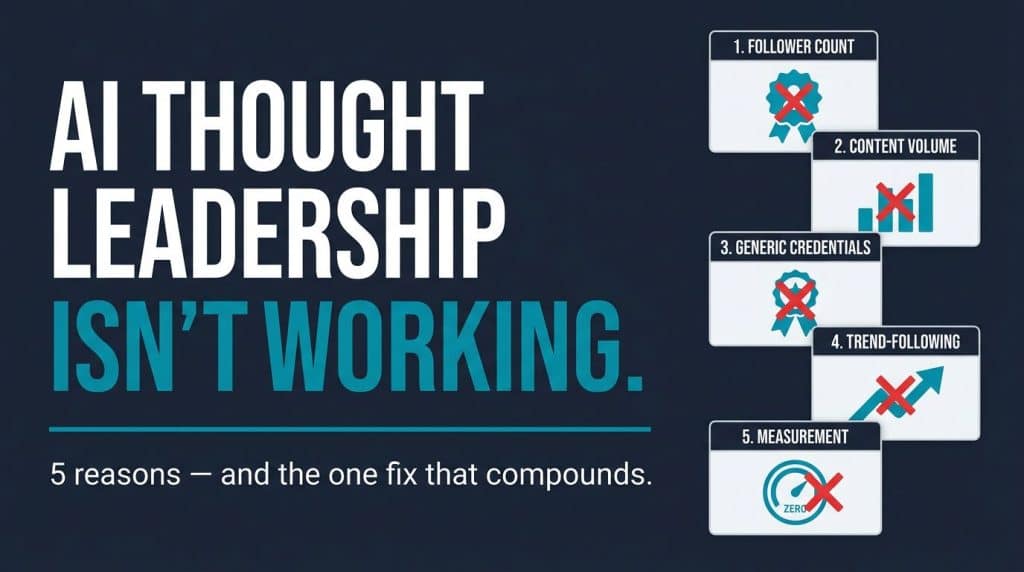
AI thought leadership is no longer a content volume game. It is a judgment credibility game that most B2B founders are losing by playing old rules. Dan Pratl, Founder and CEO of Quadron, argues that when AI can replicate credentials, titles, and polished prose, the only signal that survives is a documented track record of predictions made before outcomes are known. For B2B tech founders, building on anything else means a pipeline that evaporates under scrutiny.
Building AI thought leadership requires replacing vanity metrics with a verifiable judgment track record. Dan Pratl, CEO of Quadron, demonstrates this by publicly logging specific market predictions with disclosed reasoning before outcomes are known. When AI can produce credentials, titles, and polished writing, the only credibility signal it cannot replicate is a timestamped record of right calls made under uncertainty.
Table of Contents
About Dan Pratl
Dan Pratl is Founder and CEO of Quadron, a company built on the premise that genuine expertise can be made verifiable even when AI makes everything else look like expertise. Pratl developed Quadron’s methodology by building a systematic record of specific market predictions with disclosed reasoning, logged before outcomes were known. That process earned enterprise client trust in a market where credentials alone no longer distinguish serious practitioners from polished generalists. Most B2B tech founders are watching their content get commoditized by AI tools producing equivalent-looking output at a fraction of the cost. Pratl’s approach to AI thought leadership reveals the one signal AI cannot manufacture: a judgment track record built in public.
Watch The Episode
Reason 1: Your Credibility Signals Are Proxies, Not Proof
Every signal B2B founders have relied on to establish expertise is a proxy. A title, a certification, a LinkedIn following, a steady publishing cadence: these signal that someone might know what they are doing. Not one of them proves it.
The only credibility signal AI cannot replicate is a timestamped record of right calls made under genuine uncertainty.
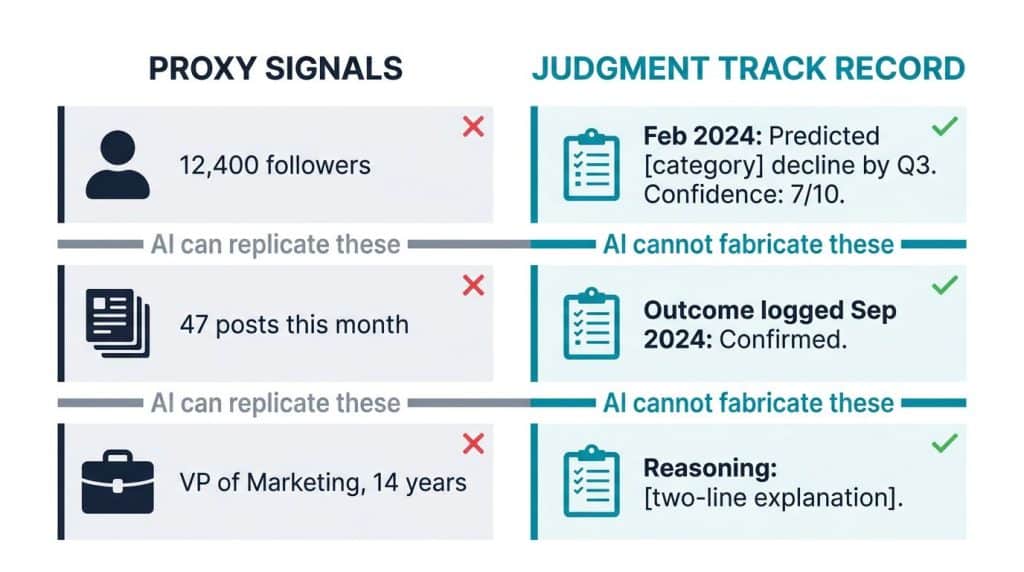
Dan Pratl draws a direct line between this problem and the rise of generative AI. (For a full breakdown of what thought leadership actually means in this context, see What is Thought Leadership and How to Become a Thought Leader.) When AI can produce polished white papers and credible LinkedIn posts at near-zero cost, output-based credentials lose their signal value. The volume of content a person publishes no longer distinguishes them from someone running a well-designed AI system.
According to Edelman’s 2024 B2B Thought Leadership Impact Study, 61% of decision-makers now weigh thought leadership more heavily than traditional marketing materials when evaluating partners. That shift creates both pressure and opportunity: the bar for what constitutes credible thought leadership has risen precisely because AI-generated content now fills the lower tier.
Pratl’s framework identifies the distinction that matters: demonstrated knowledge versus demonstrated judgment. Knowledge can be recited. Judgment is the capacity to make a specific call under uncertainty and be held accountable for it. AI can replicate the former. It cannot replicate the latter.
The companies getting this right have stopped measuring thought leadership by impressions or shares. They track how often their public positions have been validated by subsequent market events. Pratl notes that Quadron clients using this approach report stronger enterprise pipeline conversion within 6 to 12 months. That requires fundamentally different content production.
Pratl argues that AI thought leadership built on proxy signals is not protected by effort or quality. It is exposed the moment a prospective client compares it against an AI-generated alternative and finds no meaningful difference.
Pratl’s core observation is that most credibility systems were designed for a world where production was the hard part. AI shifted the bottleneck entirely: production is now cheap, and judgment is the scarce resource. B2B tech founders who haven’t updated their credibility strategy are building for a world that no longer exists.
Proxy Signals vs. Judgment Record: What Each Earns
| Signal Type | Examples | Can AI Replicate? | What It Earns |
|---|---|---|---|
| Proxy signal | LinkedIn followers, publish cadence, white papers, certifications | Yes, at scale and lower cost | Attention, short-term reach |
| Judgment record | Timestamped predictions, disclosed reasoning, public accuracy reviews | No — requires time and real stakes | Credibility, enterprise trust, pipeline |
The shift from proxy signals to judgment records is not optional for B2B tech founders competing in 2026. It is the only structural move that survives AI commoditization.
Reason 2: The Systems You’re Using Were Never Built for This
LinkedIn’s algorithm optimizes for engagement. According to Pratl, an emotionally resonant hot take performs better than a measured, specific prediction with disclosed reasoning. That is a design choice, not a bug, and it was never aligned with demonstrating judgment.
Dan Pratl built Quadron’s credibility methodology in direct response to this misalignment. The standard content calendar rewards publishing consistency. It measures success in impressions, follower growth, and shares. None of these metrics answer the question a prospective enterprise client actually asks: has this person been right before, in public, when it mattered?
The repurposing workflow compounds the problem. A podcast clip becomes a LinkedIn post, which becomes a newsletter excerpt, which becomes a short-form video. The insight is the same insight, distributed across formats. The reach multiplies. The judgment signal does not.
Most B2B content operations are built to solve a distribution problem. They assume the underlying insight is worth distributing. Pratl’s framework surfaces a prior question: is this claim testable, or does it merely sound valuable? A claim that cannot be tested is indistinguishable from AI-generated insight-sounding content, identical in format and absent in accountability.
A claim that cannot be tested is indistinguishable from AI-generated content: identical in format, absent in accountability.
Pratl’s operational model at Quadron inverts the standard approach. His team logs specific market positions with explicit reasoning before outcomes are known, rather than producing content and measuring reach. The measurement is retrospective accuracy, not prospective reach. That inversion is what makes the credibility system work when AI saturates the content layer.
Pratl’s observation at Quadron is that most AI thought leadership tools were designed to help people produce more content faster. None were designed to help people build a verifiable judgment record. These are different products solving different problems, and most B2B founders are buying the former while hoping it delivers the latter.
Why Does AI Thought Leadership Measured by Volume Always Lose?
AI thought leadership measured by volume always loses because volume metrics reward production, not prediction accuracy. Enterprise buyers do not evaluate how much a founder has published. They evaluate whether that founder was right before everyone else knew the answer.
Measuring thought leadership by follower count is like measuring a surgeon’s quality by the number of consultations booked. Volume is a function of marketing. Quality is a function of outcomes. Most B2B founders track the first and ignore the second.
Volume is a function of marketing. Judgment is a function of outcomes. These are not the same asset.
Dan Pratl’s framework at Quadron introduces a different category of metric: prediction accuracy. When a practitioner makes a specific market call, names the timeframe, and publishes their reasoning, the outcome becomes verifiable by any third party. Over time, that record of right calls compounds into a credibility asset. No AI tool can manufacture it because doing so requires being accountable over time.
The mechanics of this approach require discipline most content operations don’t have. A market prediction logged in January 2024 with explicit reasoning sits in a public record. By Q4 2024, the outcome is visible. Pratl’s team reviews these records and publishes the results, including the ones that were wrong. The transparency is intentional: wrong calls disclosed honestly do more for credibility than correct calls that were never put at risk.
Research by TopRank Marketing and Ascend2 in their 2026 B2B Thought Leadership Study found that 32% of B2B buyers now discover thought leadership through generative AI tools. That makes the citability of your positions, not just their reach, the deciding factor in whether buyers encounter your thinking at all.
AI thought leadership built on volume metrics always loses to a practitioner with a shorter track record and higher prediction accuracy. An enterprise buyer evaluating two vendors does not count LinkedIn posts. They ask whether the vendor understood their category before everyone else did, and whether there is evidence.
Pratl’s framework holds that judgment is scarce because producing it requires time, domain depth, and genuine stakes. All three are things AI cannot manufacture. Content volume is abundant because producing it requires none of them. B2B tech founders optimizing for the abundant resource are competing in a market that AI is about to flood with better-funded competitors.
How Do You Prove AI Thought Leadership Before the Outcome Is Known?
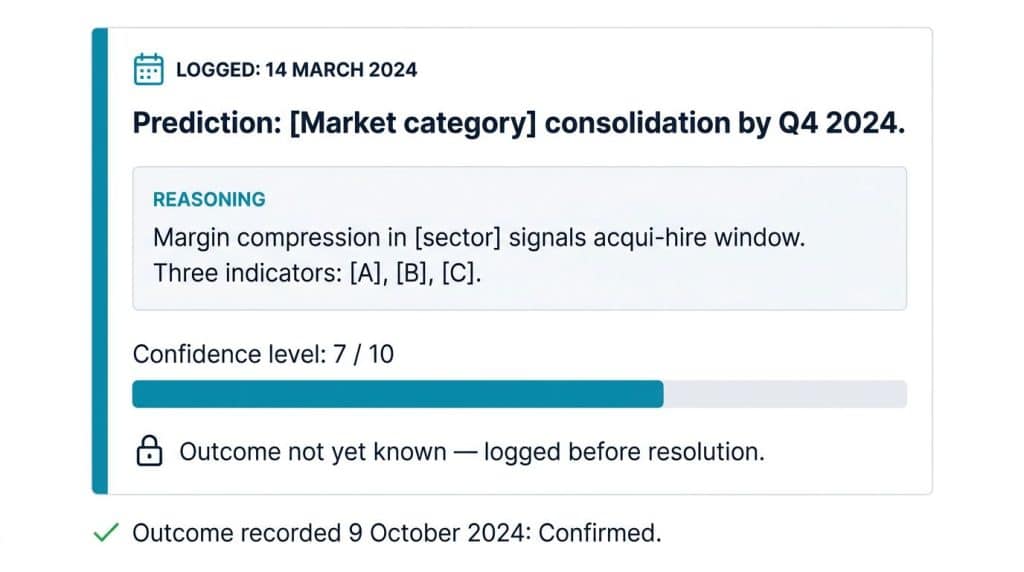
You prove AI thought leadership before the outcome is known by logging your specific market positions publicly, with dates and explicit reasoning, before the result is visible. A position published in January with a named confidence level becomes independently verifiable by December. No retrospective claim can replicate that record.
Most B2B thought leaders comment on trends after they are confirmed. The article is published once the outcome is clear, the lesson is obvious in retrospect, and the risk is zero. This is journalism written after the fact and presented as foresight.
Dan Pratl identifies this as the core structural problem: there is no timestamp on a claimed insight. A founder can write in 2025 that they understood a 2023 market shift all along. There is no mechanism to check whether that is true. Enterprise clients cannot verify the claim and default to other proxies, which AI can already replicate.
A documented prediction record is a credibility asset that accumulates over time and cannot be fabricated retroactively.
Pratl’s process at Quadron solves this by creating a documentation system with temporal evidence. Positions are logged with dates, specific claims, explicit reasoning, and named confidence levels. When the market outcome is known, the original entry is revisited in public. The gap between what was claimed and what happened becomes part of the record.
The enterprise sales implication is direct. A founder who shows three specific market calls from the past two years demonstrates something a credentials page cannot replicate. The original reasoning is intact. The outcomes are visible. Pratl’s methodology is built specifically for this moment in a sales conversation.
AI thought leadership without pre-outcome documentation is unfalsifiable. Unfalsifiable claims look the same as AI-generated content to a sophisticated enterprise buyer. Pratl’s distinguishing feature of genuine judgment: it was expressed before the answer was known, in a specific form that can be independently checked years later.
Pratl’s framework treats credibility as a time-series asset, not a static claim. Each documented prediction adds to the record, and the record compounds. A practitioner with two years of logged calls, reviewed publicly, has built an asset that requires two years of discipline to replicate. That is a durable competitive advantage in AI thought leadership.
Reason 5: You’re Building Your Reputation on Someone Else’s Platform
LinkedIn has changed its content algorithm at least four times in the past three years. Each change redistributed reach, deprioritized certain content formats, and reset engagement dynamics for thousands of B2B thought leaders who had built their audience there. The platform did not ask their permission.
Dan Pratl makes a structural argument about where credibility should live. A reputation built primarily on a platform’s algorithm is a reputation held on lease. The landlord can change the terms. Most B2B founders treating LinkedIn as their primary credibility infrastructure are not building an asset; they are building a tenancy.
A reputation built on a platform’s algorithm is a reputation held on lease. The landlord can change the terms.
Pratl’s approach at Quadron separates the judgment record from the distribution channel. The documented predictions, disclosed reasoning, and reviewed outcomes live on infrastructure that Quadron controls. The platforms are used for distribution, not for storage. An algorithm change does not erode the underlying asset.
The practical implication is direct. (See also: 4 Steps to Double Your LinkedIn Leads Today for a tactical view of using LinkedIn as distribution, not storage.) AI thought leadership programs should separate what they are building from where they are building it. An audience is not a credibility record. Reach is not proof of judgment. A founder who loses their LinkedIn account tomorrow should be able to point a prospective client to an independent record on a domain they control and be evaluated on that record alone.
Pratl’s framework at Quadron separates the judgment record from the distribution channel. Documented predictions and outcomes live on owned infrastructure; platforms handle distribution only. An algorithm change cannot erase what was built on infrastructure the founder controls. This is the structural difference between a credibility asset and a credibility tenancy in AI thought leadership.
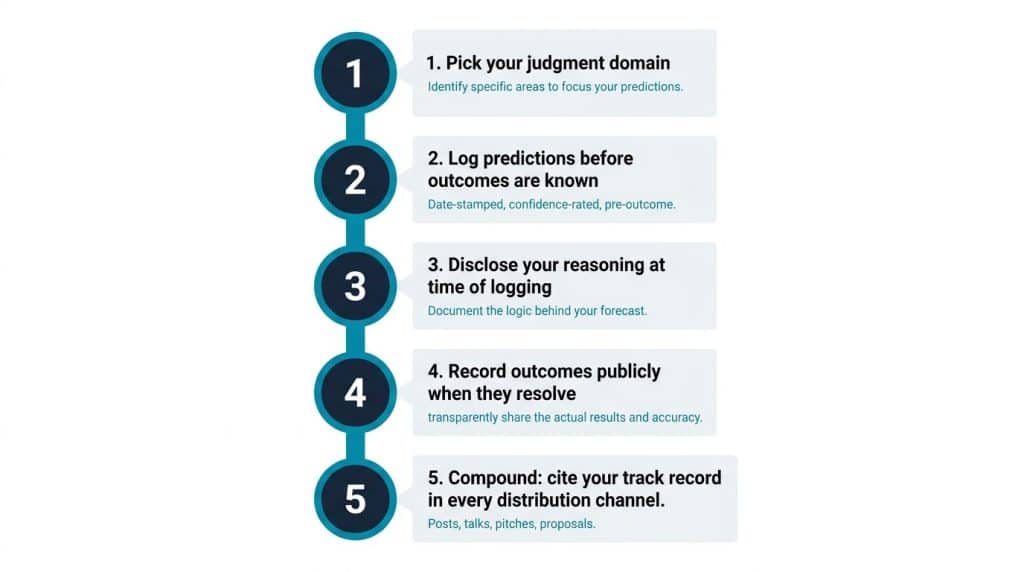
How to Build an AI Thought Leadership Strategy That Compounds
Diagnosing the problem is not enough. The following five steps translate Pratl’s framework into a system any B2B founder can implement, regardless of current following size or publishing frequency.
Step 1: Identify your three signature market positions. Choose three specific claims about your category that you are willing to stand behind publicly. These are not observations. They are predictions: specific, time-bound, and falsifiable. “AI will commoditise generic B2B content by Q3 2025” is a position. “AI is changing content” is not.
Step 2: Log each position before the outcome is known. Publish the claim on a domain you own, not only on social platforms. Include the date, the specific prediction, your explicit reasoning, and a named confidence level (high, medium, low). This timestamp is what makes the record verifiable.
Step 3: Build the documentation on infrastructure you control. A subdirectory on your company domain, a self-hosted newsletter archive, or a dedicated predictions page works. The requirement is that it is accessible by URL and not dependent on a third-party algorithm to surface it. Platforms amplify the record; they do not store it.
Step 4: Review your record publicly on a quarterly cadence. When an outcome is known, return to the original post and document what happened. Accurate calls are noted. Wrong calls are disclosed with the reasoning that led you astray. The transparency is not a weakness. It is the signal that separates a credibility record from a highlight reel.
Step 5: Use AI for production, not judgment. (The 4-Part Leadership Voice Framework for Founders covers how to keep your voice distinct from AI output across formats.) AI tools accelerate writing, formatting, distribution, and research. The judgment function, including which positions to take, what the reasoning is, and how to review the outcomes, stays human-authored. This is what makes the record yours and no one else’s.
A judgment record built in public for 18 months cannot be replicated by a competitor who starts today.
The judgment-record approach is within reach for a B2B founder spending four hours per month on it. The compounding comes from consistency, not volume. A founder with 18 months of logged positions has built something that a competitor starting today cannot replicate until 18 months from now.
Frequently Asked Questions
What is AI thought leadership?
AI thought leadership refers to the practice of building professional credibility and expert authority in categories where artificial intelligence is reshaping how expertise is created, distributed, and verified. In 2026, this requires building a verifiable track record of specific, time-stamped positions made before outcomes were known, not just publishing insightful content. Dan Pratl, Founder and CEO of Quadron, defines the distinction as the difference between demonstrated knowledge and demonstrated judgment: the former AI can replicate, the latter it cannot.
Does AI replace thought leaders?
AI does not replace thought leaders, but it has made most traditional thought leadership tactics indistinguishable from AI-generated content. When a large language model can produce polished white papers, credible LinkedIn commentary, and well-researched market analysis at scale, output-based credibility loses its differentiation. What AI cannot replicate is a documented record of specific predictions made under genuine uncertainty before outcomes are known. Thought leaders who have built this kind of temporal accountability record retain a credibility advantage that no AI system can manufacture retroactively.
How can B2B founders prove expertise when AI commoditizes knowledge?
B2B founders prove expertise in an AI-saturated market by creating a time-series credibility record: specific market positions logged with dates, explicit reasoning, and named confidence levels, reviewed publicly once outcomes are known. Dan Pratl’s methodology at Quadron operationalizes this directly. A founder who can show an enterprise prospect three specific market calls from the past two years, with original reasoning intact and outcomes visible, has demonstrated something a credentials page or a polished content archive cannot replicate.
What makes a credible B2B thought leader in 2026?
A credible B2B thought leader in 2026 is defined by three things: specific claims made before outcomes were known, disclosed reasoning that allowed the claim to be evaluated, and a public record of accuracy that accumulates over time. Follower counts, content volume, and platform presence are still relevant for distribution, but they no longer function as credibility signals because AI tools can replicate them at scale. The credibility signals that survive AI commoditization are the ones that require time, accountability, and genuine domain stakes.
How do you use AI for thought leadership without sounding generic?
Using AI for thought leadership without sounding generic requires separating the judgment function from the production function. AI tools accelerate content production, formatting, distribution, and research. They cannot provide the underlying position, the disclosed reasoning, or the accountability for being wrong. Dan Pratl’s approach at Quadron uses AI for production efficiency while keeping the judgment record entirely human-authored: the predictions, the reasoning, and the retrospective reviews are written by practitioners with direct accountability for the claims. AI amplifies the distribution of genuine judgment. It does not manufacture it.
How do I establish AI thought leadership as a B2B founder?
Establishing AI thought leadership as a B2B founder starts with identifying three to five specific market positions you are willing to stand behind publicly before outcomes are confirmed. Log each position with a date, explicit reasoning, and a confidence level on infrastructure you own. Review the record quarterly in public, including calls that proved wrong. This process produces a verifiable judgment record over 12 to 18 months that no amount of retrospective content can replicate.
How do I measure whether my AI thought leadership is working?
Effective AI thought leadership measurement tracks three signals: prediction accuracy (how many of your public calls proved correct), citation quality (whether your positions are referenced in enterprise sales conversations or industry writing), and pipeline attribution (whether prospects mention specific claims you made before reaching out). Follower growth and content engagement are distribution metrics, not credibility metrics. The two compound differently over time. A practitioner with a shorter track record and higher prediction accuracy will consistently outperform one with a larger following and no documented calls.
Conclusion
Pratl’s core finding is that the credibility crisis in B2B thought leadership is not caused by AI producing better content than humans. It is caused by humans producing content that is indistinguishable from what AI generates. The founders who will maintain expert authority are the ones who build a record of being right about things before the outcome was certain, not the ones who simply write more.
For B2B tech founders, this has a direct implication for how they allocate attention. Time spent on publishing cadence and follower growth compounds slowly. Time spent documenting specific market positions with disclosed reasoning compounds permanently, because each logged call either adds to or revises a credibility record that no AI tool can fabricate. The judgment record is the asset. The content is the distribution mechanism.
If you want to build a thought leadership strategy that survives AI commoditization, Sproutworth’s content strategy service is designed for B2B founders who need to translate genuine domain expertise into a credibility infrastructure that enterprise buyers can verify.
The question is not whether AI thought leadership matters for your pipeline. It is how long you can afford to compete with credibility signals that AI has already learned to replicate at scale.
Related Resources
- B2B Content Marketing Strategy for Funded Startups — How to build a content engine that compounds alongside your thought leadership
- LinkedIn Content Strategy for B2B Founders — Distribute your judgment record to the buyers who need to see it
Related Links
- Quadron — Dan Pratl’s company applying the judgment-record framework to B2B market positioning
- Dan Pratl on LinkedIn — Follow his public prediction record and market commentary
Some topics we explore in this episode include:
- Failures of Current Credibility Systems: Limitations of LinkedIn, credentials, and prediction markets in proving expertise.
- Personal Healthcare Catalyst: The founder’s experience navigating his mother’s illness revealed system gaps.
- Systemic Infrastructure Breakdown: Examples from regulation, open source, and crypto where systems outlive their purpose.
- Quadron Product Overview: How Quadron works for professionals and key concepts like lenses and claims.
- Legal Protection of Expertise: Structuring and enforcing expertise ownership through trade secrets.
- Incentives and Reward Mechanisms: Incorporating incentives to align and compensate expertise in the AI economy.
- Enterprise vs. Consumer Adoption: Strategies for enterprise sales versus grassroots user-driven adoption.
- Talent Retention and Organizational Risk: The impact of visible, portable expertise on retaining talent and competitiveness.
- Shifting to Expertise Ownership Culture: The cultural and behavioral change needed for individuals to manage their expertise as an asset.
Listen to the episode
Subscribe to & Review the Predictable B2B Success Podcast
Thanks for tuning into this week’s Predictable B2B Podcast episode! If the information from our interviews has helped your business journey, please visit Apple Podcasts, subscribe to the show, and leave us an honest review.
Your reviews and feedback will not only help me continue to deliver great, helpful content but also help me reach even more amazing founders and executives like you!
