

Guest Introduction
Mike Malloy is the founder of Malloy Industries Consulting Group, a firm that helps B2B SaaS companies scale operations through fractional executive matchmaking. With 15 years of corporate experience spanning Deloitte, a CEO role at Wave Born Sunglasses, and program director at the Halian Incubator, Mike has guided 200+ executives in helping businesses grow from $2M to $20M and beyond.
He helped three entrepreneurs secure deals on Shark Tank and serves as adjunct professor and entrepreneur-in-residence at Georgetown University. His firm has matched fractional executives across 100+ projects, with a 365-day warranty and a second-match guarantee on every placement.
Watch the Full Episode
Table of Contents
Figuring out how to scale a B2B startup is one of the most deceptive challenges in business.
The early wins feel like proof that the formula is working. Revenue grows. The team expands. Then, somewhere around $1-2M, the machine stops. The same moves that got you here start working against you. And no amount of extra hours changes that.
After hosting 500+ conversations with B2B tech founders and CEOs on the Predictable B2B Success podcast, a pattern becomes impossible to ignore: the strategies that get you to $1M are actively preventing you from reaching $10M. The sooner a founder accepts this, the faster everything changes.
Mike Malloy, founder of Malloy Industries, has spent years testing this hypothesis in the field. His firm has matched 200+ fractional executives with B2B SaaS companies, helping them move from stalled growth to predictable, scalable revenue. The lessons he shares are not theoretical. They come from watching companies succeed and fail at every stage of this journey.
Key Takeaways From This Episode
- Scaling a B2B startup means growing revenue without proportionally growing founder hours or costs.
- Most B2B startups stall before $5M because the founder is the bottleneck, not the market.
- Product-market fit must be validated before any scaling investment is made.
- Different growth channels dominate at different revenue stages.
- The “Who Not How” mindset is the most reliable unlock for founders stuck in execution.
- Fractional executives provide VP-level talent to $1-10M companies at 30-50% of full-time cost.
- Protecting CEO time for creative and ideation work predicts faster scaling outcomes.
What Does It Mean to Scale a B2B Startup?
Scaling a B2B startup means growing revenue without proportionally increasing costs, headcount, or founder hours. A company that doubles revenue by doubling headcount has grown. A company that doubles revenue by building better systems has scaled. The distinction determines what you prioritize at every stage.
This is not a semantic difference. It is the difference between a business that is trapped on a treadmill and one that builds genuine enterprise value.
According to research compiled by Lenny Rachitsky from interviews with 20+ unicorn founders, top B2B startups take an average of two years from founding to hit $1M ARR, and roughly 1.5 years from their first paying customer. That benchmark is a practical reality check. If you signed your first customer 18 months ago and are still well below $1M ARR, the problem is almost certainly not the market. It is something internal: ICP clarity, pricing, sales process, or the founder’s ability to delegate.
McKinsey research on startup performance found that 80% of startups that landed Series A funding failed within eight years. The ones that survived shared one distinguishing trait: they built repeatable, systematic revenue engines before they ran out of runway.
That is what this article breaks down, stage by stage.
What is the difference between growth and scaling in a B2B startup?
Growth means adding revenue. Scaling means adding revenue while maintaining or improving unit economics. A B2B startup that is truly scaling can increase ARR by 2x or 3x without the CEO working twice as many hours or the cost base tripling. The practical test: if removing the founder from operations for 30 days would cause revenue to collapse, the company is growing, not scaling.
Why Do Most B2B Startups Stall Before $5M?
Most B2B startups stall before $5M because the founder is the product, not just the founder of the product. Early customers buy because they trust the founder personally. The pitch works because the founder’s charisma, story, and relationships carry it. This works brilliantly up to a point. Then it becomes the ceiling.
Building scalable B2B operations requires acknowledging that stamina gets you to $1M, but systems get you to $10M. Mike Malloy puts it plainly: “What got you here won’t get you there.”
The specific failure modes Mike sees most often across 100+ engagements:
- Fuzzy ICP. The ideal customer profile was never formally validated. Conversion rates are low not because of pipeline volume but because the company is talking to the wrong people.
- The founder as the bottleneck. Every decision flows upward. Every sales call needs the CEO. The business moves only as fast as one exhausted person.
- No documented process. The sales playbook exists only in the founder’s head. There is nothing to hand off, train from, or improve systematically.
- Junior fixes for senior problems. When growth stalls, many founders hire mid-level managers rather than experienced operators. The problems at $3M require $3M-level thinking.
According to a Gallup study on workplace engagement, managers account for 70% of the variance in team engagement. A founder who insists on controlling everything inadvertently erodes the initiative of the people around them. The result is a company that can only scale as fast as one person can move.
Why do B2B founders struggle to delegate as their startup grows?
Most founders achieved early success by being personally involved in every decision. Delegation feels like losing control or accepting lower quality. Mike Malloy’s research across 100+ B2B scaling engagements shows the real cost runs the other direction: every hour a founder spends on tasks someone else could do is an hour not spent on the strategic work only the founder can do. The inability to delegate is the single most consistent constraint on B2B startup growth past $2M ARR.
Related episode: How to Scale Your Agency Without Burning Out — Brian Smith, Strategy Ladders
Product-Market Fit: The Non-Negotiable Before You Scale
Product-market fit is the condition in which your product solves a problem buyers consistently seek out, pay for without heavy persuasion, and refer others to, unprompted. No amount of sales process, fractional leadership, or growth channel investment will fix a product that lacks genuine market fit. Scaling before fit is one of the most expensive mistakes a B2B startup can make.
This point surfaces consistently across 500+ CEO interviews on the Predictable B2B Success podcast. Founders who scaled successfully were ruthlessly honest about whether their product was genuinely solving a problem buyers would pay to have solved, or whether they were manufacturing artificial demand for something the market did not urgently want.
The clearest signal of real product-market fit is organic pull: customers come back unprompted, refer others without being asked, renew without a sales conversation, and would be genuinely disappointed if the product disappeared.
Mike Malloy’s framework for testing fit is systematic. In the first month of any engagement, his team puts the entire business on what he calls “the mechanics rack.” They review customer discovery notes, churn data, NPS scores, and expansion revenue patterns. When those signals are healthy, the company is ready to scale. When they are not, the focus shifts to product-customer alignment before any scaling investment is made.
A company can hit $500K or even $1M ARR selling to the wrong customers. These are often customers who bought because of the founder’s relationship, accepted a discount that made the economics unviable, or needed heavy customization that cannot be replicated at scale. Real fit means repeatable buying, at sustainable price points, from buyers who look like each other.
A Harvard Business Review analysis of startup failure identified premature scaling before achieving product-market fit as one of the top three causes. The companies that scaled successfully resisted the pressure to hire and expand before the foundation was solid.
This aligns with what I see when developing educational email courses for B2B tech founders. The courses that convert best are built around problems buyers are actively searching for solutions to, not problems the founder assumes they have. The discipline required to validate before scaling applies equally to product, sales, and content.
How do you know if your B2B startup has genuine product-market fit?
Product-market fit in a B2B startup is present when: customers renew without a sales push, net revenue retention exceeds 100%, unprompted referrals arrive from happy customers, your best customers can clearly articulate why they bought and would buy again, and churn is low and explainable. If you are relying on discounting or founder relationships to close and retain most customers, the fit is not yet strong enough to scale safely.
How to Scale a B2B Startup: The Stage-by-Stage Playbook
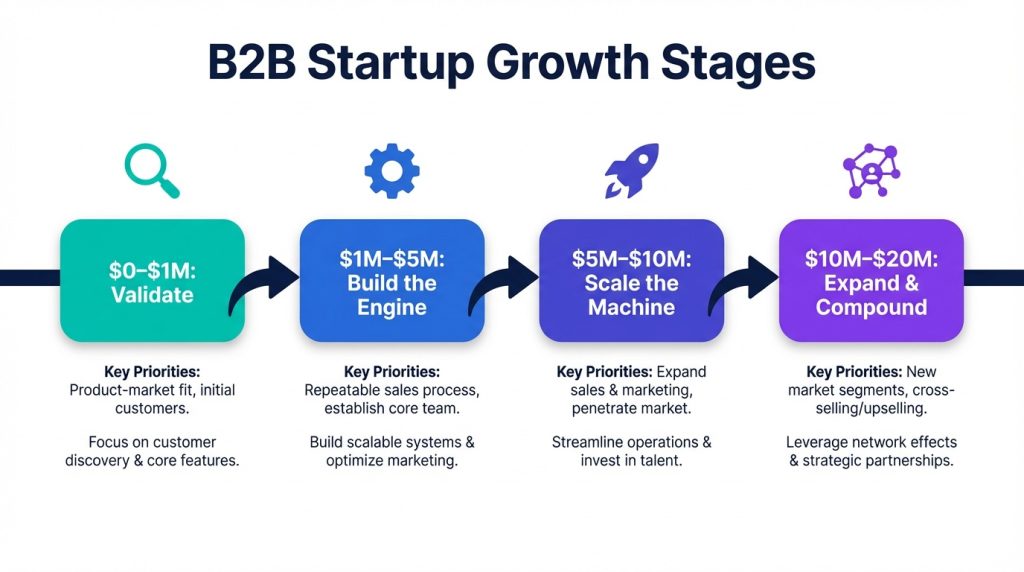
Scaling a B2B startup is not one journey. It is four distinct ones, each requiring a different set of priorities, capabilities, and leadership behaviours. What works at $500K actively fails at $5M. What works at $5M is insufficient at $15M. The biggest scaling mistakes happen when founders apply the playbook from the wrong stage.
$0 to $1M ARR: Validate and Survive
This phase is entirely about finding what works. The goal is not to build a machine. The goal is to find the one thing that reliably converts and lasts long enough to repeat.
Most growth here is brute force: founder-led sales, warm introductions, and relentless iteration. What works is often pattern recognition and the willingness to change direction quickly. According to Lenny Rachitsky’s research across 20+ top B2B companies, this phase typically takes 1.5 years from first customer to $1M ARR, even for companies that eventually scaled to hundreds of millions.
Key priority: ICP clarity and proof of repeatable sales.
$1M to $5M ARR: Build the Engine
This is where most B2B startups stall. The founder’s personal network is tapped out. Referrals are inconsistent. The sales process lives inside one person’s head and cannot be taught, transferred, or optimized.
Creating a predictable revenue stream at this stage requires two things working in parallel: documenting what works, and starting to delegate who does it. According to a 2024 HubSpot State of Sales report, companies with a formally documented sales process close deals at 28% higher rates than those without one.
Key priority: Process documentation, CRM hygiene, and first professional sales hires.
$5M to $10M ARR: Scale the Machine
At this stage, the engine exists. The question is how to run it predictably and find the channels that compound.
Mike Malloy describes this phase with a useful mental model. If you spend $500 testing ten marketing channels and one returns $2,500 on a $50 investment, you have found your multiplier. Pour resources into that channel until it stops working, while simultaneously testing the next set of channels in parallel. Marketing at this stage is not a strategy. It is disciplined experimentation.
Key priority: Multi-channel testing, repeatable conversion rates, and scaling what works.
$10M to $20M ARR: Expand and Compound
This phase introduces channel partnerships, co-marketing, bundled offers, and product expansion. The ICP is now well understood. The question becomes who else is already selling to your ideal customer, and how do you get in front of them faster?
Operational complexity compounds here in ways most founders underestimate. More customers mean greater demands on customer success. More revenue means HR, finance, and legal complexity that the founder cannot manage alone. The CEO who tries to manage it all personally hits a ceiling every time.
Key priority: Channel partnerships, product expansion, and operational infrastructure for the next stage.
Which Growth Channels Work Best at Each Stage?
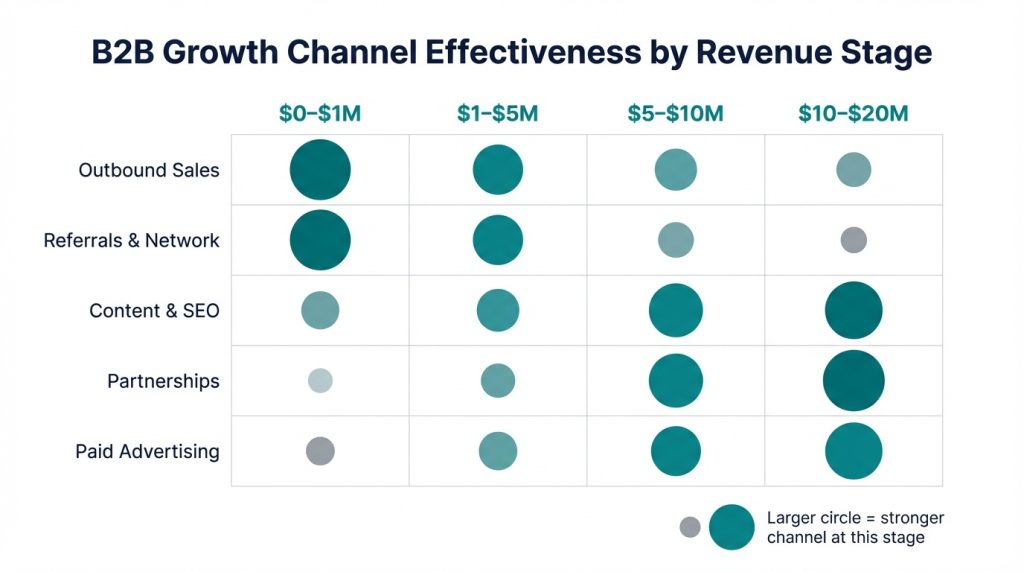
The channel mix that scales a B2B startup changes materially at each revenue stage. Most scaling guides describe stages without specifying which channels actually move revenue at each one. Based on patterns across 500+ CEO interviews and research across top B2B companies, here is how the channel mix typically evolves.
Outbound Sales: Dominant from $0 to $5M
Outbound sales is the most reliable acquisition channel for early-stage B2B startups. It is the only channel you can control from day one, before you have brand awareness, organic traffic, or a referral network.
Done well, outbound means highly targeted prospecting, personalized outreach, and a short, thoughtful sequence. Done poorly, it is spray-and-pray emailing that burns sender reputation and team morale. Mike Malloy’s team builds outbound playbooks during the $1-$ 5M phase. The key is not volume. It is ICP precision: knowing exactly which company type, title, and trigger event predicts conversion.
Referrals and Network: Essential from $0 to $3M and Beyond
For most B2B startups, referrals from happy customers and the founder’s personal network represent the majority of early revenue. According to Nielsen research on trust in advertising, 88% of people trust referrals from people they know more than any other form of marketing.
Referrals do not scale linearly without a deliberate system. Mike Malloy’s answer is to build a referral engine rather than hope customers recommend you organically. That means asking systematically at specific milestones, incentivizing referrers, and tracking which customer profiles refer most frequently.
Content and SEO: Builds from $1M, Compounds at $3M+
Content is a slow channel with a powerful compounding effect. Companies like HubSpot, Vanta, Amplitude, and Figma built significant portions of their growth engines on content and SEO. But it requires patience and consistency before it pays off.
The approach I take when developing content strategies for funded B2B tech companies is to build around the specific questions buyers are actively researching, not around product features. Each piece of content answers one discrete question that a problem-aware buyer is already searching for. Done consistently over 12-24 months, this compounds into an organic lead generation engine that reduces dependence on paid acquisition.
Partnerships and Co-Marketing: Most Valuable at $5M+
Channel partnerships, integration partnerships, and co-branded marketing become viable growth levers once the ICP is locked in and the sales motion is proven. The logic is simple: find companies already selling to your exact buyer and create a structural reason to be recommended.
According to Gabriel Weinberg and Justin Mares in Traction, there are 19 distinct traction channels available to any growing startup. Mike Malloy recommends identifying four to seven viable channels for your specific business and running structured experiments across all of them rather than betting everything on one.
Paid Advertising: Useful at $3M+, Risky Before That
Paid ads are expensive to get wrong. The economics only work if your CAC-to-LTV ratio is already understood and validated. The CAC-to-LTV ratio should be at least 3:1 before investing meaningfully in paid channels. If it costs $100 to acquire a customer, that customer must generate at least $300 in lifetime revenue. The closer that ratio gets to 10:1, the more aggressively paid channels can be scaled.
B2B Startup Growth Channel Comparison
| Channel | Best Stage | Time to First Results | Scalability |
|---|---|---|---|
| Outbound sales | $0 to $5M | 30-60 days | High with ICP precision |
| Referrals and network | $0 to $3M+ | Immediate | Medium, needs system |
| Content and SEO | $1M to $3M+ | 6-18 months | Very high, compounds |
| Partnerships | $5M+ | 3-6 months to activate | High if ICP is locked |
| Paid advertising | $3M+ | 30-90 days | High with strong CAC/LTV |
The “Who Not How” Mindset That Unlocks the Next Level
The “Who Not How” framework, developed by Dan Sullivan and Ben Hardy, is the principle of asking “Who already knows how to do this?” rather than “How do I figure this out myself?” Mike Malloy has made it the cornerstone of his coaching for founders scaling past $2M ARR.
The practical implication: instead of the founder spending 40 hours learning a new skill, they spend four hours finding and briefing the right person who already has that skill. The time difference compounds dramatically at scale.
This is where leveraging a proper delegation process becomes a genuine growth strategy rather than an administrative convenience. Delegation is not about offloading tasks you dislike. It is about protecting the time that only the CEO can fill: investor conversations, strategic partnerships, top-tier client relationships, and the thinking that generates asymmetric outcomes.
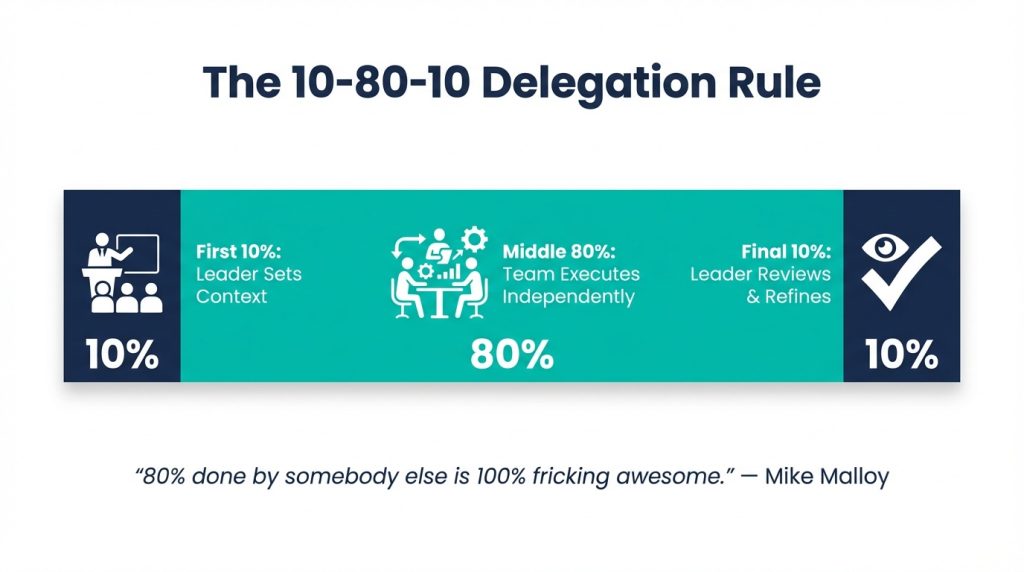
Mike Malloy’s 10-80-10 Rule is a delegation framework where the leader sets context in the first 10% of a project, the team executes the middle 80% independently, and the leader reviews and refines the final 10%. The result is that the CEO removes themselves from 80% of the heavy lifting while still ensuring quality. As Mike puts it, “80% done by somebody else is 100% fricking awesome.”
The 10-80-10 Rule works in practice because it solves two problems simultaneously: it gives team members enough context to execute without constant check-ins, and it gives the leader a clear, bounded review role that does not collapse back into doing.
A pattern I notice when ghostwriting LinkedIn content for Series B CEOs is that the ones who struggle most to delegate are also the ones with the weakest external narrative. They are so buried in execution that they never develop the strategic voice that builds investor confidence and attracts enterprise buyers. The who-not-how shift is not just operational. It is what frees a founder to communicate and lead at the level their growth stage demands.
What is the 10-80-10 Rule for CEO delegation?
The 10-80-10 Rule, introduced by Mike Malloy of Malloy Industries, is a delegation framework with three stages. In the first 10%, the leader explains the why, the project’s connection to the company’s North Star metric, and what success looks like. In the middle 80%, the team member executes independently without micromanagement. In the final 10%, the leader reviews, refines, and helps close the project. This removes the CEO from 80% of execution while maintaining quality control.
The Sales Scalability Scorecard: Where Do You Actually Stand?
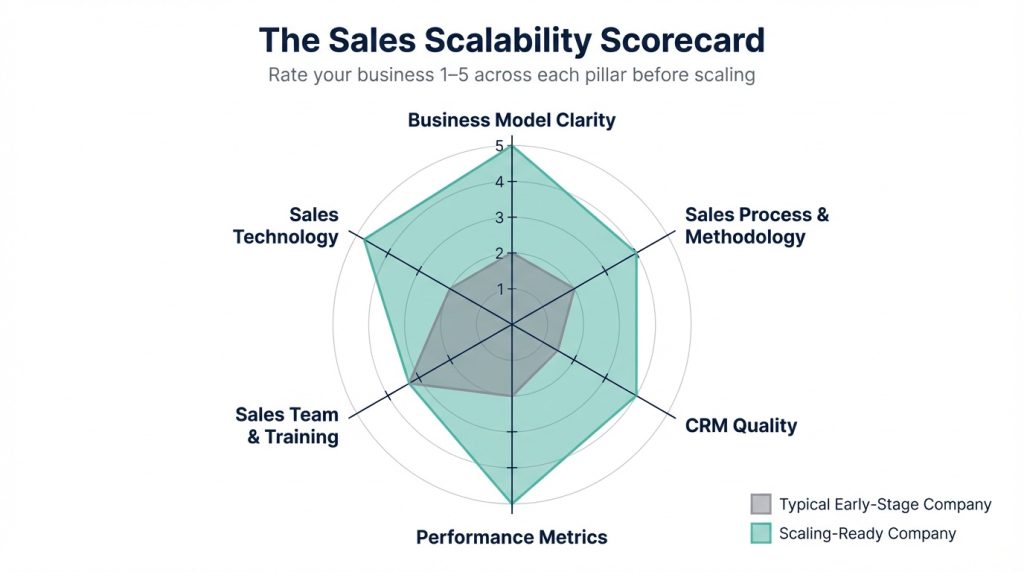
The Sales Scalability Scorecard, developed by Mike Malloy of Malloy Industries, is a six-pillar diagnostic framework that evaluates a B2B startup’s readiness to scale its sales function. Each pillar is rated on a 1-5 scale to produce a report card that identifies where to invest before the next growth stage.
The six pillars are:
- Business model clarity: Does the team understand who they are selling to and why those buyers convert?
- Sales processes and methodologies: Is there a documented, repeatable playbook that works without the founder on every call?
- CRM quality: Is the data clean, complete, and actively used to make decisions?
- Performance metrics and analysis: Does the team know CAC, LTV, and conversion rates at every funnel stage?
- Sales team and training: Are sellers equipped, coached, and developing independently?
- Sales technology tools: Are the tools being used, and does anyone know what the company is actually paying for?
The pillar most founders overestimate is business model clarity. Every founder thinks they have nailed their ICP. Mike Malloy’s experience across 100+ engagements is that the ICP is fuzzy far more often than founders realize. The right buyer is often a different title, a different department, or a different company stage than originally assumed.
A useful benchmark: Salesforce research shows that 68% of sales professionals do not have a complete understanding of their customers’ needs. That number is even higher at early-stage companies where the founder’s intuition has never been formally codified.
When I work with B2B tech founders to develop educational email courses, the same gap consistently arises. Content falls flat not because the writing is poor but because the ICP research is shallow. The Scorecard forces specificity before any resource gets spent on scaling.
You can access the free Sales Scalability Scorecard at malloyindustries.com/pod.
Related episode: How to Build High-Performing Sales Teams — John Golden, PipelineCRM
What is the most common weakness found in the Sales Scalability Scorecard?
Business model clarity is the most consistently overestimated pillar in Mike Malloy’s Sales Scalability Scorecard. Most founders believe they know exactly who their ideal customer is. In practice, the ICP is often defined too broadly, targeting the wrong title, company stage, or department. Companies that discover this early, through the Scorecard diagnostic rather than through months of failed outbound, avoid one of the most expensive scaling mistakes in B2B.
How Do You Transition From Founder-Led Sales Without a Revenue Dip?
Transitioning from founder-led sales without a revenue dip requires starting the documentation process before the handoff, not after. The single biggest cause of post-handoff revenue drops is a new sales leader who has nothing to build from. If the playbook lives only in the founder’s head, the first 60 days of the transition become a period of discovery rather than execution.
Done wrong, the handoff causes revenue to dip, sales cycles to lengthen, and the pipeline to stall while a new leader spends months figuring out what the founder instinctively knew. Done right, the handoff accelerates growth because a skilled sales leader can do things the founder could never systematically do: build team process, coach reps, and optimize the funnel on a repeatable basis.
Mike Malloy’s 30-90-Day Sales Handoff Playbook:
Days 1-30: Intelligence gathering. The incoming sales leader sits alongside the founder on live calls. They listen, observe, and document. What language resonates? What objections surface? What parts of the pitch only work because of the founder’s personal story or relationships? Nothing is built yet. Everything is captured.
Days 31-60: Playbook construction. Scripts are drafted. The CRM is restructured around the right pipeline stages. Objection-handling frameworks are documented. The goal is to capture the founder’s institutional knowledge in a format that does not require the founder’s presence.
Days 61-90: Independent execution. The new leader runs calls independently and iterates on what is working. The founder steps back to review, not to do. By the end of this phase, the sales motion runs without daily founder involvement.
According to McKinsey research on B2B sales transformation, companies that successfully transition from founder-led sales see 15-20% faster revenue growth in the 12 months following the handoff compared to those that delay the transition past the natural inflection point.
Related episode: People-First Sales Leadership and Sustainable Revenue Growth — Richard Cogswell
This is also where improving operational efficiency becomes non-negotiable. The handoff only works if there are documented systems for a new leader to plug into on day one.
What causes most founder-led sales transitions to fail?
The most common cause is insufficient pre-transition documentation. When the sales playbook lives inside the founder’s head, an incoming sales leader spends their first 60-90 days in discovery mode rather than execution mode. Revenue slows, pipeline stalls, and the transition gets blamed rather than the preparation. Mike Malloy’s 30-90-day handoff playbook addresses this by front-loading intelligence gathering before any playbook construction or independent execution begins.
Fractional Executives vs. Full-Time Hires: The Real Cost Comparison
A fractional executive is a senior-level operator who works with a company on a part-time or project basis, providing VP-level or C-suite expertise without the cost or commitment of a full-time hire. For B2B startups between $1M and $10M ARR, this model frequently outperforms the full-time alternative on speed, cost, and risk.
The conventional wisdom is that serious companies hire full-time. Mike Malloy’s data from 100+ fractional placements suggests this is often the wrong call at this revenue stage.
| Factor | Full-Time Executive | Fractional Executive |
|---|---|---|
| Annual cost (salary + benefits + equity) | $250,000 to $400,000+ | $60,000 to $180,000 |
| Time to hire | 3 to 6 months | 7 to 14 days |
| Time to productivity | 60 to 90 days post-hire | 2 to 4 weeks |
| Commitment flexibility | High risk, difficult to exit | Month-to-month, 10-day exit clause |
| Seniority level accessible | Limited by budget | VP-level at fraction of cost |
| Protection if wrong fit | No recourse | 365-day warranty, second match free |
The economics are clearest at the $1-5M ARR stage. A startup at this revenue level typically cannot afford a $350,000 VP of Sales but urgently needs one. A fractional sales leader at $8,000-$15,000 per month provides that calibre of thinking and execution without the risk of a bad full-time hire. Mike Malloy estimates that a bad full-time executive hire typically costs 1.5 to 2 times the executive’s annual salary, including severance, lost productivity, and the cost of restarting the search.
The case for full-time hiring strengthens once a company crosses $10M ARR and has the revenue complexity, team size, and domain specificity to justify a permanent leader building a function over several years.
When does it make sense to use a fractional executive over a full-time hire?
Fractional executives deliver the most value in the $1M to $10M ARR window, where a B2B startup needs VP-level or C-suite expertise but cannot justify the $250,000 to $400,000 annual cost of a full-time hire. They start in days rather than months, operate month-to-month, and carry no long-term employment risk. Once a company crosses $10M ARR and has sufficient revenue complexity and team scale, converting key fractional roles to full-time becomes the logical next step.
The Four Types of CEO Time That Predict Scaling Success
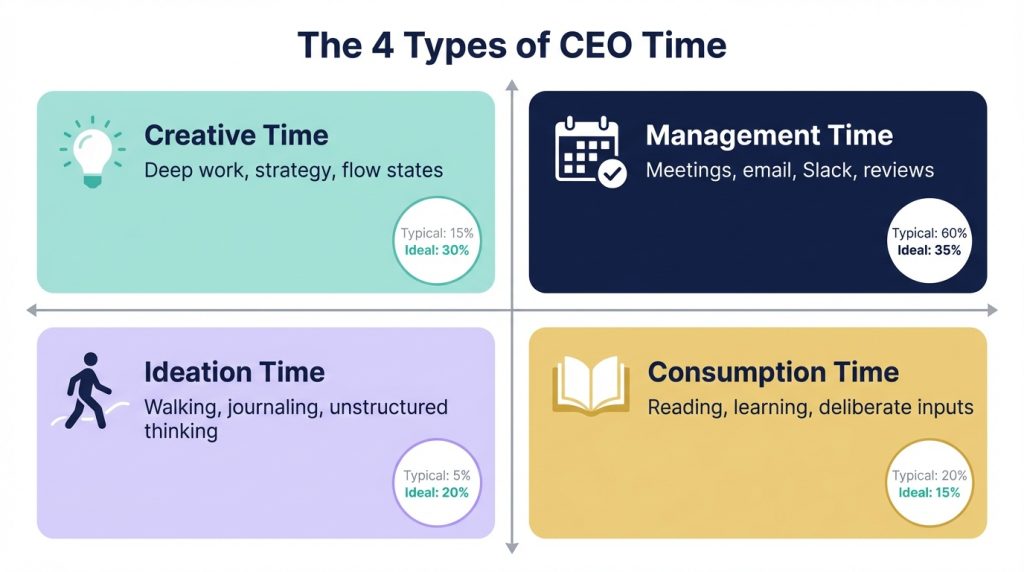
The Four Types of CEO Time, adapted by Mike Malloy from Sahil Bloom’s framework, is a model that divides professional time into four categories: Creative, Management, Ideation, and Consumption. Most scaling CEOs are dramatically out of balance across all four, with Management Time consuming the categories that actually drive growth.
The four types of CEO time:
1. Creative Time is deep work, flow states, and strategic output. This is where the highest-value CEO work happens. It requires uninterrupted blocks that meetings and messages constantly erode. Mike Malloy recommends protecting at least two to three dedicated hours daily for this category.
2. Management Time is meetings, email, Slack, and project reviews. This is the dominant category for most scaling CEOs and the one that devours the others. The goal is not to eliminate it but to contain it before it crowds out everything else.
3. Ideation Time is unstructured thinking: walking, journaling, quiet reflection with no deliverable expected. This is the most neglected category and the one Mike Malloy argues is most predictive of asymmetric growth. Without ideation time, strategy is always reactive rather than generative.
4. Consumption Time is deliberate learning through reading, listening, and studying. Everything a founder creates is downstream from something they consumed. Protecting high-quality inputs protects the quality of strategic output.
The trap most scaling founders fall into is that Management Time colonizes all the rest. The inbox is perpetually full. The calendar fills before Creative or Ideation time gets protected. The CEO becomes permanently reactive.
Mike Malloy’s practical tool is Toggl for time tracking. He runs a monthly time audit against one question: what can I cut, systematize, or delegate? Over time, this consistently shifts work up the value chain and frees the CEO to operate at the level the business needs.
A McKinsey survey on executive time allocation found that senior leaders who deliberately protect time for strategic thinking are 2.5x more likely to report strong business performance outcomes.
When ghostwriting newsletters for Series B CEOs, the constraint is rarely ideas. It is protected time to develop those ideas. The pattern across funded B2B tech companies is consistent: Ideation Time disappears first under scaling pressure and is the first category that needs to be deliberately restored.
How should a B2B startup CEO allocate their time to support scaling?
Mike Malloy recommends using Toggl to run a monthly time audit across the four categories: Creative, Management, Ideation, and Consumption Time. The diagnostic question is: what can I cut, systematize, or delegate? Most CEOs discover that Management Time consumes 60-70% of their week. The target is to contain Management Time to under 40% and protect at least two to three hours daily for Creative Time, plus deliberate weekly blocks for Ideation and Consumption.
Frequently Asked Questions
What does it mean to scale a B2B startup?
Scaling a B2B startup means building systems, processes, and teams that enable revenue growth without proportional increases in the founder’s time or cost base. True scaling happens when the business can double or triple ARR without doubling or tripling founder workload. Growth adds revenue. Scaling adds revenue while improving or maintaining unit economics.
How long does it take to scale a B2B startup to $1M ARR?
Based on Lenny Rachitsky’s research across 20+ successful B2B companies, the average time from founding is 2 years, and from first paying customer, 1.5 years. Companies significantly behind this benchmark typically have an ICP clarity problem or a sales process gap, not a market size problem. This benchmark is a diagnostic tool, not a judgment.
When should a B2B startup use a fractional executive instead of a full-time hire?
The $1M to $10M ARR window is where fractional executives deliver the most value. VP-level talent costs $250,000 to $400,000 annually as a full-time hire. A fractional equivalent typically costs $60,000 to $180,000 and starts in 7-14 days. Once a company reaches $10M ARR and has sufficient team complexity, converting fractional roles to full-time positions becomes the logical next step.
How do you prevent a revenue dip when transitioning from founder-led sales?
Begin documentation before the transition, not after. Capture ICP research, objection-handling language, effective discovery questions, and key pipeline relationships before the new leader starts. Mike Malloy’s 30-90-day handoff playbook (intelligence gathering, playbook construction, independent execution) keeps pipeline continuity intact throughout the transition and prevents the new leader from spending their first two months in discovery mode.
What are the key signals that a B2B startup is ready to scale?
Five signals your B2B startup is ready to scale past $1M ARR:
(1) CAC to LTV ratio of at least 3:1;
(2) net revenue retention above 100%;
(3) a documented sales process that someone other than the founder can execute;
(4) unprompted referrals from happy customers; and
(5) a validated ICP that the whole team can articulate. If two or more signals are weak, fix the foundation before adding fuel.
Related Resources
- How to Scale Business Operations to Drive Growth Quickly: What scalable operations actually require and how to build the infrastructure before it becomes urgent.
- Sales Operations: What It Is and How to Implement It to Drive Growth: Building a sales operations function that supports consistent, predictable revenue growth at scale.
- How to Create a Predictable Revenue Stream That Rapidly Drives Growth: The revenue architecture that moves B2B companies from reactive selling to systematic growth.
- How to Improve Operational Efficiency to Drive Growth: A data-backed framework for identifying and closing operational efficiency gaps at key revenue thresholds.
- B2B Growth Marketing: Building High-Performing Tech Brands: How the most successful B2B companies integrate brand, content, and channel strategy into a unified growth engine.
A Final Thought on Scaling
The B2B startups that successfully scale from $1M to $20M are not the ones with the best product or the most hustle. They are the ones who figured out, usually the hard way, that growth past a certain threshold is a leadership and systems problem.
Ask who, not how. Validate product-market fit before you scale. Protect your highest-value time. Build systems that run without you at the center. And bring in the expertise you need at each revenue stage rather than waiting until the ceiling is already crushing you.
Whether you build these capabilities internally or partner with specialists in executive content, thought leadership, or strategic communications, the foundation is always the same: clarity of message, consistency of execution, and a leadership team that can scale without the founder doing everything. Learn more about how Sproutworth helps funded B2B tech companies communicate and scale with authority.
Related Links
- Mike Malloy on LinkedIn: linkedin.com/in/mikemalloy
- Malloy Industries website: malloyindustries.com
- Free resources for podcast listeners: malloyindustries.com/pod
Some topics we explore in this episode include:
Listen to the episode.
Subscribe to & Review the Predictable B2B Success Podcast
Thanks for tuning into this week’s Predictable B2B Podcast episode! If the information from our interviews has helped your business journey, please visit Apple Podcasts, subscribe to the show, and leave us an honest review.
Your reviews and feedback will not only help me continue to deliver great, helpful content but also help me reach even more amazing founders and executives like you!
