

Your entire leadership team describes what you do differently.
One executive says you’re a “unified data platform.” Another calls it “AI-powered analytics.” Your newest VP thinks you’re “customer intelligence software.”
Meanwhile, prospects Google your category and find 47 competitors saying the exact same things. Better, faster, cheaper. More features, better integrations, lower pricing.
You’re stuck in what Mike Damphousse calls “category jail.” And it’s costing you deals, burning marketing budget, and tanking your valuation in investor conversations.
After working with B2B tech companies from seed to Series C, I’ve watched this pattern destroy promising startups. They build genuinely different products, then position them exactly like everyone else.
The escape isn’t better marketing. It’s category design.
📌 Key Takeaways (2-Minute Read)
The Problem: Companies waste millions positioning against competitors in crowded categories, where only 24% of market value exists.
The Solution: Category design creates new markets where you set the rules and capture 76% of market capitalization.
The Process: Mike Damphousse’s 4-day category sprint creates executive alignment and a Category POV that transforms investor conversations and sales consistency.
The Result: Prescriptive Data Solutions went from hundreds of failed pitches to $26M Series A in weeks using this approach.
The Decision: Use category design if you have a genuinely different insight. Use positioning if you’re competing in existing markets. Both are valid strategies.
Read Time: 8 minutes | Listen: Full Podcast Episode
Table of Contents
What Is Category Design?
Category design is a business strategy in which companies create and dominate new market categories rather than compete within existing ones. By defining a unique problem and solution through a strategic narrative, category leaders capture 76% of total market value, while competitors compete for the remaining 24%.
Unlike traditional positioning that fights for share in crowded markets, category design creates new markets with rules you’re uniquely positioned to win.
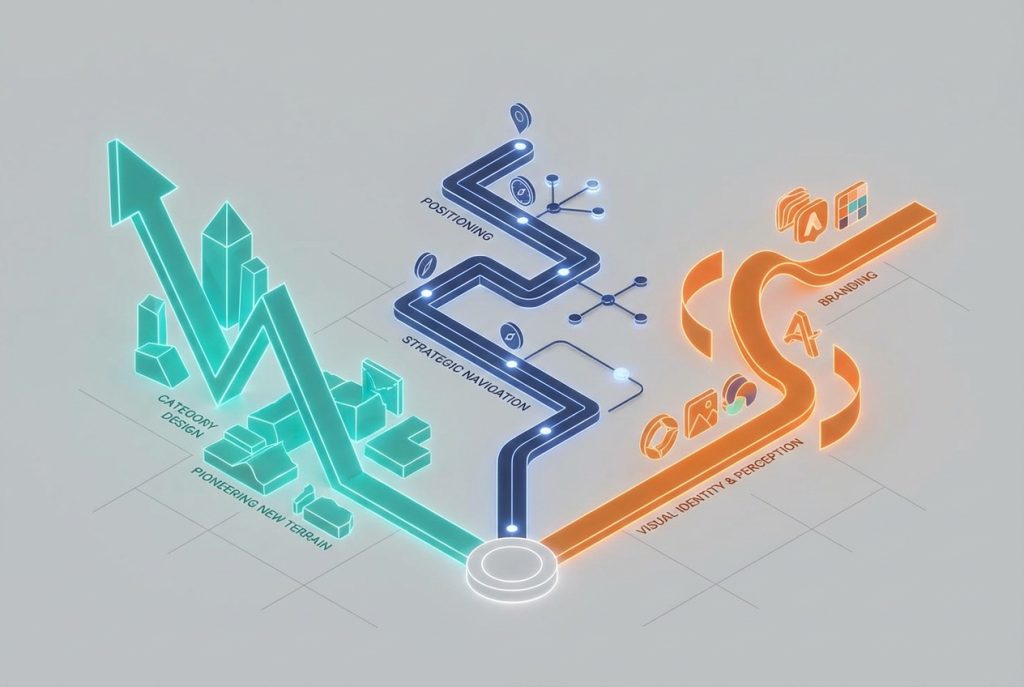
Category Design vs. Positioning vs. Branding: What’s the Difference?
Understanding these three concepts is critical for strategic decision-making.
| Aspect | Category Design | Brand Positioning | Branding |
|---|---|---|---|
| Core Question | “What game should we play?” | “How do we win this game?” | “How should we look and feel?” |
| Strategic Goal | Create new market | Capture market share | Build recognition |
| Time Horizon | 3-7 years | 12-18 months | Ongoing |
| Who Leads | CEO/Founders | CMO/Strategy | Creative/Marketing |
| Primary Output | Category POV (800-1,000 words) | Positioning statement | Visual identity system |
| Market Context | “We’re solving a problem nobody else sees” | “We’re better than competitors at X” | “We’re memorable and trusted” |
| Competition | Minimal (greenfield) | Direct (existing category) | Indirect (attention) |
| Example | iPhone creating smartphone category | “Enterprise CRM for mid-market” | Nike’s swoosh and “Just Do It” |
| Budget Required | High (market education) | Medium (competitive marketing) | Medium (creative development) |
| Success Metric | 76% market cap share | Top 3 market position | Brand recall and NPS |
Category design defines the market. Positioning finds your seat at the table. Branding makes you memorable once you’re there. The companies that dominate use all three, but they start with category design.
What Category Jail Actually Costs You
When prospects can’t differentiate you from competitors, they default to price comparisons.
📊 76% of market value
Category leaders capture 76% of total market capitalization while competitors fight over the remaining 24%
According to Harvard Business Review research, category leaders capture 76% of total market value in their space. The remaining competitors fight over 24%.
That’s not a marketing problem. That’s a category design problem.
Mike Damphousse, co-founder of Category Design Advisors, spent eight years fixing this exact issue for 50+ companies.
He describes category jail as being “stuck in a very crowded space where buyers and analysts don’t understand what you’re offering and why you’re different.”

How Category Jail Shows Up in Your Business
The symptoms show up everywhere. Your sales team pitches the same story but closes inconsistently. Marketing creates campaigns that sound identical to competitors. Investors struggle to explain your defensibility.
In ghostwriting content for Series B SaaS founders, I see companies waste six months perfecting messaging that still positions them in a crowded category. They optimize the wrong thing.
📊 81% decide before talking to sales
81% of B2B buyers pick their vendor before contacting sales—if you’re indistinguishable in research, you’ve already lost
Research from 6sense shows that 81% of B2B buyers select their preferred vendor before speaking with sales. If you’re indistinguishable in their pre-sales research, you’ve already lost.
Understanding B2B buyer psychology reveals why: buyers’ unconscious minds create mental shortcuts based on the first company that introduces a problem and solution. If that’s not you, you’re fighting an uphill battle.
Why Traditional Differentiation Fails
Most B2B companies rely on feature comparison matrices.
“We’re faster than Competitor A.”
“We integrate better than Competitor B.”
“We’re cheaper than Competitor C.”
This is what Damphousse calls the “er” trap. Better, brighter, faster, cheaper. If your differentiation ends in “er,” you’re using the wrong words.
“If your differentiation ends in ‘er,’ you’re using the wrong words. Better, faster, cheaper—that’s the ‘er’ trap that keeps you in category jail.”
— Mike Damphousse, Category Design Advisors
Category design flips this completely. Instead of competing within an existing category’s rules, you create a new category with different rules. Rules you’re uniquely positioned to win.
When I develop sales narratives for B2B tech executives, the companies that break through aren’t those with incrementally better features. They’re the ones solving a problem the market didn’t know needed solving.
Consider the iPhone launch. Apple didn’t enter the crowded smartphone market by being “better” than Blackberry or Motorola. They created a new category entirely. The App Store became the differentiator. “There’s an app for that” wasn’t about hardware specs. It was about reimagining what a phone could do.
The result? Apple generates 75% of smartphone category profits, according to Damphousse, despite Android devices vastly outnumbering iPhones globally.
The Magic Triangle: Product, Company, and Category Design

Successful category creation requires synchronizing three elements simultaneously.
Product Design: Build a solution that solves the category problem differently, not incrementally better.
Company Design: Structure your business model, culture, and operations around the category you’re creating.
Category Design: Develop the market narrative, proprietary language, and strategic positioning that defines the new space.
Most companies optimize only product design and wonder why differentiation fails. The magic happens when all three align.
The Four-Day Category Sprint That Changes Everything
Here’s what makes Damphousse’s approach different from six-month consulting engagements.
He compresses category design into four intensive days.
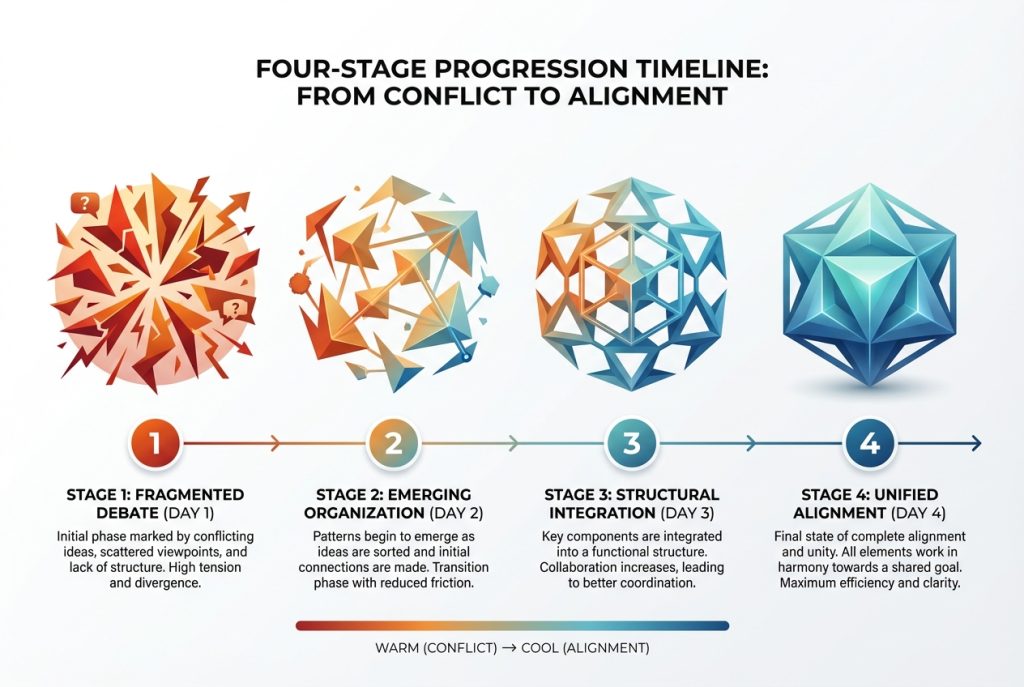
Day One: Brutal Alignment
Six to 12 executives debate the company’s actual identity. Not what they want to be. Not what marketing says they are. What they genuinely solve that nobody else solves the same way.
Damphousse describes it as “almost like a boxing match. They tell us what they think they are, we tell them what they’re not, and then we debate it.”
This gets brutal. One client’s VP of Sales resigned mid-workshop because the process revealed fundamental misalignment. But that’s the point. Better to surface disagreement now than after burning $2 million on ineffective campaigns.
Days Two and Three: Writing the Category POV
Damphousse and co-founder Kevin Maney write what they call a Category Point of View (POV). This 800 to 1,000-word document becomes your constitution. It’s the strategic narrative that everyone rallies behind.
The POV follows a specific structure: define the problem, quantify the costs of not solving it, paint the future with the problem solved, introduce your category as the solution, and establish why now is the moment for market creation.

In creating educational email courses for funded startups, I’ve seen companies try to shortcut this step. They assign it to marketing. It fails every time because category design isn’t a marketing initiative. It’s a CEO-level strategy decision.
Day Four: Word-by-Word Consensus
The entire executive team reviews the POV line by line. Word by word. If someone argues a word should be “red” and another says “magenta,” Damphousse lets them debate until consensus emerges.
This creates something marketing memos never achieve. Every executive signs off on every word. They own it. They can deliver it consistently for years.
When category design works, you get what Damphousse calls the “aha moment.”
One CEO wiped his eyes after hearing his company’s story properly articulated for the first time. “We’ve been working on this for two or three years,” he said, “and that’s the first time I’ve heard our story make sense.”
The Prescriptive Case Study: $26M in Weeks
📊 $26M Series A in weeks
Prescriptive went from hundreds of failed pitches to $26M funding using category design—same product, different story
Prescriptive Data Solutions spent years struggling to explain what they did.
They had ex-Microsoft executives, brilliant technology, and hundreds of investor pitches that went nowhere. They were in a category jail.
In January 2020, they went through Damphousse’s four-day category sprint.
The following week, CEO Chris Blackley attended the JP Morgan Healthcare Summit with a completely rewritten pitch deck. He had 10 investor meetings scheduled.
Nine investors responded with interest. One said no.

Prescriptive closed a $26 million Series A weeks later.
The difference wasn’t the product. The product was identical before and after the workshop. The difference was a category POV that led investors to see a greenfield opportunity rather than crowded competition.
According to Wynter’s research, 73% of B2B marketing executives rank word-of-mouth and peer recommendations as the most influential factor in vendor selection. Category design gives investors and buyers a differentiated story to share.
Prescriptive’s team still references that workshop day years later. Not because of the deliverable. Because the process created alignment that persisted.
Why This Is a CEO Problem, Not a Marketing Problem
Most CMOs approach Damphousse for category design work.
He tells them to get their CEO on the call first.
“This is gonna influence everything that CEO does, all the strategies they implement. This is not a marketing project. This is core business strategy.”
— Mike Damphousse on why CMOs can’t lead category design alone
“This is gonna influence everything that CEO does, all the strategies they implement,” Damphousse explained when one CMO pushed back. “This is not a marketing project. This is core business strategy.”
In working with B2B growth marketing teams, I’ve watched companies delegate category work to marketing departments. It consistently fails because category design affects product roadmap, sales methodology, pricing strategy, and partnership decisions.
When Marketing Leads Category Design (And Why It Fails)
When SAP acquired Qualtrics for $8 billion in 2018, critics questioned the premium price tag (14 times projected annual sales). SAP’s CEO defended it by citing category design research: companies that create new categories typically capture 76% of total market capitalization.
Since Qualtrics created the experience management category, SAP bet the acquisition would deliver outsized returns despite the steep price.
Investors understand category economics. They know good teams make money, but category leaders make billion-dollar returns.
Research cited in Play Bigger shows that only 13 of the Fortune 100 companies were category creators. Despite being a minority, these businesses accounted for over 50% of the Fortune 100’s revenue growth and almost 75% of market capitalization growth.
This is why VCs take category design seriously. It’s the difference between a good exit and a generational return.
The Category Creation Formula: Context Plus Missing Plus Innovation
Damphousse’s new book, The Category Creation Formula, breaks category design into three components.
Context: Market conditions that make your category possible. A pandemic. Economic collapse. New technology like AI. Shifting buyer expectations.
Missing: What’s absent from current solutions? Not a feature gap. A fundamental problem nobody else recognizes.
Innovation: How you solve the missing piece differently.
When I’m creating LinkedIn content strategies for Series A-C CEOs, the ones generating qualified leads aren’t those posting about their product features. They’re teaching the market about the problem their category solves.
Category design is a living thing. You revisit it as context shifts.
If you painted your category POV five years ago and haven’t updated it since ChatGPT launched, you’re operating with outdated strategy. AI shifted context dramatically. Your category positioning should reflect that.
The companies that dominate categories aren’t those with perfect initial positioning. They’re the ones continuously refining as markets evolve.
Five Mistakes That Kill Category Design Efforts
Most category design efforts fail before they even launch. Here are the critical pitfalls to avoid.
Mistake #1: Delegating category design to marketing
Category design affects product roadmap, pricing strategy, and sales methodology. When CEOs delegate it, alignment breaks down, and the POV becomes just another marketing memo.
Mistake #2: Creating a category without genuine differentiation
Slapping a new label on an incremental improvement doesn’t create a category. You need a fundamentally different solution to a problem the market hasn’t articulated.
Mistake #3: Running out of capital before market education completes
Category creation takes 18-24 months. Companies that underfund education efforts abandon the category halfway through and revert to competitive positioning.
Mistake #4: Inconsistent category messaging across executives
If your VP of Sales describes the category differently from your CEO, prospects get confused. The 4-day sprint prevents this by creating word-by-word alignment.
Mistake #5: Measuring success using competitive metrics
Category design success isn’t measured by market share in an existing category. It’s measured by category POV adoption, earned media mentions, analyst recognition, and ultimately market cap concentration.
The antidote: Follow Damphousse’s framework—get CEO sponsorship, align executives completely, fund adequately, and measure category-specific KPIs.
Lightning Strikes: Bringing Your Category to Market
Creating a category POV is only half the battle.
Lightning Strikes are the forcing functions that launch your category into the market’s consciousness. These are coordinated campaigns that align every company function around introducing the problem and solution to buyers.
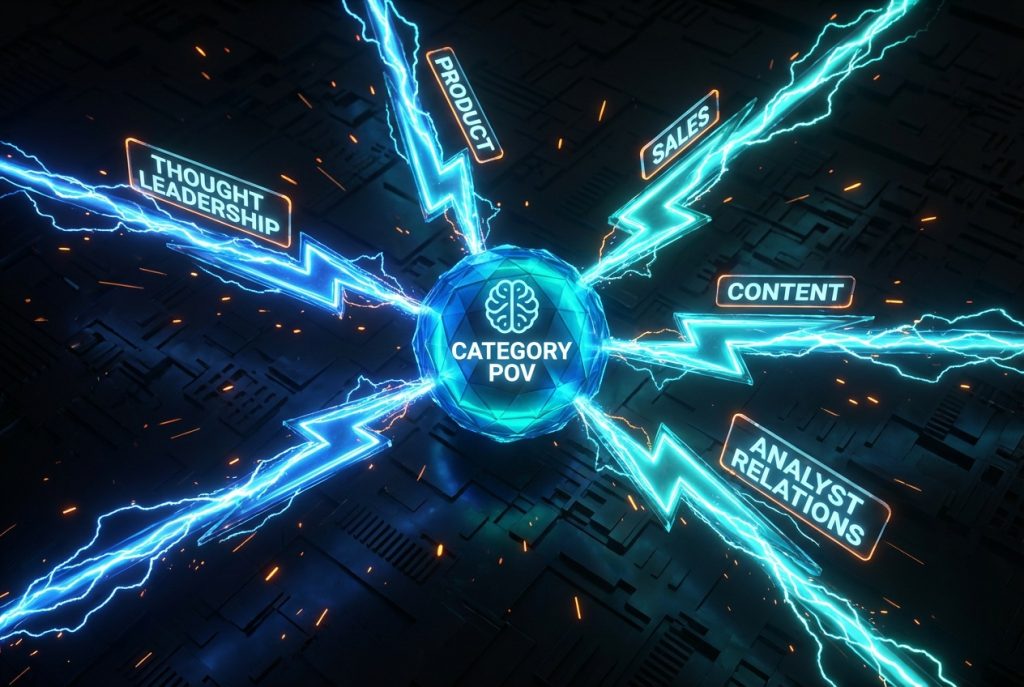
A Lightning Strike isn’t a product launch. It’s a market education moment. You’re teaching the world about a problem they didn’t know existed and introducing your category as the answer.
LinkedIn used Lightning Strikes when introducing its sales solutions category. They coordinated product releases, thought leadership content, analyst briefings, and customer stories around a single narrative. The result: a multi-billion dollar business unit that defined a new category.
This connects directly to B2B sales enablement. Your sales team can’t execute if they don’t have a category story to sell. Lightning Strikes arms them with the narrative, proof points, and proprietary language to differentiate in every conversation.
Who Should Be Your Category Evangelist?
Every category needs a champion. Someone with authority who can consistently articulate the category POV to every audience.
Usually, this is the CEO or a founder. Sometimes it’s a CMO or Chief Evangelist with the credibility and communication skills to own the story.
The category evangelist becomes the public face of the problem and solution. They write, speak, podcast, and present relentlessly on the category. They use proprietary language that anchors the category in buyers’ minds.
Damphousse emphasizes: “Whoever the evangelist is, they need to have that POV burned into their firmware. Everything that I’ve said on this podcast, I’ve probably said a thousand times. I don’t veer from the story.”
This repetition matters. Category design relies on the anchoring effect. The first company to introduce a concept becomes the brand buyers remember. Your evangelist reinforces that anchoring through consistent, relentless messaging.
Why Some Companies Should Stay in Existing Categories
Category design isn’t for everyone.
Damphousse holds free “office hours” where anyone can discuss their category. He books three to five conversations weekly. That’s hundreds of companies annually.
He works with about five companies per year.
“We say no more than we say yes,” Damphousse explained. Usually because he doesn’t see a genuine category opportunity or the team isn’t capable of executing it.
When Competing Beats Creating
If you’re already in a category someone else created and can’t carve out meaningful differentiation, category design becomes futile.
Better to acknowledge you’re competing in an existing market and optimize for that reality.
Christopher Lochhead’s book Niche Down addresses this scenario. You’re in a crowded space, but you can tell a slightly different story or carve out a specific niche.
The question isn’t whether to create a category. The question is whether you have a genuine insight about a missing piece that customers will recognize as transformative.
If not, competing effectively in an existing category is a perfectly valid strategy.
Category Design Self-Assessment: Is It Right For You?

Use this framework to determine whether category design or positioning is more strategic.
You should pursue category design if:
✅ Your innovation makes existing categories inadequate (you can’t describe what you do using current market language)
✅ You have 18-24 months of runway to educate the market (category creation requires sustained investment)
✅ Your leadership team can align on a single POV (executive disagreement kills category design)
✅ You solve a problem prospects don’t know they have (requires market education, not just marketing)
✅ You have capital to fund both ground war (sales) and air war (content/thought leadership)
✅ Your solution makes the old way obsolete, not just incrementally better (10x different, not 10% better)
You should pursue positioning instead if:
✅ The market category is established but underserved (customers know they need your solution type)
✅ You need revenue now and can’t wait 18-24 months (positioning accelerates sales cycles)
✅ Your innovation is incremental (faster, cheaper, simpler than existing options)
✅ Competitors have educated the market (you can leverage their category creation work)
✅ You have a limited runway (category design requires significant capital investment)
✅ You’re targeting a specific niche within a known category (specialized positioning works)
Still unsure? Ask yourself: “Can I describe what we do in existing market language without sounding like 47 other companies?” If no, category design. If yes, positioning.
From Category Jail to Category Leadership: What Changes
When category design succeeds, three things shift immediately.
First, misalignment evaporates. Your executives finally agree on what you do and why it matters. Sales pitches become consistent. Marketing messaging aligns with product positioning. Everyone tells the same story.
Second, investor conversations transform. Instead of explaining why you’re better than 47 competitors, you explain the new problem you’re solving. VCs recognize a greenfield opportunity.
Third, content strategy inverts. You stop competing for attention within a crowded category. You create attention by educating buyers about a problem they didn’t know existed.
Damphousse emphasizes: “Stop talking about your brand. Stop talking about how good you are, how fast you are. Start talking about the problems you solve.”
This aligns with B2B buyer research showing that 86% of buyers say content accelerates purchase decisions. But not just any content. Content that empathizes with specific pain points and provides solutions.
In ghostwriting newsletters for Series B CEOs, the most effective approach isn’t frequency. Demonstrating industry fluency builds investor and customer confidence.
Category design provides the strategic foundation for that content. You’re not just creating blog posts. You’re educating the market about a category you’re defining.
The Adjacent Possible: Where Categories Get Born
Damphousse references a concept from author Steven Johnson called “the adjacent possible.”
Exciting products and services are born at the edge of what’s currently possible. Not so far ahead that adoption is impossible, but just beyond what exists today.
Many struggling companies are stuck in what was possible yesterday.
The adjacent possible exists between available technology and what society will adopt. Push too far ahead, and you’re building something nobody understands. Stay too conservative, and you’re indistinguishable from competitors.
Category design lives in this space. You’re solving a problem that’s just become solvable, but nobody else has articulated the solution yet.
When building content strategies for cleantech startups, I see companies struggle with this balance. They have breakthrough technology but position it against yesterday’s solutions instead of tomorrow’s problems.
The category POV bridges this gap. It shows buyers why the old approach no longer works and why your new approach addresses the gap.
Dominant Design: Why the Market Chooses Winners
Economist Paul Geroski studied category evolution and developed the concept of “dominant design.”
When a category emerges, multiple companies pile in with different approaches. Eventually, the market chooses the design that best solves their problem.
That becomes the dominant design. Competing vendors consolidate or disappear. Market cap grows. The category leader captures 76% of the value.
The iPhone became the dominant smartphone design. Not because it had the best specs. Because it offered the App Store ecosystem that users valued most.
Damphousse emphasizes: “If I can set the rules for the category and I can create the POV for the category, you don’t care that other people are following you. That’s great actually. Competitors lend credibility.”
This relates to a cognitive science concept known as the anchoring effect. The first company that delivers a concept becomes the brand that customers remember.
If you introduce a problem and solution first, you’re the brand they anchor to. Even when competitors copy your language, you maintain category leadership because you introduced it.
The Content Strategy Shift After Category Design
Traditional B2B content struggles to gain attention within existing categories.
“10 Best CRM Solutions for Enterprise”
“How Our Platform Compares to Salesforce”
“Why Choose Us Over the Competition”
Category design content educates about new problems.
Instead of competing within the CRM category, you might create the “Revenue Operations Platform” category. Your content teaches why traditional CRM thinking fails for modern go-to-market teams.
According to Scribewise research, 59% of buyers want content that empathizes with and addresses their specific pain points. AI-generated content can’t provide the care and intuition required for this differentiation.
When I’m developing educational email courses for funded startups, the most effective approach is to structure each email around a single strategic question that prospects are already researching. No product pitches until email five or later.
Category design provides those strategic questions. You’re not marketing a product. You’re educating a market about a problem and positioning your category as the solution.
The companies seeing results from content aren’t those publishing more frequently. They’re those with a clear category POV that every piece of content reinforces.
What Investors Actually Want From Your Category Story
VCs understand category economics better than most founders.
They know that good teams make money one out of 10 times. But category leaders deliver billion-dollar returns.
When pitching investors with a category POV, the conversation shifts from competitive differentiation to market creation.
Instead of: “We’re better than these 12 competitors because…”
It becomes: “Here’s the problem that’s emerged. Here’s what’s missing. Here’s the category we’re creating to solve it.”
Damphousse worked with LinkedIn’s sales solutions division on their category POV. The result required LinkedIn to put product development on hold for six months to align the product with the category they wanted to own.
That’s how seriously category design impacts strategy. It’s not window dressing for marketing. It’s a foundational business direction.
According to recent VC data, global venture capital funding for AI startups reached $131.5 billion in 2024, representing one-third of all VC investment and a 52% jump from 2023. But not all AI companies attract funding equally. Those defining new categories within AI capture disproportionate attention.
Series A and B companies that break through aren’t lucky. They’re strategic about category positioning.
Whether you build this capability in-house or work with category design specialists, the foundation remains identical: a clear POV about the problem you solve that nobody else articulates the same way.
Why Category Design Matters More in 2026
Market conditions are creating unprecedented category opportunities—but only for companies that move strategically.

The AI gold rush is creating category opportunities
With $131.5 billion in VC funding flowing to AI startups in 2024, the race isn’t to build “better AI.” It’s to define NEW categories within AI that others will follow. The winners will be those who educate markets on problems AI creates or solves that didn’t exist before.
Economic uncertainty rewards category leaders
In market downturns, procurement teams consolidate vendors and default to category leaders. Companies that positioned themselves as “better alternatives” struggle. Category kings maintain pricing power and customer retention.
Buyer skepticism demands stronger differentiation
After years of SaaS proliferation and “me-too” products, buyers are fatigued by incremental claims. Category design cuts through by introducing genuinely new problems and solutions.
Post-COVID work models enable category creation
Remote work, hybrid models, and distributed teams have created new problems that existing software categories don’t address. Companies that define these new categories will dominate.
The question isn’t whether category design works. The question is whether you have the courage, capital, and conviction to execute it before your competitors do.
Learn more about strategic content approaches for funded B2B tech companies
Guest Expert: Mike Damphousse
Mike Damphousse is co-founder of Category Design Advisors and co-author of “The Category Creation Formula” (releasing February 2026) alongside Kevin Maney. With 30+ years as a CEO and CMO across multiple startups, Mike brings a technical founder’s perspective to category design. He previously co-authored “Play Bigger” (2016), which introduced category design to the business world. Category Design Advisors takes equity stakes in client companies to ensure long-term alignment beyond traditional consulting engagements. Mike has guided 54 companies through category design, from seed-stage startups to IPO-bound enterprises, including LinkedIn and Sprinklr.
Related Links:
- Category Design Advisors
- The Category Creation Formula (Pre-Order)
- Play Bigger
- Category Jail and Other Symptoms a Company Needs Category Design
- A Category Designer’s Pitch Deck
- Adjacent Possible
- Category Creation Lifecycle and the Dominant Design
- Mike Damphousse on LinkedIn
Further Reading: Category Design Resources
Essential Books:
- Play Bigger by Al Ramadan, Dave Peterson, Christopher Lochhead, and Kevin Maney (2016) — The book that introduced category design to mainstream business
- The Category Creation Formula by Mike Damphousse and Kevin Maney (2026) — Practical framework from this article’s interview
- Niche Down by Christopher Lochhead — When category design isn’t possible, this shows how to carve specific positioning
- The 22 Immutable Laws of Branding by Al Ries and Jack Trout (1993) — Law #8 covers category strategy in consumer marketing
Key Thought Leaders:
- Mike Damphousse — Co-founder of Category Design Advisors, guided 50+ companies through category design
- Christopher Lochhead — Co-author of Play Bigger, hosts Category Pirates newsletter
- Al Ramadan — Co-author of Play Bigger, pioneered category design as discipline
- Kevin Maney — Business journalist and co-author of both Play Bigger and The Category Creation Formula
Industry Research:
- Category Pirates newsletter (free, weekly category design insights)
- Harvard Business Review’s category leadership research
- Play Bigger advisory research on category economics
Frequently Asked Questions
How do I know whether we’re in category jail or have a sales execution problem?
Sales teams get blamed for everything, but smart CEOs recognize a common thread missing: your point of view. If your salespeople pitch the same way for years and struggle, or your marketing communicates like every other company, you’re likely in category jail. The symptom is inconsistent results across your team despite similar effort. When Prescriptive’s sales team couldn’t close deals despite brilliant technology and strong prospects, the issue wasn’t sales capability. It was category positioning. After category design, their close rate transformed overnight with the same sales team.
Can category design work for early-stage companies or only later-stage ones?
Category design works at every stage from seed to IPO. According to Damphousse, “If you’re two guys with a credit card just graduated from Stanford, it’s a good time to do category design. If you’re LinkedIn and you’re a multi-billion dollar division, it’s a good time to do category design.” The sooner you implement it and the more disciplined you are about revisiting it, the stronger your positioning becomes. Early-stage companies actually have an advantage because they haven’t burned years telling the wrong story to the market.
How long does it take to see results from category design?
Results vary by context, but Prescriptive saw investor interest transform within weeks. They went from hundreds of failed pitches to nine interested investors from 10 meetings and closed $26 million shortly after. For market-wide category adoption, expect longer timelines. According to Harvard Business Review’s research on category kings, companies that IPO when they’re 6 to 10 years old create the most value. Categories typically take years to fully develop as you educate the market and establish a dominant design.
What’s the difference between category design and positioning?
Category design defines the game. Positioning decides your seat at the table. Instead of fighting for a niche within an existing category, category design names a new problem and solution, then mobilizes product, marketing, and sales around a single POV. Positioning assumes you’re operating within established category rules. Category design rewrites the rules. The payoff is outsized because category leaders capture 76% of market capitalization, while positioned competitors compete for the remaining 24%.
How do I convince my CEO that category design isn’t just marketing?
Frame it as a business strategy, not messaging. Category design influences product roadmap decisions, sales methodology, pricing strategy, partnership approaches, and fundraising narratives. Reference the SAP-Qualtrics acquisition: SAP paid $8 billion (14 times projected sales) specifically because Qualtrics created the experience management category. That’s a CEO-level strategic bet, not a marketing tactic. When category design succeeds, it affects every function. That’s why it requires CEO sponsorship from day one or it fails.
Video Content
Related Resources from Sproutworth
- How to Create Powerful Sales Narratives That Drive Growth
- The Importance of Storytelling Content Strategy for Success
- B2B Growth Marketing: Building High-Performing Tech Brands
- B2B Buyer Psychology: Fortune 100’s $50B Strategy
- B2B Sales Enablement: How to Develop a Game Plan For Growth
Some topics we explore in this episode include:
Listen to the episode.
Subscribe to & Review the Predictable B2B Success Podcast
Thanks for tuning into this week’s Predictable B2B Podcast episode! If the information from our interviews has helped your business journey, please visit Apple Podcasts, subscribe to the show, and leave us an honest review.
Your reviews and feedback will not only help me continue to deliver great, helpful content but also help me reach even more amazing founders and executives like you!
