

Table of Contents
Most B2B tech CEOs believe their brand stands out. They’re wrong.
After ghostwriting positioning strategies for dozens of funded startups, I’ve watched the same pattern repeat. Executives point to their “superior technology” or “best-in-class service.” Their competitors say the exact same things. The market hears white noise.
Here’s what makes this failure so expensive. When your brand differentiation strategy exists only in marketing slides, you’re not just invisible to buyers. You’re hemorrhaging talent to competitors who’ve figured out how to make employees feel ownership of something genuinely unique.
Guest Expert: Barry LaBov
Barry LaBov is a two-time Ernst & Young Entrepreneur of the Year award winner, celebrated author of The Power of Differentiation: Win Hearts, Minds and Market Share (distributed by Simon & Schuster), and founder of LaBov Marketing Communications & Training.
With decades of experience helping B2B manufacturing and technology companies break through commoditization, Barry has pioneered frameworks that transform how companies identify and activate their unique market position. His approach has helped clients reduce distributor turnover from 150% to 40% while simultaneously increasing pricing power and customer retention.
Barry’s data is sobering: 90% of companies fail to recognize their actual differentiators. Even more critical, they never activate the one asset that could transform their positioning overnight: their employees.
What Is Brand Differentiation Strategy?
Brand differentiation strategy is the systematic process of identifying, articulating, and activating the 1-3 unique attributes that make customers choose you over alternatives and employees choose to stay.
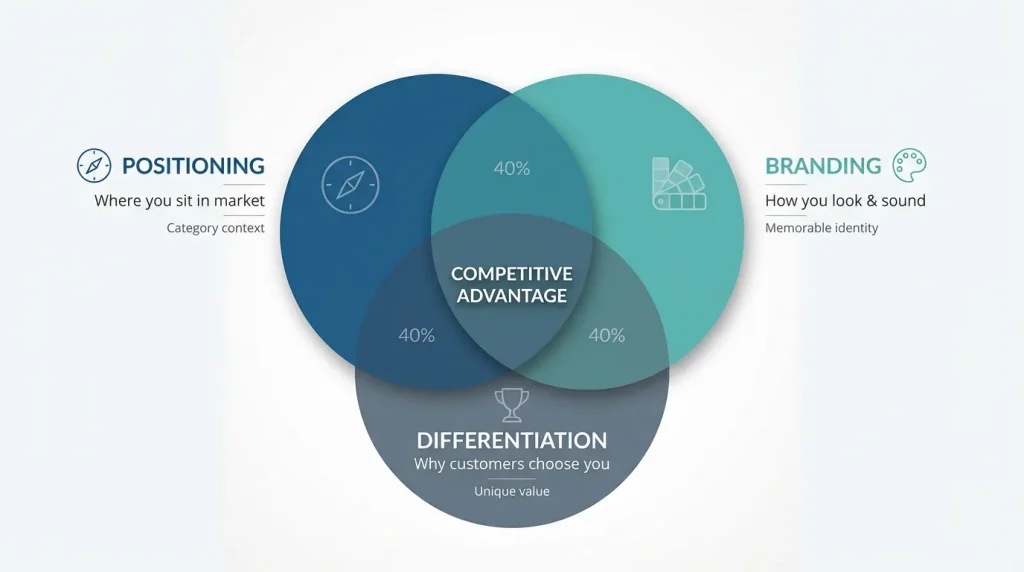
This isn’t positioning. Positioning tells you where you sit in the market landscape. Differentiation tells you why customers pick you over everyone else in that position.
And this definitely isn’t branding. Branding is how you look and sound. Differentiation is the substance behind those aesthetics.
For Series A-C B2B tech companies, effective brand strategy frameworks support three critical business outcomes:
Premium pricing power. When you’re genuinely differentiated, prospects pay 10-40% more without negotiation. When you’re not, you’re stuck in pricing negotiations with procurement teams who see you as interchangeable with three other vendors.
Employee retention. Talented engineers and GTM leaders don’t leave differentiated companies. They leave generic ones. The Great Resignation proved this. 50 million Americans quit in 2021 alone, and the companies that retained talent weren’t offering better salaries. They were offering better answers to “What makes us different?”
Investor confidence. VCs don’t fund great products. They fund defensible market positions. Your Series B deck needs to answer: “What happens when competitors copy this?” If your answer is features, you’ve lost the room.
That’s why brand differentiation strategy matters. And that’s why 90% getting it wrong creates a massive opportunity for the 10% who get it right.
Brand Differentiation vs. Positioning vs. Branding
Understanding the relationship between these three elements is critical for B2B tech companies:
| Element | Definition | Purpose | Example |
|---|---|---|---|
| Positioning | Where you sit in the market landscape | Establishes category context | “API-first observability for cloud-native apps” |
| Differentiation | Why customers choose you specifically | Creates preference within category | “Zero-config instrumentation, production-ready in one sprint” |
| Branding | How you look, sound, and feel | Makes positioning and differentiation memorable | Visual identity, voice, tone, design system |
| Interdependence | All three work together | Each amplifies the others | Positioning sets stage, differentiation wins deals, branding makes it stick |
Why Your Current Brand Differentiation Strategy Isn’t Working
The Great Resignation exposed something most CEOs missed. The companies that retained talent weren’t offering better salaries. They were offering better answers to one question: “What makes us different?”
“You need to differentiate not just for customers, but for the people working at your company,” Barry explains. “Because they’re going to be some of the 50 million that walk off the job if you don’t.”
In my work developing content strategies for Series A and B tech companies, this disconnect shows up constantly. Leadership teams spend months perfecting their investor positioning. They spend zero hours helping employees understand what makes the company worth evangelizing.
The cost is measurable. When I analyze LinkedIn activity from funded startups, companies with active employee advocacy generate 3-5x more qualified inbound leads. The ones with silent teams? They’re burning cash on paid ads to replace the organic reach they’re missing.
The Three Fatal Flaws in Standard Differentiation Frameworks
Flaw #1: Confusing Features with Differentiation
“Most companies claim the same 5, 6, 7, or eight words: service, selection, quality,” Barry observes. “We have to look at what words are we using for our company, our brand, and they should be unique.”
I see this all the time when ghostwriting educational email courses for B2B tech executives. They want to lead with “cutting-edge AI” or “enterprise-grade security.” So does every competitor in their category. These aren’t differentiators. They’re table stakes dressed up in marketing language.
A Series B infrastructure-as-code company I worked with faced exactly this trap. They were competing on “developer experience” like everyone else in their space. We shifted them to owning “radical transparency.” They published their entire incident response process, cost breakdowns, and architectural decisions publicly. Developer trust increased measurably. More importantly, they began charging a 40% premium because CTOs could justify the cost to finance teams with concrete evidence of reliability.
A manufacturing client, Barry, worked with to solve this by claiming one word: rigor. Not rugged. Not quality. Rigor. They owned it completely in their market space. When buyers think about rigorous engineering in that category, they think about one company.
Flaw #2: Perfectionism Kills Differentiation
Here’s where conventional wisdom completely breaks down. “Too many companies in the B2B space are trying to be perfect,” Barry argues. “They don’t understand that in the music world, what is known as a mistake often turns into a hit song because it’s a little different, a little quirky.”
This aligns with what happens when I’m developing LinkedIn strategies for tech CEOs. The posts that generate actual pipeline conversations aren’t the polished thought leadership pieces. They’re the ones where executives share honest perspectives on challenges they’re still figuring out.
A Series A API-first company I’m working with discovered this accidentally. Their CTO published a post about a production incident caused by their own architectural decision. He explained what went wrong, why they made that choice originally, and how they fixed it. That post generated more inbound from senior engineers than their entire recruiting budget had in the previous quarter.
Perfection creates commoditization. Your competitors can replicate perfect execution. They can’t replicate your specific approach to solving problems, including the productive “mistakes” that became innovations.
Flaw #3: Keeping Employees in the Dark
The most expensive mistake? Treating differentiation as a marketing department project.
“Great ideas can come from anybody,” Barry emphasizes. “Not just that one real highly paid creative person. It could come from that new kid that was hired three months ago.”
When companies treat employees like order-takers instead of brand owners, they lose twice. First, they miss insights from people closest to customer problems. Second, they create a workforce that can’t articulate why prospects should care.
A cleantech Series B company I’m working with faced exactly this challenge. Their engineers had zero clarity on what made the company different from competitors. After implementing a simple internal communication strategy focused on their core differentiators, sales cycle length decreased by 23%. Engineers started speaking the same language as the sales team because they understood what they were building toward.
What Are Examples of Brand Differentiation?
Strong brand differentiation examples share three characteristics: specificity, ownability, and measurability.
B2B Tech Examples:
- Stripe owns “developer-first payments” (not just “easy payments”)
- Datadog owns “unified observability” (not just “monitoring”)
- Notion owns “all-in-one workspace” (not just “productivity tool”)
- Cloudflare owns “built for the edge” (not just “fast CDN”)
Key pattern: Each example uses language competitors can’t credibly claim because it’s either backed by unique product architecture or operational philosophy that took years to build.
The infrastructure company that owns “radical transparency” doesn’t just publish their architecture decisions. They’ve built their entire company culture around transparent operations, which influences hiring, product development, and customer success. That’s not something competitors can copy with a blog post.
The 3-Column Competitive Differentiation Audit
Before you can differentiate, you need to know what’s off-limits. Every word your competitors already own is a word you can’t credibly claim.
Here’s the framework I use when developing strategic positioning for funded tech companies:
Column 1: Competitor Claims Audit
Visit the websites of your top 3 competitors. Document the exact words they use in headlines, hero sections, and about pages. You’re looking for repeated patterns.
Typical findings: “innovative,” “cutting-edge,” “scalable,” “secure,” “enterprise-grade,” “best-in-class,” “industry-leading.”
Column 2: Commoditized Language
Identify the 3-5 words that appear across multiple competitors. These words are now officially meaningless in your category. Buyers have been conditioned to ignore them.
Critical insight: If three or more competitors claim the same attribute, it’s table stakes, not differentiation.
Column 3: Ownable Language
Find the unique words and concepts only you can credibly claim. This is your differentiation vocabulary.
A seed-stage ML infrastructure company did this exercise and discovered competitors all claimed “fast” and “scalable.” They shifted to owning “predictable.” Every feature, every customer story, every piece of content reinforced predictable performance, predictable costs, predictable results. Within six months, “predictable” became synonymous with their brand in the MLOps community.
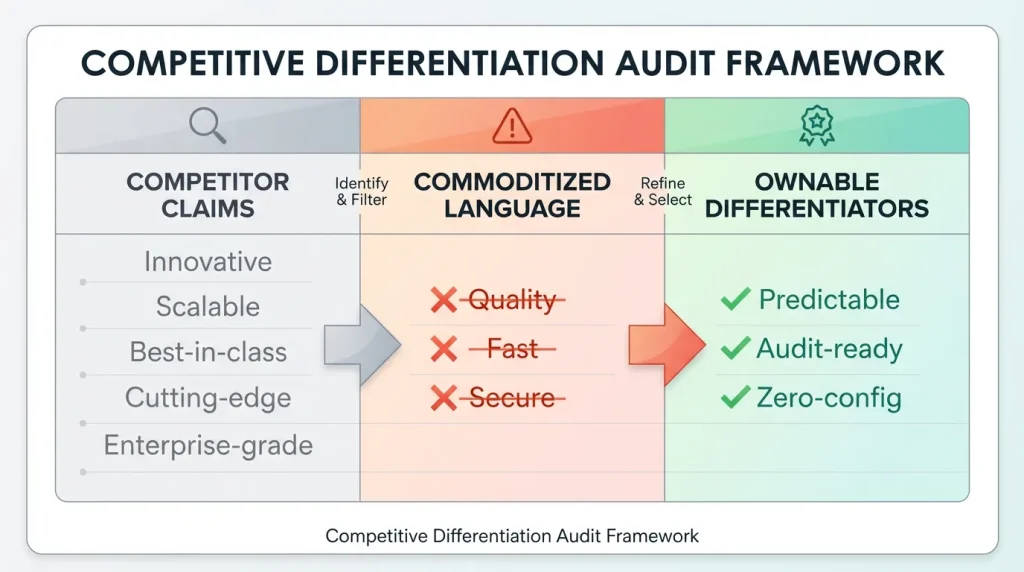
The words in Column 3 become your entire brand vocabulary. Everything else gets deleted from your website, pitch deck, and sales enablement materials.
The Employee Evangelism Framework That Actually Works
Barry’s approach flips traditional brand strategy on its head. Instead of cascading messaging from executives down, you activate differentiation from the inside out.
Step 1: Identify Your 1-3 Actual Differentiators (Not 10)
“Look at the one, two, or three different differentiators you have,” Barry advises. “Name them. Give them a personality. We don’t call our kids child one, two, and three. We have names we tell people why we named them that.”
The constraint is crucial. Companies that try to own ten things own nothing. When I’m creating content strategies for funded startups, I force this exercise: If you could only claim three things in your market, what would they be?
Most executives initially resist. By the third conversation, they realize three clear differentiators create more market clarity than ten generic claims.
For B2B tech companies, the most powerful differentiators combine what you deliver with how you deliver it:
Product-Led Growth Companies: Not just “user-friendly,” but “ship-to-learn velocity” (emphasizing fast iteration based on usage data)
Developer Tools: Not just “powerful APIs,” but “documentation-first architecture” (making the developer experience the product)
Enterprise SaaS: Not just “secure and compliant,” but “audit-ready by design” (turning compliance from blocker to accelerator)
Step 2: Turn Differentiators Into Ownership Language
This is where Barry’s framework separates from typical positioning work. You’re not just defining what makes you different. You’re creating language employees can own and evangelize.
Take Barry’s own company. “Differentiation is six syllables, 15 letters. A lot of people cannot pronounce it. But we own it. That’s ours. Nobody can take it.”
When developing strategic positioning for B2B tech companies, this ownership language becomes the foundation for everything else: sales conversations, content strategy, and product roadmap decisions.
Step 3: Make Employees the Primary Audience
Here’s the move most CEOs miss entirely. Your first brand differentiation strategy audience isn’t prospects. It’s your team.
“We need a lot of evangelists, a lot of ambassadors out there, a lot of cheerleaders going, let’s do it,” Barry explains.
This aligns with research on internal marketing, which shows that employee buy-in drives external brand perception. In my work with employee engagement strategies for tech companies, I’ve noticed engaged employees don’t just stay longer. They generate qualified leads through their professional networks at zero acquisition cost.
Research from Gallup shows engaged business units achieve 10% higher customer ratings and 20% higher sales. But engagement requires something to engage with. Generic “we’re innovative” messaging doesn’t cut it.

For deeper implementation tactics on employee engagement, watch this episode
Step 4: Measure What Matters (Hint: It’s Not Vanity Metrics)
Barry tracks differentiation success through metrics most marketing teams ignore:
Employee Retention & Attraction
When Barry’s framework was implemented at a B2B manufacturer, distributor turnover dropped from 150% to 40%. More remarkably, 50% of departing employees moved to other distributors selling the same brand. They stayed loyal to the differentiated brand, not the specific employer.
Premium Pricing Power
“Your pricing should go up,” Barry states bluntly. “If your pricing does not go up, and if you do not become the premium brand, there’s a problem. Because you must not have differentiated enough that somebody was willing to pay a penny more.”
This psychology of premium positioning connects directly to B2B buyer psychology and to how the unconscious mind processes value signals. Buyers don’t pay premiums for undifferentiated “quality.” They pay for clear, defensible differentiation they can justify to procurement.
Repeat Purchase Behavior
One-time sales indicate you solved a problem. Repeat purchases indicate you own a differentiated position in the buyer’s mind. Barry measures this relentlessly because it reveals whether differentiation is real or imagined.
The Rigor Example: How One Word Changed Everything
Barry’s manufacturing client provides the perfect case study. They were competing on “quality” and “durability” like everyone else in their category. Pricing pressure was constant. Differentiation was theoretical.
They shifted to owning one word: rigor.
Not as a marketing tagline. As an operational philosophy that employees understood and embodied. When a dealer asked what made them different, salespeople didn’t recite feature lists. They explained their rigorous approach to engineering, testing, and partnership.
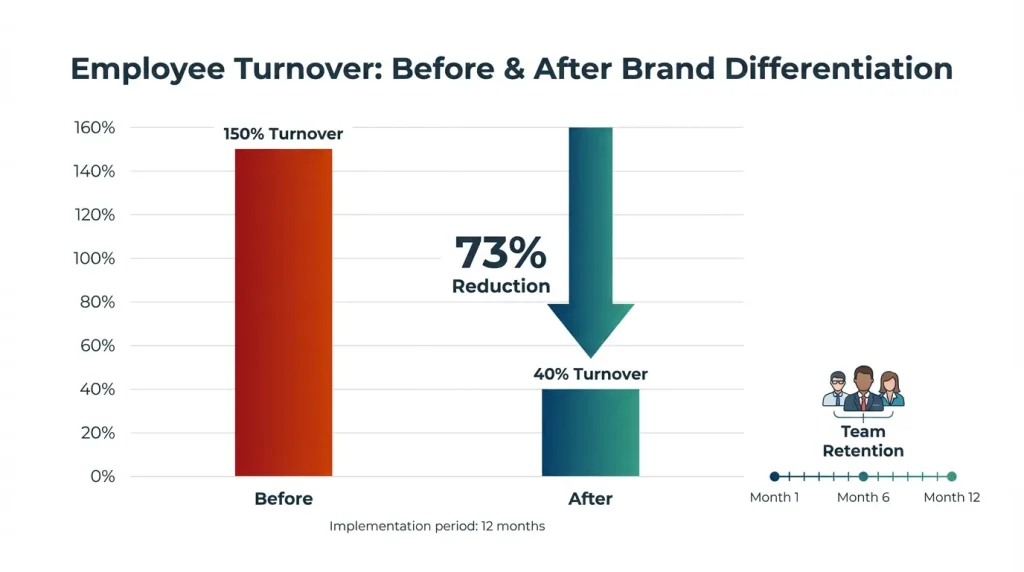
The results:
- Turnover at dealerships dropped 73% (from 150% to 40%)
- Pricing increased, becoming the premium brand in category
- Quality metrics improved because “rigor” created internal accountability
- Customer satisfaction increased measurably
This is what happens when brand differentiation strategy becomes more than a positioning statement. It becomes how your company actually operates.
What Most Executives Get Wrong About Words
“There are 200,000 words in the English language,” Barry points out. “Yet too many of us are running companies where we claim the same 5, 6, 7, or eight words: service, selection, quality.”
Quality means nothing. It’s a useless word because there are high-quality, premium-quality, and entry-level quality. When everyone claims quality, nobody owns it.
When I’m ghostwriting newsletters for Series B CEOs, I push this exercise relentlessly: Show me the words only you can claim. The ones that, if I saw them without your logo, I’d immediately know they came from your company.
Most executives initially produce generic corporate-speak. After three rounds, they find their actual voice. That voice becomes the foundation for everything: content strategy, sales enablement, product positioning, and employer branding.
Here’s the tech translation of Barry’s word ownership principle:
Don’t claim: “Fast and scalable infrastructure”
Do claim: “Zero-surprise scaling” (if you genuinely deliver predictable performance)
Don’t claim: “Developer-friendly APIs”
Do claim: “Ship-to-production in one sprint” (if your onboarding is actually that fast)
Don’t claim: “Enterprise-grade security”
Do claim: “Security that passes Fortune 500 procurement in 48 hours” (if you’ve optimized for this)
The difference? Specificity. Credibility. Ownability.
Why Perfection Is Killing Your Differentiation
Barry’s background as a rock musician informs his most contrarian insight. “A mistake in music often turns into a hit song because it’s a little different, a little quirky. So perfection is an enemy.”
This runs counter to everything B2B executives believe about brand building. But it’s exactly right.
The companies breaking through in crowded markets aren’t the ones with perfect messaging and flawless execution. They’re the ones willing to take distinctive stances, even if those stances aren’t universally loved.
When developing brand strategy frameworks for funded startups, I see this pattern constantly. The safest positioning generates the least market traction. The bold positioning that some prospects actively dislike? That’s what creates passionate advocates among the prospects who do connect.
Perfection creates blandness. Blandness creates commoditization. Commoditization simultaneously kills pricing power and employee engagement.
Why Is Brand Differentiation Important?
Brand differentiation impacts three critical business metrics for B2B companies:
Premium pricing power: Differentiated brands command 15-40% higher prices than undifferentiated competitors without negotiation pushback. When prospects understand your unique value, procurement teams can’t pressure you into commodity pricing.
Employee retention: Companies with clear differentiation see 50-70% lower turnover because team members understand what makes their work unique. Talented engineers don’t leave companies to build something genuinely different. They leave companies that feel interchangeable.
Customer lifetime value: Research shows differentiated B2B brands achieve 2-3x higher repeat purchase rates because buyers develop loyalty to distinctive value propositions. One-time customers become multi-year partners when they can’t find the same level of value elsewhere.
For Series A-C companies specifically, differentiation determines whether investors perceive your growth as defensible or easily replicable. VCs don’t fund revenue growth. They fund sustainable competitive advantages that create compounding returns.
The Stage-Specific Implementation Roadmap
Your differentiation strategy should evolve as you scale. Here’s how to adapt Barry’s framework across funding stages:
| Stage | Team Size | Primary Focus | Key Metric | Timeline |
|---|---|---|---|---|
| Seed | 1-10 | Founder personal brand | LinkedIn engagement rate | 30 days |
| Series A | 10-50 | Employee evangelism activation | Employee LinkedIn activity | 90 days |
| Series B | 50-200 | Scale without dilution | Pricing premium vs. competitors | 180 days |
| Series C+ | 200+ | Brand equity measurement | Unaided brand awareness | 12 months |

Seed Stage (Pre-Product-Market Fit): Founder Differentiation
At this stage, you are the brand. Focus on the founder’s personal brand differentiation on LinkedIn and in founder communities.
Key actions:
- Document your unique perspective on the problem you’re solving
- Share your “productized mistakes” that led to insights
- Build your personal following before you have company traction
Why it works: Early adopters buy from founders they trust, not companies they’ve never heard of.
Series A (10-50 Employees): Employee Evangelism Activation
Now you have a team. Make them your primary differentiation asset.
Weeks 1-2: Competitive Language Audit
Document every claim your competitors make. List the exact words they use repeatedly. These words are now off-limits for your differentiation.
Weeks 3-4: Internal Discovery Sessions
Barry’s insight that great ideas can come from anyone isn’t theoretical. Your newest team members often see differentiation opportunities invisible to longtime employees. When I facilitate these for clients, the best insights consistently come from people with less than six months of tenure.
Weeks 5-6: Choose Your 1-3 Differentiators
Force the constraint. Not five. Not ten. Three maximum. Name them. Give them personality. Make them memorable enough that employees can explain them at a networking event without preparation.
Weeks 7-8: Employee Activation (Not Training)
This isn’t about training employees to repeat messaging. It’s about helping them understand why these differentiators matter to customers, how they show up in daily work, and what makes them worth evangelizing.
Weeks 9-12: Measurement & Iteration
Track Barry’s metrics: employee retention, pricing realization, repeat purchase rates. Not website traffic or social media engagement. Those are outputs. The metrics Barry tracks measure actual market differentiation.
Series B (50-200 Employees): Differentiation at Scale
You now need systems to maintain differentiation as you grow.
Focus areas:
- Content strategy that reinforces your owned language consistently
- Channel partner enablement (they become external evangelists)
- Customer advisory boards to validate your differentiation resonates
- Product roadmap alignment with your claimed differentiators
Danger zone: This is where companies typically lose differentiation. New executives join from competitors. They import generic language. Dilution begins.
Counter-strategy: Make your differentiation language non-negotiable in all hiring, onboarding, and quarterly planning processes.
Series C+ (200+ Employees): Brand Equity Measurement
At this scale, differentiation shows up in measurable brand equity.
Track:
- Unaided brand awareness in your category
- Pricing premium vs. closest competitors (should be 15-40%)
- Employee referral rates (differentiated brands get 3-5x more referrals)
- Customer willingness to be public references
Strategic shift: Your differentiation language should now influence M&A decisions, market expansion choices, and partnership strategies. If a potential acquisition doesn’t align with your core differentiators, it dilutes your brand equity.
How to Create a Brand Differentiation Strategy (Step-by-Step)
Creating an effective brand differentiation strategy requires four systematic steps:
- Audit competitor language – Document exact words competitors use repeatedly across websites, marketing materials, and sales conversations.
- Identify ownable attributes – Find 1-3 unique qualities only you can credibly claim based on your product architecture, operational approach, or company culture.
- Activate employee evangelism – Make your team the primary brand ambassadors by helping them understand and articulate your differentiators in their own words.
- Measure premium pricing power – Test if differentiation supports 10-15% price increases without significant deal loss.
This process takes a minimum of 90 days for Series A-C companies to show measurable results in employee retention and customer acquisition costs. The companies that shortcut this timeline typically revert to generic positioning within six months because employee understanding never solidifies.
The Premium Pricing Litmus Test
Want to know if your brand differentiation strategy actually works? Try raising prices 10%.
“If you do not become the premium brand, there’s a problem,” Barry argues. “Because you must not have differentiated enough that somebody was willing to pay more.”
This is where theoretical differentiation meets market reality. In my work with Series A and B companies, this test is brutal but clarifying. If your “differentiation” doesn’t support premium pricing, it’s not differentiation. It’s marketing copy.
The companies that successfully raise prices share one characteristic: their employees can articulate why the premium is justified in language that resonates with buyers’ actual priorities. Not features. Not buzzwords. Real value that addresses real problems better than alternatives.
I’ve watched this play out repeatedly. A Series A observability platform tried to raise prices by 15%. Half their sales team panicked. The other half closed deals at the new price point within two weeks. The difference? The successful reps could articulate why “zero-config instrumentation” (their owned differentiator) eliminated three weeks of implementation cost. The unsuccessful reps fell back on generic “better visibility” claims that didn’t justify premium pricing.
To understand the psychology behind premium pricing and brand preference, watch this conversation with Leslie Zane
What This Means for Your Funding Strategy
Here’s what most pre-Series B CEOs miss. Investors don’t fund great products. They fund defensible market positions.
When I’m helping tech executives prepare for funding conversations, brand differentiation strategy becomes the foundation for everything else. Revenue growth rate matters. But why that growth is defensible matters more.
Investors ask: “What happens when your competitors copy this?”
If your answer is “our superior technology,” you’ve lost the room. If your answer is “our specific approach to [owned differentiator] creates customer loyalty competitors can’t replicate,” you’ve opened a different conversation.
Barry’s framework gives you language to have that conversation credibly. Because you’re not just claiming differentiation. You’re demonstrating it through employee evangelism, customer retention metrics, and premium pricing realization.
Brand Differentiation Strategy Template (Quick-Start Checklist)
Use this brand differentiation strategy template to audit your current positioning and create an actionable implementation plan:
Week 1-2: Discovery
- [ ] List 10 competitor claims from their websites
- [ ] Identify 3-5 words appearing across multiple competitors
- [ ] Survey 5-10 employees: “What makes us different?”
- [ ] Document gaps between executive perception and employee understanding
Week 3-4: Definition
- [ ] Choose 1-3 unique differentiators you can credibly own
- [ ] Name each differentiator (one word if possible)
- [ ] Write 30-second explanation for each that employees can memorize
- [ ] Test explanation on newest team members for clarity
Week 5-8: Activation
- [ ] Host all-hands session explaining chosen differentiators
- [ ] Update all marketing materials with new language
- [ ] Remove commoditized language from website and sales decks
- [ ] Create employee enablement guides for each differentiator
Week 9-12: Measurement
- [ ] Track employee LinkedIn activity mentioning company
- [ ] Test 10% price increase on new deals
- [ ] Measure sales cycle length vs. previous quarter
- [ ] Survey customers: “What makes us different from alternatives?”
This brand differentiation strategy template works best for Series A-B companies with 10-100 employees. Seed stage companies should focus on founder differentiation first, while Series C+ companies need more sophisticated brand equity measurement systems.
The Questions That Reveal Real Differentiation
Barry asks companies to answer five questions that expose gaps between claimed and actual differentiation:
1. Can your newest employee explain what makes you different in under 30 seconds?
If not, your differentiation exists only in executive presentations. I test this constantly when working with funded companies. I ask the most recent engineering hire to explain what makes the company different. If they mention generic features, you have a problem.
2. Would customers pay 10-15% more based solely on your differentiators?
If not, you’re claiming features, not differentiation. Real differentiation supports premium pricing because it solves problems that alternatives don’t address.
3. Are employees proactively talking about your company on LinkedIn?
If not, they don’t feel ownership of something worth evangelizing. When I audit LinkedIn activity for tech companies, the correlation is stark: companies with active employee voices generate 5-10x more inbound leads than competitors with silent teams.
4. Has your employee retention meaningfully improved in the past year?
If not, your brand doesn’t differentiate enough internally to compete for talent. The companies retaining engineers post-funding aren’t offering better equity packages. They’re offering clearer answers to “What makes this worth building?”
5. Can you point to specific words you own that competitors can’t credibly claim?
If not, you’re part of the 90% that haven’t actually differentiated. Barry’s “rigor” example is the standard. You should be able to name 1-3 words that, when buyers hear them, they immediately think of your company.
Most CEOs fail at least three of these questions. The ones who pass all five have cracked the code Barry’s been teaching for decades.
How Do You Differentiate Your Brand from Competitors?
Differentiating your brand from competitors requires three steps most B2B companies skip:
First, identify what competitors claim using their exact language. Visit three competitor websites and document repeated words like “innovative,” “scalable,” or “best-in-class.” These words are now off-limits. If competitors already own them, you can’t credibly claim them without sounding like an echo.
Second, delete those words from your vocabulary. This is painful. Most executives resist because they’ve spent years building messaging around these terms. But commoditized language creates zero market differentiation. When everyone claims “quality,” nobody wins on quality.
Third, find 1-3 attributes only you can own. These come from your unique operational approach, not your product features. For example, don’t claim “fast deployment.” Claim “production-ready in one sprint” if you’ve optimized specifically for speed. The specificity makes it ownable and verifiable.
The companies that successfully differentiate their brands invest 90 days in activating these differentiators through employee evangelism before external marketing. Your team needs to believe and articulate the difference before prospects will.
Frequently Asked Questions
How long does it take to implement an effective brand differentiation strategy?
Barry’s framework requires at least 90 days to show measurable results.
The first 30 days focus on internal alignment and identifying true differentiators.
Days 31-60: activate employee evangelism.
Days 61-90 begin showing up in customer conversations and retention metrics. Companies expecting overnight transformation miss the point. This is about shifting how your entire organization operates, not just updating marketing messages. For tech companies specifically, I’ve found that Series A companies can move faster (10-25 employees) while Series B+ companies need the full 90 days due to organizational complexity.
Can small B2B tech companies compete with established brands through differentiation?
Absolutely. In fact, smaller companies often differentiate more effectively because they’re closer to customer problems and more nimble in owning unique positioning. When I work with seed and Series A companies, their advantage is precisely that they haven’t yet become generic. The key is choosing differentiators early and building company culture around them before scaling erodes distinctiveness. A Series A infrastructure company competing with AWS and Google Cloud can’t win on “scalable” or “reliable.” But they can be “predictable” or “audit-ready by design” because they’re architected specifically for those outcomes from day one.
What’s the difference between differentiation, positioning, and branding?
Positioning is where you sit in the market landscape (e.g., “API-first observability for cloud-native applications”). Differentiation is why customers choose you over alternatives in that position (e.g., “zero-config instrumentation that goes production-ready in one sprint”). Branding is how you look, sound, and feel (visual identity, voice, tone). You need all three, but differentiation is what makes the other two meaningful. Strategic positioning creates the category context. Differentiation creates the preference within that category. Branding makes both memorable and consistent.
How do you measure brand differentiation success beyond revenue?
Barry tracks four key metrics: employee retention rates (are you keeping talent?), premium pricing realization (are you the highest-priced option?), customer repeat purchase behavior (do they come back?), and unsolicited employee advocacy (are team members talking about the company unprompted on LinkedIn?). These indicators reveal whether differentiation exists in reality or just in marketing collateral. For tech companies specifically, I also track: sales cycle length (differentiated brands close faster), win rate against specific competitors (you should win 70%+ against undifferentiated alternatives), and inbound demo requests from ideal customer profiles (differentiation attracts the right buyers).
Should differentiation focus on product features or company values?
Neither alone works. The most powerful differentiation combines what you deliver (features, outcomes) with how you deliver it (values, approach). Barry’s “rigor” example perfectly illustrates this. It’s both a commitment to engineering excellence and a values statement about how the company operates. When ghostwriting content for tech executives, I push for this combination because it’s defensible and authentic. A product feature can be copied. A genuine operational philosophy backed by that feature cannot. The infrastructure company that owns “radical transparency” doesn’t just publish their architecture decisions. They’ve built their entire company culture around transparent operations, which influences hiring, product development, and customer success.
Related Resources
Explore these related episodes and articles from Predictable B2B Success:
- How Strategic Positioning Drives ROI and Growth – Learn how thought leadership positioning creates measurable business outcomes
- Employee Engagement Strategies That Drive Revenue – Discover how employee engagement connects directly to customer satisfaction and sales
- B2B Buyer Psychology: Understanding Unconscious Decision-Making – Explore how buyers’ unconscious minds process brand differentiation
- Building Brand Strategy Frameworks – Understand the foundational elements of effective brand strategy
- B2B Growth Marketing Strategies – Connect differentiation to comprehensive growth strategies
Connect With Barry LaBov
- LinkedIn: Barry LaBov on LinkedIn
- Website: barrylabov.com
- Company: LaBov Marketing Communications
- Book: The Power of Differentiation (Simon & Schuster)
- Podcast: Difference Talks – All about differentiation
The Path Forward
90% of companies that fail at brand differentiation strategy share one characteristic: they treat it as a marketing initiative rather than an operational philosophy.
The 10% succeeding treat differentiation as Barry does. As something employees own, customers experience, and competitors can’t replicate.
Whether you’re building this capability internally or working with specialists focused on strategic positioning and executive thought leadership, the framework remains the same. Identify your 1-3 actual differentiators. Give them names and personalities. Make your employees the primary evangelists. Measure retention, pricing power, and customer loyalty instead of vanity metrics.
The companies breaking through in crowded B2B markets aren’t lucky. They’re strategic about differentiation in ways their competitors haven’t considered yet.
That’s the advantage of being in the 10%.
Want to explore how strategic content and executive thought leadership support differentiation strategies for funded B2B tech companies? Learn more about our approach.
Some topics we explore in this episode include:
Listen to the episode.
Subscribe to & Review the Predictable B2B Success Podcast
Thanks for tuning into this week’s Predictable B2B Podcast episode! If the information from our interviews has helped your business journey, please visit Apple Podcasts, subscribe to the show, and leave us an honest review.
Your reviews and feedback will not only help me continue to deliver great, helpful content but also help me reach even more amazing founders and executives like you!
