

Last updated: April 2026 | By Vinay Koshy
To build a sales organization that performs consistently, you need three things working together: the right attitude across your team, the right competencies embedded through ongoing coaching, and the right execution discipline in how you spend your time. Most organizations focus on only one of these. The gaps in the other two explain most of the underperformance.
Scott Roy has spent 15 years helping companies build sales organizations that hold up under real-world pressure. As co-founder of Whitten & Roy Partnership (WRP), he has spent that time building and fixing sales organizations across 51 countries. His conclusion, backed by more than 400 client transformation projects, is that the problems look different on the surface but trace back to the same root causes.
The most surprising insight from our conversation: selling toilets in rural Cambodia is not meaningfully different from selling enterprise software in Indiana. The products, prices, and contexts differ. The human process of helping someone understand their problem and commit to solving it? That is the same everywhere.
If you are a founder trying to figure out how to build a sales organization that performs consistently, this episode covers the frameworks, the common mistakes, and the techniques that drive real improvement.
Table of Contents
About Scott Roy
Scott Roy is the co-founder of Whitten & Roy Partnership, an international sales consultancy founded in 2009 by Scott and Dr. Roy Whitten.
Since launch, WRP has completed more than 400 client transformation projects across 51 countries. The firm runs two divisions: WRP Commercial, which serves B2B companies in the US and UK, and WRP Social Impact, which works with social enterprises and NGOs across Africa and Asia. Scott is also the co-author of Decision Intelligence Selling and Sell Well, Do Good, both available on Amazon.
How to build a sales organization: the structural foundation
Before any methodology can take hold, you need the right structure in place. Most founders who want to know how to build a sales organization skip this step and hire before they have a repeatable sales process. That sequencing error is expensive to undo.
Start with founder-led sales
Your first sales organization is you. Before hiring anyone in sales, the founder should own the full sales process long enough to understand what actually closes deals, which objections consistently arise, and which customer type delivers the best outcomes. Without that knowledge, you cannot hire to a standard you have not yet defined.
Most sales leaders recommend staying in founder-led sales until you have closed at least 10 to 20 customers through a repeatable process. At that point, you have enough signal to train someone else to replicate it.
The hiring sequence that scales
The sequence matters as much as the hires themselves. A common mistake is hiring account executives before there is enough pipeline to keep them busy. The result is expensive sellers spending most of their time prospecting, which they are usually not the right people to do.
A practical sequence for most B2B companies at seed to Series A:
- First hire: an AE who can also prospect. At an early stage, you need one person who can run the full cycle while the founder stays close to deals.
- Second hire: a dedicated SDR. Once the AE has enough inbound or outbound pipeline to justify specialization, split the roles. The SDR qualifies. The AE closes.
- Third hire: a Customer Success Manager. Retention and expansion revenue compound faster than new-logo acquisition revenue. CSM coverage protects what you have already built.
- First sales manager hire. Only bring in a sales manager when you have at least three to four reps. A manager with no one to manage is a wasted headcount.
Three org models and when to use each
Most B2B sales organizations draw from three structural patterns. The right one depends on your deal complexity, average contract value, and stage.
The island model gives each rep full ownership of the sale from prospecting to close. It works at a very early stage when you need flexibility and have few reps. It does not scale because the skills required at each stage of the sale are different, and one person rarely excels at all of them.
The assembly line model separates prospecting (SDR), closing (AE), and retention (CSM) into specialist roles. This is the standard structure for B2B SaaS companies at Series A and beyond. It scales predictably and creates clear career paths for each function.
The pod model groups an SDR, AE, and CSM into a small team responsible for a defined customer segment, vertical, or geography. It works well for companies with complex enterprise sales or distinct market verticals that require specialized knowledge.
Structure determines who does what. It does not determine how well they do it. That is where the methodology comes in, and it is where most organizations underinvest.
The RACE equation: the diagnostic every sales leader needs
Understanding how to build a sales organization that performs consistently starts with a single diagnostic question: which of the three variables is failing?
Results in any sales organization are a direct function of three variables: attitude, competence, and execution.
Scott developed this framework in his late 20s while managing 150 salespeople and trying to understand why performance varied so widely across teams with the same product and the same training. The equation: R = A + C + E.
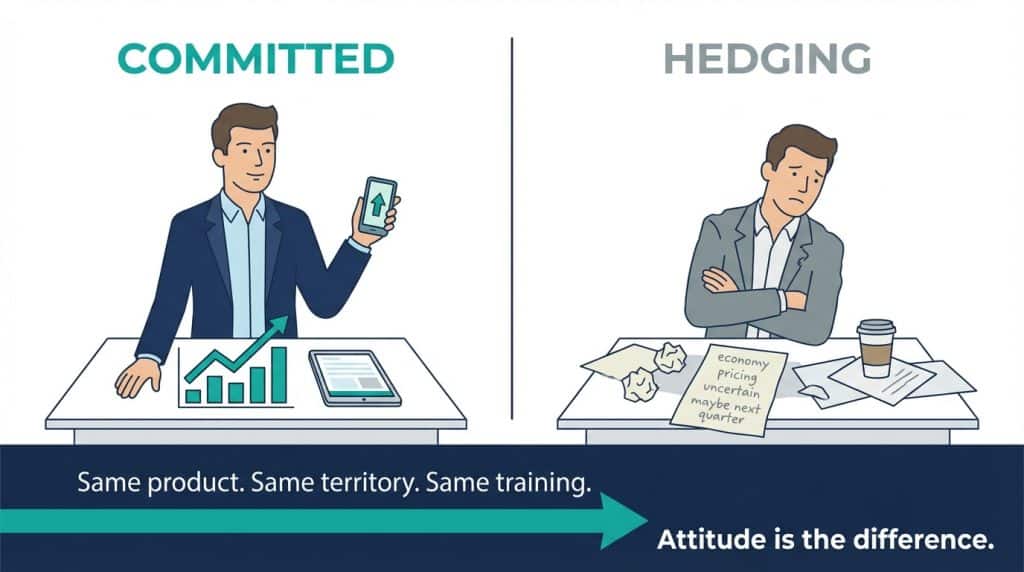
Most sales leaders reach for competence training when results drop. That is the natural instinct. But competence alone does not explain why two salespeople with identical training, the same product, and the same territory produce wildly different results. The other two variables do.
Attitude is not about positivity or energy. Scott defines it as commitment: whether a salesperson is 100% committed to the process or hedging. High performers make no excuses. The economy, the pricing, the product, the territory, none of it is the reason. Poor performers consistently find external reasons for every missed result. The pattern holds across industries, cultures, and products.
Competence is the set of skills required at each stage of the sale: establishing rapport, listening in a way that builds trust, diagnosing problems in depth, involving multiple stakeholders, costing the problem before presenting a solution, and leading a client through a buying decision. These are learnable. Most salespeople have never been taught them.
Execution is about time and activity. Are your salespeople spending time with the right people, doing the right things, at the right moments in the sales cycle? Inefficiency in execution is one of the most common issues Scott finds when he walks into a new client engagement. Salespeople who spend half their day on non-selling activities are a competence and coaching problem before they are a motivation problem.
The diagnostic value of this framework is that it removes guesswork. When a sales team underperforms, you identify which variable is failing and address that specifically, rather than defaulting to another training event. That diagnostic precision is what separates founders who know how to build a sales organization from those who keep investing in the wrong variable.
Why is attitude harder to fix than most founders expect
One of the hardest parts of knowing how to build a sales organization is that the most damaging performance problem is also the least visible.
Attitude problems are invisible until you know what to look for.
The most common failure mode is hedging. A salesperson who is hedging looks committed from the outside. They show up, make calls, and attend meetings. But internally, they are not fully committed to the process. They are looking for the trap door: a reason the customer will not buy, or a reason the outcome is outside their control. “The product is priced too high.” “The economy is tough right now.” “This prospect is not really ready.”
This matters because attitude is a multiplier on everything else. A salesperson with high competence and a hedging attitude performs inconsistently, well when conditions are favorable, poorly when they are not. A committed salesperson with average competence outperforms a hedging salesperson with strong skills over any meaningful time window.
The same dynamic applies at the management level. A sales manager who hedges on their own commitments models that behavior for the team. Culture is not built through value statements. It is built through what leaders do consistently, especially under pressure.
Why sales training fails, and what embedding actually looks like
The most expensive misconception about how to build a sales organization is that a training event creates lasting behavior change.
87% of salespeople forget training content within a month when there is no reinforcement program in place.
Scott puts it more directly. He once appeared on another podcast where the host noted that the United States spends roughly $19 billion annually on corporate sales training. His response to the host’s implied question, what do we have to show for it, was honest: not much.
The reason is structural. Most sales training is an event. A two-day workshop. An external provider. Skills explained and practiced in a controlled environment. Salespeople leave with knowledge of the method. They return to the field and, within weeks, their managers, who were not trained in the new methodology, coach them back into their previous patterns. The training evaporates.
Research from multiple training effectiveness studies confirms that 85-90% of sales training programs fail to produce lasting behavior change after 120 days. The problem is not the content. It is the absence of embedding.
Here is what embedding actually looks like in practice:
Diagnose before you prescribe. A sales consultant who does not understand the specific cause of underperformance will design training that does not match the problem. Generic sales training assumes all sales environments are identical. They are not. Diagnosis precedes design.
Train managers first. This is the step most organizations skip entirely. If managers have not been trained in the new methodology, they will undo every lesson the training delivered within weeks. The manager is the single most influential factor in whether skills stick.
Redesign how managers coach. The wrong question for a manager to ask during a live opportunity review is: “How big is the deal and when will it close?” That question is appropriate in the final stages of a complex sale. Asked at stage two of a six-stage process, it creates pressure to rush the diagnosis phase and invite objections that could have been avoided.
The right questions at every review: What stage is the customer at? Have they skipped any steps? What is your very next step and why? These questions develop judgment over time. They also tell a manager far more about the health of a deal than a closing date estimate does.
Field coaching over office coaching. Managers who work alongside salespeople in front of customers develop those salespeople faster than managers who conduct review meetings in conference rooms. The field is where the methodology is tested, refined, and embedded.
For a practical look at how this applies to team structure, see this overview of B2B sales enablement and how to develop a game plan for growth.
Precision listening: the skill most salespeople have never been taught
Precision listening outperforms questioning because it builds trust while deepening the customer’s own understanding of their problem. It is also one of the most underestimated skills when founders think about how to build a sales organization.
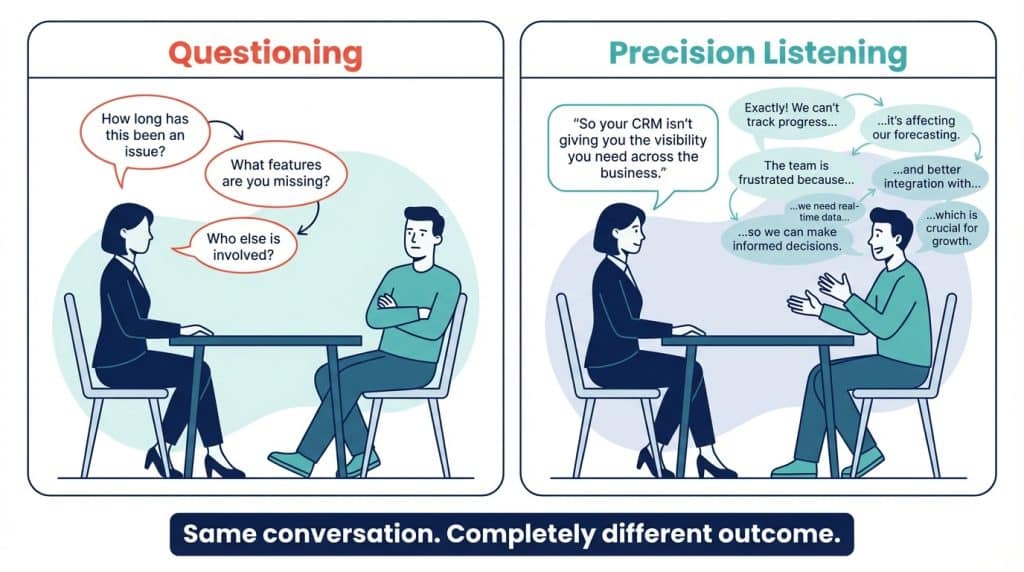
Most salespeople were trained to ask questions. Open-ended questions, probing questions, clarifying questions. The question-and-answer format feels structured and professional. Scott argues that it produces worse diagnostic outcomes than the alternative.
In a questioning-based approach, the salesperson asks and the customer answers. The conversation is linear. The salesperson collects information. The customer responds to prompts.
In precision listening, the salesperson listens carefully to what the customer says and reflects it back. Not verbatim, but capturing the substance of what was said. The customer then corrects, clarifies, or extends the thought.
The difference in practice is significant. A customer says their CRM is not working. A questioning response might be: “How long has this been an issue? What features are you missing?” Precision listening responds: “So your CRM isn’t giving you what you need.”
That one statement invites the customer to go deeper. They explain that salespeople are not inputting accurate data. The reports cannot be trusted. That forecasting is unreliable. That inventory planning and cash flow are affected downstream. The problem expands from a CRM complaint to an enterprise-wide visibility failure, without a single additional question.
Scott traces this technique to Carl Rogers, one of the 20th century’s most influential psychologists. Rogers found that when clients heard their own words accurately reflected back to them, they felt understood and continued to think more deeply about their situation. Two things happen simultaneously: the customer feels heard, and the customer develops a clearer and more concerning picture of their own problem. Both of those outcomes advance the sale.
The four-step DQ selling process
Any founder who wants to know how to build a sales organization that wins across different markets needs a methodology that adapts to any product, price point, or culture.
The DQ selling framework works across products, cultures, and deal sizes because it aligns with the buyer’s natural decision-making process.
WRP’s proprietary methodology, Decision Intelligence Selling (DQ Selling), is built on a single principle: the salesperson’s job is to help the customer make the best possible decision, not to convince them of anything. That reframe changes how every stage of the sale unfolds.
Step 1: Define the problem. Understand the customer’s problem in depth so they can determine whether it is worth solving. This step may take one meeting or five, depending on complexity. It is not complete until both parties understand the problem to the same depth. The salesperson who rushes this step to get to the proposal invites every objection that follows.
Step 2: Cost the problem. Help the customer calculate, or estimate, what the problem is costing them annually. Not the cost of your solution. The cost of the problem. This step makes an abstract situation concrete. A problem that costs $2 million per year is hard to defer. A vague operational inefficiency is easy to live with until the next budget cycle.
Scott recommends preparing back-of-envelope cost categories for the most common problems your product solves. Customers often do not know the answer immediately. Your job is to give them the framework to think through it, not to force a number they cannot support.
Step 3: Confirm they want to solve it. Only after the problem is understood and costed, ask whether the customer wants to find a solution. This is the logical sequence, and it completely changes the nature of the conversation. The customer is now pulling the solution rather than the salesperson pushing it.
Step 4: Establish the expected ROI. Present how your solution addresses the problem. Estimate the return on investment. The ROI should be a multiple of the investment cost and should address the cost of the problem identified in step 2.
One India-based telemedicine startup illustrates the impact of following this sequence. When WRP began working with them, they had completed 75,000 telemedicine appointments. After being trained to stop leading with the technology and instead follow the DQ selling process, they closed over 1 million appointments in the following year. The year after that, they doubled it. By year three, they had reached 10 million total appointments. The methodology was the same one used with enterprise clients. The company had five or six employees when the engagement started.
The framework also works in high-volume transactional environments. A WRP client in Bangladesh selling eyeglasses had a historical closing rate of 42% over ten years. After a diagnostic engagement and targeted coaching on the DQ process, their closing rate reached nearly 80% within 6 weeks.
Slowing down on problem diagnosis speeds up the second half of every sales cycle. This is the counterintuitive core of the entire methodology.
For more on how underperforming B2B sales processes can be rebuilt, see this episode with Mark Phinick on how deal coaching revives stalled sales cycles.
The sales management promotion trap
When founders think about how to build a sales organization, the promotion decision is where most of them create their biggest structural problem.
Sales managers who were once top salespeople often revert to selling rather than developing their team.
The skills that make someone an exceptional salesperson actively work against them as a sales manager. As a salesperson, you guard your time fiercely. You protect yourself from conversations and tasks that pull you away from selling. That self-preservation is a competitive advantage.
As a sales manager, the same behavior becomes a liability. The job is to develop people. You ride along on sales calls. You debrief. You coach. You ask questions about the quality of each stage rather than about the numbers.
Organizations that promote top performers into management without specific management training consistently find the same pattern. The new manager takes over calls. They close deals themselves. They manage by output metrics, “how many calls did you make this week?”, rather than by the quality of each stage in the selling process. The team does not develop. The manager becomes a supersalesperson rather than a multiplier.
Scott’s approach requires managers to understand what good selling looks like at each stage of the DQ process before they begin coaching others. They are taught what questions to ask that develop judgment, not just track results. The competencies of selling and of developing other people are different skill sets. Training one does not transfer to the other.
Building a sales culture: treat your team as customers
The cultural dimension is what most sales frameworks leave out of the conversation about how to build a sales organization.
Treating your salespeople the way you want them to treat customers builds a high-performing culture.
This is not a metaphor. It is a management operating principle. If you listen to your team, understand their situation, respond to their concerns, and recognize their contribution, they will model that behavior with buyers. The inverse is equally true.
Sales culture is not built through mission statements. It is built on how managers spend time with performers at every level, not just with those who are struggling. Top performers who feel unseen and unacknowledged leave. Replacing an experienced salesperson costs more than any retention investment. Scott recommends periodic one-on-one conversations with top performers that are not about the numbers: listening to how they are doing as people, not just as revenue contributors.
AI will not fix a culture problem. Scott is direct on this point. Tools amplify what a sales organization already does well. An organization with a strong attitude, competence, and execution will extract more value from AI than one with unresolved performance problems. AI does not fix the underlying issues. It accelerates whatever is already present in the culture.
CRM as a sales planning tool, not a management audit
When you decide how to build a sales organization, how you frame the CRM shapes whether salespeople treat it as a tool that helps them or a system that monitors them.
The CRM is a sales-planning tool, not a management weapon, when salespeople willingly input data.
The single most common reason salespeople avoid entering data into a CRM is how the tool is framed internally. When management uses the CRM primarily to monitor and audit activity, it becomes a surveillance mechanism. Salespeople enter the minimum required data, enter it late, and find workarounds.
WRP reframes CRM adoption by mapping the DQ selling steps directly into the CRM stages. A salesperson with 20 active opportunities uses the system to track each customer’s position in the buying process, the agreed next step, and whether any steps have been skipped or rushed. The CRM serves the salesperson’s own planning first. Management visibility is a byproduct.
When salespeople own their pipeline data because it helps them sell better, data quality improves without enforcement. Pipeline reviews become genuine coaching conversations rather than interrogations about numbers that do not yet exist.
For more on building a predictable B2B sales process, see this overview of what a high-performing B2B sales process looks like at each stage.
Frequently asked questions about how to build a sales organization
What is the most important thing to get right when building a sales organization?
When thinking about how to build a sales organization, the most important foundation is diagnosing why your current sales performance is where it is before making any changes. Scott Roy’s RACE equation (Results = Attitude + Competence + Execution) gives you a diagnostic lens. Most founders assume competence is the issue and invest in training. Often, the bigger gap is in attitude, whether salespeople are genuinely committed or hedging, or in execution, whether time is being spent on the right activities with the right people. Training competence without addressing the other two variables rarely produces lasting change.
How long does it take to build a high-performing sales organization?
Knowing how to build a sales organization that performs consistently takes longer than most founders expect because it requires more than hiring and training. Embedding a methodology through the management layer takes time. Scott Roy’s clients who follow the full embedding process, training managers before salespeople, redesigning coaching conversations, and reinforcing skills through field work, typically see meaningful performance shifts within six to twelve weeks. The India-based telemedicine startup WRP grew from 75,000 completed appointments to over 1 million in its first year.
Should you hire salespeople or train internal people first?
When figuring out how to build a sales organization, Scott recommends starting with a clear understanding of what your sales process requires before making hiring decisions. Hiring high-attitude candidates and training them to competency in your specific context often outperforms hiring experienced salespeople who come with ingrained habits from a different methodology. The key hiring criterion is openness to learning, not just past performance. Past performance in a different selling environment with different skills does not automatically transfer.
What makes sales training stick beyond the initial program?
Training sticks when managers are trained first and then actively coach the methodology in the field. According to research, 87% of salespeople forget training content within a month when there is no reinforcement program in place. The reinforcement mechanism is management coaching, specifically managers who ask the right questions about process quality rather than just output metrics. Without that, training evaporates.
Is the same sales approach effective across different countries and cultures?
Yes, in terms of the underlying process. Scott Roy has worked across 51 countries and 53 cultures. His consistent finding is that the human process of identifying a problem, understanding its cost, committing to solving it, and matching it to a solution does not change between cultures. What changes are the product, the price point, and the context? The process of helping a human being make a clear decision about a problem they face is universal. That consistency is one of the most reassuring factors to consider when thinking about how to build a sales organization that can scale globally.
Related resources
If this episode’s frameworks on building a high-performing sales organization sparked questions about your own setup, these episodes and resources go deeper on each dimension.
- What is B2B Sales: How to Create a Successful Sales Process
- B2B Sales Process: Key Stages and Best Practices
- How to Overcome B2B Sales Challenges and Drive Growth with Deal Coaching
- B2B Sales Enablement: How to Develop a Game Plan for Growth
- Free Sales Health Assessment — 25-question diagnostic, results delivered immediately (Whitten & Roy Partnership)
Connect with Scott Roy
- Website: wrpartnership.com
- Books: Decision Intelligence Selling: Transform the Way Your People Sell and Sell Well, Do Good: DQ Selling for Social Enterprises
Some topics we explore in this episode include:
Listen to the episode.
Subscribe to & Review the Predictable B2B Success Podcast
Thanks for tuning into this week’s Predictable B2B Podcast episode! If the information from our interviews has helped your business journey, please visit Apple Podcasts, subscribe to the show, and leave us an honest review.
Your reviews and feedback will not only help me continue to deliver great, helpful content but also help me reach even more amazing founders and executives like you!
