

Table of Contents
Meet Our Expert: Colin Hirdman
Colin Hirdman launched his first business straight out of college without a single business, marketing, or finance class to his name.
That bold move set the tone for the next two decades.
Together with his childhood best friends, he co-founded Monkey Island Ventures and built over a dozen software and service businesses.
His latest venture, Rainmaker, helps founders, business coaches, fractional executives, and sales teams grow their LinkedIn networks, leads, and sales through what he calls “authentic automation.” Over the past seven years, Colin has refined a systematic LinkedIn lead generation strategy that delivers predictable B2B results through his proven prospecting framework.
He doesn’t focus on profile optimization or organic posts. Instead, he zeroes in on what actually drives revenue: building first-degree connections with ideal clients and engaging them through education, not sales pitches.
Colin’s philosophy is simple but powerful: nobody wants to be sold on LinkedIn, but virtually everyone is willing to be educated. His process-driven methodology, which we’ll explore in detail throughout this article, has proven successful for solopreneurs and large corporations alike, generating consistent LinkedIn leads and sales opportunities.
The $2.4 Million LinkedIn Mistake Your Competitors Are Making
Most B2B companies are bleeding opportunities on LinkedIn.
Here’s what I see daily when ghostwriting for Series B and C tech CEOs:
They’re posting content three times a week. Getting 50 views. Two likes from their office manager and a college roommate they haven’t spoken to in years.
They’re paying $7,500 monthly for Sales Navigator seats across their sales team. Convinced it’s the magic bullet for LinkedIn lead generation strategy.
They’re hiring expensive agencies to “optimize their brand presence.”
Then they wonder why their pipeline looks like a ghost town.
💰 REALITY CHECK: With an average B2B deal size of $50K and a 48-deal annual quota, each wasted quarter costs you $600K in missed revenue. Four quarters? That’s $2.4M your competitors are handing you on a silver platter.
Here’s the uncomfortable truth: LinkedIn doesn’t advertise: 80% of sales reps still aren’t using social selling effectively, even though 75% of B2B buyers now use social media to research vendors before engaging with sales teams.
The disconnect isn’t subtle.
It’s costing you real revenue while your competitors—the ones doing this right—are booking meetings with your dream accounts.
Why LinkedIn’s “Best Practices” Are Destroying Your Pipeline
The problem isn’t LinkedIn.
The problem is that everyone’s following the same tired playbook from 2019.
“What I am focusing on is continually growing out my first degree network of ideal client prospects,” Colin explains. “So anytime I want to leverage a LinkedIn activity, I have a larger pool of prospects that I can drive every time I’m doing that.”
Most marketers obsess over their LinkedIn profiles and organic content for social selling.
They pour hours into crafting the perfect post. Desperately chasing likes and comments.
Meanwhile, their actual prospects?
They never see it.
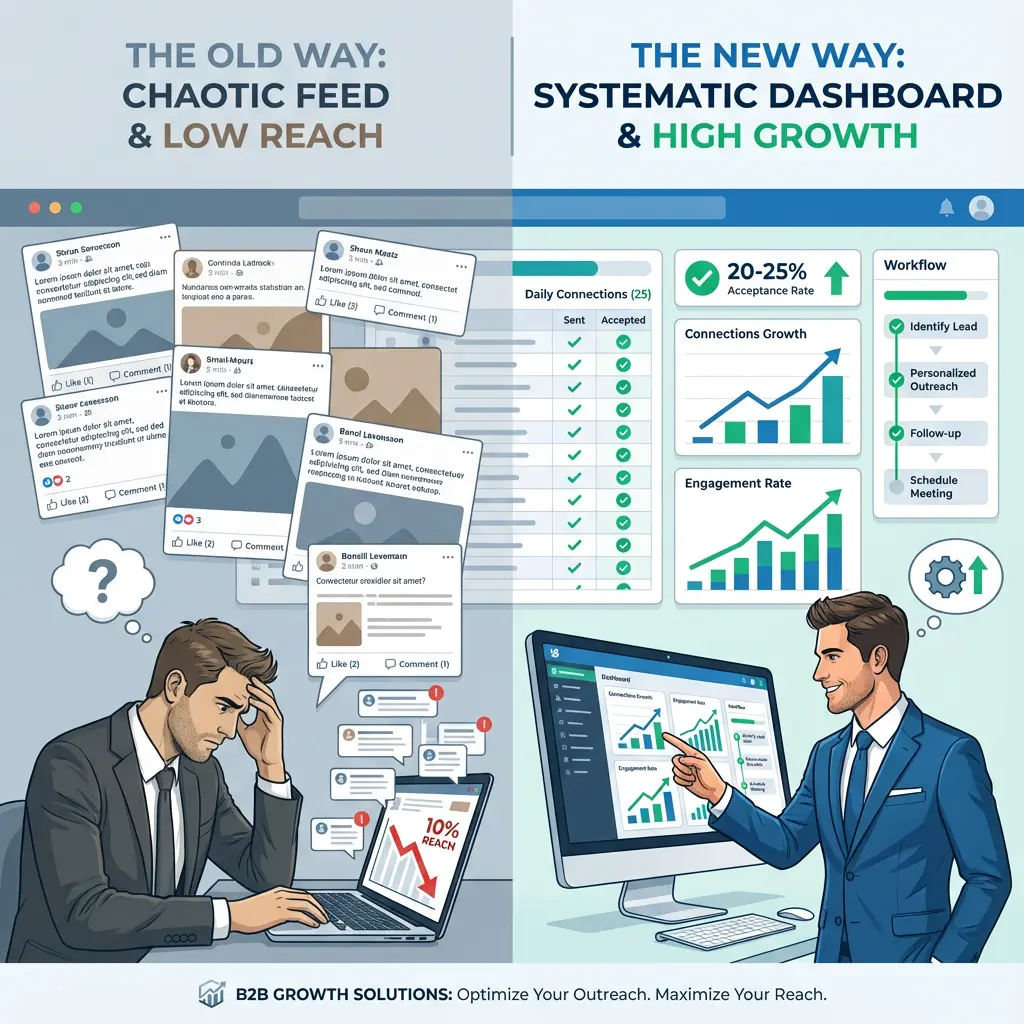
📊 STAT: Only about 10% of your connections see any given post. Of that 10%, maybe 2-3% are actually your ideal customer profile who are actively looking for B2B solutions.
Do the math. Post to 5,000 connections. Maybe 500 see it. Perhaps 15 are your ICPs. Of those 15, how many are actively in-market?
The math is brutal.
Traditional LinkedIn Strategy vs. Revenue-Generating Approach
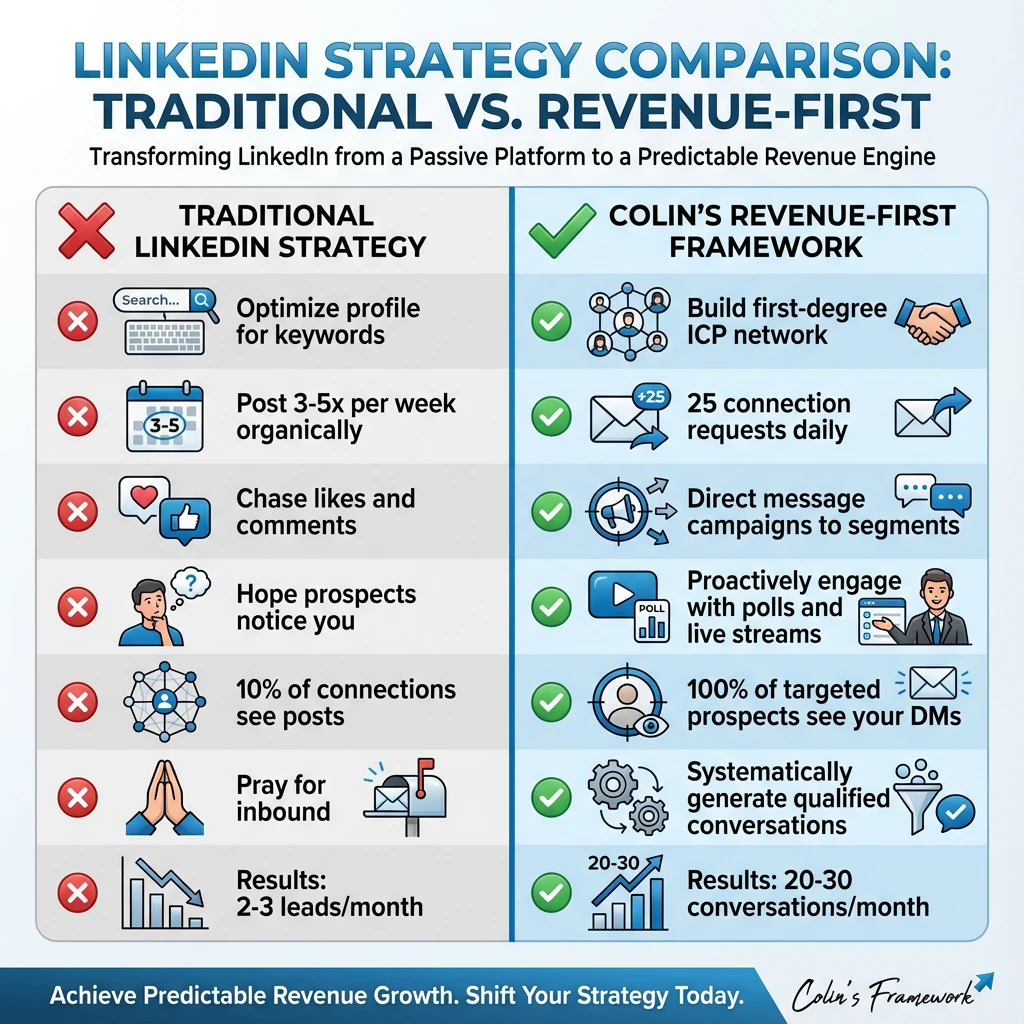
| Traditional LinkedIn Strategy | Colin’s Revenue-First Framework |
|---|---|
| Optimize profile for keywords | Build first-degree ICP network |
| Post 3-5x per week organically | 25 connection requests daily |
| Chase likes and comments | Direct message campaigns to segments |
| Hope prospects notice you | Proactively engage with polls and live streams |
| 10% of connections see posts | 100% of targeted prospects see your DMs |
| Pray for inbound | Systematically generate qualified conversations |
| Results: 2-3 leads/month | Results: 20-30 conversations/month |
Colin takes a completely different approach to LinkedIn business development.
He ignores profiles. Skips the endless organic posting game.
Instead, he focuses on three specific things that directly generate LinkedIn leads and revenue.
And I’ve seen this same principle work across every educational email course I’ve ghostwritten: education before extraction, value before volume.
🎯 QUICK WIN #1: Your First 24 Hours
What to do:
- Optimize Sales Navigator filters for your ICP
- Build list of 100 second-degree prospects
- Send 25 connection requests (no message)
- Track in simple spreadsheet
⏱️ Time: 45 minutes
📈 Expected Result: 3-7 acceptances within 24 hours
The Three-Layer Framework That Generated $847K Pipeline in 90 Days
Colin thinks about LinkedIn lead generation strategy in three distinct layers.
Miss one, and your entire strategy collapses.
One of my clients, a Series B cleantech company, implemented just Layer 2 of this framework.
Revenue conversations increased 340% in six weeks.
When they added Layers 1 and 3? Pipeline doubled. Again.

Layer 1: Philosophy (The Foundation That Kills 90% of LinkedIn Strategies)
Before you touch Sales Navigator or write a single message, you need to adopt three mindsets that most companies ignore entirely:
Educational First, Sales Never (In Initial Outreach)
“Nobody wants to be sold on LinkedIn,” Colin states flatly. “Virtually everyone is willing to be educated on LinkedIn.”
This isn’t motivational fluff. This is strategic positioning for B2B LinkedIn marketing.
When you lead with education, you’re not another desperate vendor sliding into DMs. You’re a resource. A trusted advisor. Someone worth connecting with.
Here’s what this looks like in LinkedIn prospecting practice:
DON’T: “Hi [Name], I saw you’re looking to scale your sales team. We help companies like yours achieve 200% growth in 90 days. Can I show you how?”
DO: “Hi [Name], I noticed your recent post about scaling challenges. I just created a framework document on building sales processes from $5M to $50M ARR. No pitch, just 23 pages of what actually worked. Want me to send it over?”
The onus falls entirely on you to understand your prospects’ pain points.
Figure out what you can teach them that provides genuine value.
From ghostwriting educational email courses for dozens of B2B tech startups, I can tell you: this shift in mindset alone doubles conversion rates for LinkedIn lead generation strategy campaigns.
Authentic and Genuine Communication (Or: Stop Sounding Like a Bot)
LinkedIn users can smell fake from miles away.
The generic “I’d love to connect with fellow innovators in the SaaS space” messages?
They’re immediately deleted.
Authenticity means treating LinkedIn like a professional networking event, not a cold calling list. You wouldn’t walk up to someone at a conference and immediately pitch your services.
So please don’t do it on LinkedIn.
💡 PERSONAL OBSERVATION: I once worked with a SaaS VP of Sales who insisted on “optimizing” every message for conversion. His acceptance rate? 8%. We stripped out the sales language, added human voice, focused on shared experiences. Rate jumped to 27% in two weeks. Same prospects. Different approach.
Experimentation Mindset (Test or Die)
LinkedIn has dozens of features most people never touch for a B2B lead generation strategy: polls, live streams, document sharing, native video, LinkedIn articles, and events.
Colin’s approach? Test them all.
“You’re going to try different features and functions within LinkedIn stack,” he explains. “What works? If something doesn’t work, table that, maybe you try it again later.”
The companies winning on LinkedIn aren’t following a static playbook. They’re constantly testing, measuring, and iterating.
One client’s poll about sales compensation structures got 847 votes and generated 23 qualified conversations. Cost? Zero dollars and 4 minutes to write.
Another client’s LinkedIn live stream about compliance challenges attracted 64 attendees and converted to 8 sales meetings.
Test. Measure. Double down on winners.
Layer 2: Audience Building (The Asset Most CEOs Completely Ignore)
Here’s where most LinkedIn lead generation strategy efforts derail.
Companies either:
A) Target way too broad (“Let’s connect with all CEOs!”)
B) Give up too quickly (“We reached out to 50 people and only 10 connected”)
C) Never build a systematic approach
Colin’s method is surgical for LinkedIn prospecting.
And it’s the same precision I apply when defining ICP for educational content strategies: narrow is powerful.
Use Sales Navigator Like a Sniper Rifle, Not a Shotgun
Sales Navigator isn’t just a search tool for social selling. It’s your prospect qualification engine.
You need to identify second and third-degree connections that match your ideal customer profile down to specific criteria:
- Job title AND seniority level
- Company size AND growth indicators (Series B+, recent funding, hiring signals)
- Industry AND sub-industry categories
- Geographic targeting (if relevant)
- Years of experience
- Technology stack (if using certain tools)
- Company growth signals (hiring sprees, funding announcements)
“You could do Sales Navigator,” Colin notes. “Some of my clients will send me like lists from ZoomInfo. I’ll use those. We’ll get lists sometimes from trade shows or events, conferences.”
The LinkedIn Events Growth Hack Nobody’s Using
This one’s criminally underutilized for generating LinkedIn leads.
Colin recommends attending LinkedIn events hosted by direct competitors or industry associations.
Why?
Because everyone attending that event is publicly raising their hand and saying, “This topic interests me.” They’re pre-qualified prospects engaging with content directly related to what you solve.
“Go attend those events and you could start building out a list of prospects from those events,” Colin advises.
This gives you a warm introduction angle that converts at 3-4x the rate of cold LinkedIn outreach.
“I saw you attended [Event Name]” beats “I noticed your company” every single time.
🎯 REAL EXAMPLE: One of my clients attended a competitor’s webinar on “Scaling Operations at $10M ARR.” They identified 47 attendees matching their ICP. Connection request acceptance rate: 38%. Three became customers within 90 days. Total cost: $0 and 2 hours of time.
🎯 QUICK WIN #2: LinkedIn Event Hack
What to do:
- Find competitor or industry association event
- Register and attend (even if passive)
- View attendee list during/after event
- Export 20-30 relevant prospects to spreadsheet
- Connect with note mentioning event
⏱️ Time: 2 hours (including event attendance)
📈 Expected Result: 35-40% acceptance rate (vs 20-25% cold)
Building Prospect Lists That Don’t Suck
You need multiple sources feeding your LinkedIn business development pipeline:
- Sales Navigator searches (refined weekly)
- LinkedIn event attendees (competitors and associations)
- Trade show participant lists
- Competitor event observers
- Industry association members
- Engaged commenters on relevant posts
- People who liked/shared competitor content
The goal? Build a consistent pipeline of second and third-degree connections to reach out to weekly.
Not monthly. Weekly.
Layer 3: Strategy (Where Execution Beats Theory Every Time)
Now we get to the actual tactics for the LinkedIn lead generation strategy.
This is where Colin’s process becomes surgical.
And where most companies completely fall apart despite having Layers 1 and 2 nailed.
The 25-Per-Day Connection Formula That Guarantees Results
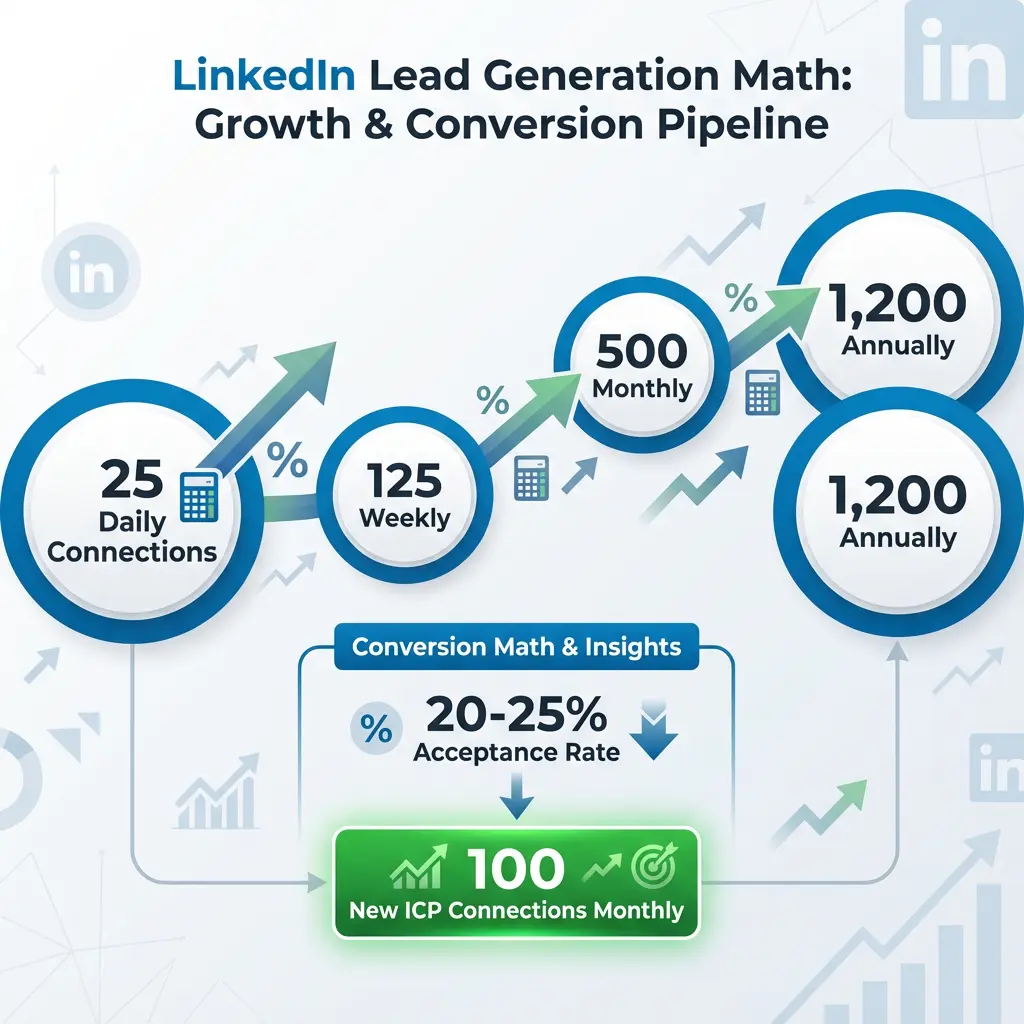
Colin’s core LinkedIn prospecting strategy is deceptively simple: reach out to 25 people per day, Monday through Friday, during normal working hours.
That’s 125 connection requests per week.
About 500 per month.
6,000 annually.
The results? “We’re typically seeing around a 20 to 25% connection rate back,” Colin reveals.
Let’s do the math on this LinkedIn lead generation strategy process:
- 500 requests per month
- × 20% acceptance rate
- = 100 new first-degree ICP connections monthly
- = 1,200 ideal prospects added to your network annually
Now here’s the part that shocks most people about this LinkedIn networking strategy:
Colin does NOT use a connection message.
“We do not use a connection message,” he states explicitly.
Wait, what?
Here’s why: Generic connection messages feel spammy for social selling. LinkedIn users are conditioned to ignore or delete them. A simple connection request with no message actually converts better because it feels less aggressive.
The message comes after they accept.
The 30-Day Withdraw Strategy (LinkedIn Hygiene Nobody Teaches)
If someone doesn’t accept your connection request within 30 days, withdraw it.
“That’s just good LinkedIn hygiene,” Colin explains.
This keeps your pending connections clean and allows you to potentially re-engage those prospects later with a fresh request when timing might be better.
Some prospects aren’t ready in March. They’re drowning in Q1 chaos.
But in June? Different story.
Activating Your Growing Network (Where Most People Stop and Leave Money on the Table)
Here’s where most people stop their LinkedIn lead generation strategy efforts. They build connections, then do nothing.
Criminal.
Colin activates his growing network through multiple engagement strategies:
Direct Message Campaigns With High-Value Assets
Create valuable assets (not pitches) and share them via direct message to relevant segments of your network.
“Maybe there’s some type of an asset that I’ve created that I think my prospects would be interested in,” Colin explains. “Maybe my prospects are divvied up into different verticals.”
For Colin, those verticals include founders, business coaches, fractionals, and sales executives.
For you? Different segments, same LinkedIn prospecting principle.
The key is segmentation. Don’t blast your entire network.
Target specific groups with assets tailored to their pain points.
From ghostwriting educational email courses, I know this principle intimately: one message to everyone converts at 1-2%. Segmented messages to specific problems? 12-18% conversion for LinkedIn leads.
The asset could be:
- A one-page framework document
- A spreadsheet calculator tool
- A video breaking down a complex topic
- An industry benchmarking report
- A case study with ROI analysis
- A checklist or template
No pitch. Just value. The conversation naturally follows.
🎯 QUICK WIN #3: Your First Asset
Create a one-page framework document:
- Addresses ONE specific ICP pain point
- Provides actionable steps/framework
- Zero sales pitch anywhere in document
- PDF format for easy sharing via LinkedIn
⏱️ Time: 60-90 minutes
📈 How to use: In DM campaigns starting week 3
LinkedIn Polls for Engagement (The 4-Minute Lead Generator)
Polls are criminally underused for B2B lead generation strategy.
Colin leverages them to gather insights while simultaneously engaging prospects.
“Maybe you want to invite them to participate in a poll that you’re doing,” he suggests.
Polls serve multiple purposes for LinkedIn marketing:
- Generate engagement metrics for algorithm boost
- Provide market research insights you can reference in sales calls
- Create conversation opportunities in comments
- Position you as someone who values audience input
- Give prospects a low-friction way to engage
Example poll from one of my clients:
“What’s your biggest challenge scaling from $5M to $25M ARR?”
- Operations complexity (24%)
- Hiring fast enough (41%)
- Maintaining culture (18%)
- Capital efficiency (17%)
Results: 234 votes, 47 comments, 12 DM conversations, 4 sales meetings.
Time investment: 4 minutes.
LinkedIn Live Streams for Authority Building (The Unfair Advantage)
Very few people host LinkedIn live streams for a B2B lead generation strategy.
That’s precisely why you should.
“Maybe there’s a LinkedIn live stream that you’re doing teaching about a specific subject or topic area that you want to invite them to,” Colin notes.
Live streams establish thought leadership faster than almost any other tactic. You’re demonstrating expertise in real-time, taking questions, and building relationships at scale.
One of my clients hosts a monthly “Ask Me Anything” session about SaaS metrics. Average attendance: 35-50 people. Conversion to sales conversations: 15-20%.
Cost per lead: $0.
Traditional lead gen? $350 per SQL.
Do the math.
Sequential Touch Points Over Time (The Compound Interest of Relationship Building)
The magic isn’t in any single LinkedIn networking tactic.
It’s in the combination and consistency.
“Now you are engaging with your audience one-on-one,” Colin explains. “You’re engaging with your audience in a way that’s providing educational value.”
You’re not bombarding people.
You’re creating multiple meaningful touch points over weeks and months. Each interaction reinforces your position as a valuable resource.
Think of it like this for LinkedIn business development:
- Week 1: Connection accepted
- Week 2: They see your poll in their feed
- Week 3: You send a valuable asset via DM
- Week 4: They attend your live stream
- Week 5: You comment thoughtfully on their post
- Week 6: You invite them to a roundtable discussion
By Week 6, you’re not a stranger. You’re a trusted resource.
And when they enter the buying window? You’re the first call.
The “Authentic Automation” Philosophy That Changes Everything
Colin’s company, Rainmaker, uses what he calls “authentic automation” for LinkedIn lead generation strategy.
This isn’t about spammy bots sending hundreds of generic messages.
“We use something that we call authentic automation,” Colin explains. The focus is initially on manual tasks being done in LinkedIn and automating those.
Think of it like this: every LinkedIn prospecting strategy Colin teaches can be executed manually. You could spend 30-60 minutes per day doing these activities yourself.
Rainmaker simply automates the repetitive parts while maintaining the authentic, personalized approach.
The automation handles:
- Sending 25 connection requests daily (time-consuming but simple)
- Withdrawing pending requests after 30 days (easy to forget manually)
- Scheduling message campaigns to specific segments (complex to track manually)
- Tracking engagement metrics (impossible to do manually at scale)
What automation doesn’t handle:
- The strategy (that’s on you)
- The content creation (that’s your expertise)
- The segmentation decisions (requires human judgment)
- The value you provide (irreplaceable)
As someone who’s built educational content systems for dozens of B2B tech companies, I see the same principle: automate distribution, but never automate the thinking.
Why InMail and Sponsored Posts Are Throwing Money Into a Bonfire
Here’s where Colin gets brutally honest about LinkedIn marketing tactics.
“I never, ever use InMail,” he states. “So just forget InMail. As soon as I see InMail, I know it’s just somebody just trying to sell me.”
InMail is LinkedIn’s paid messaging feature that lets you message people you’re not connected with. Sounds useful for B2B lead generation strategy, right?
Dead wrong.
InMail has become synonymous with spam. The moment someone sees an InMail notification, their defenses go up. They know they’re about to be pitched.
Response rates tell the story:
- InMail average response rate: 10-25% (LinkedIn’s own data)
- Direct message from first-degree connection: 40-60% (when done right)
- DM with valuable asset: 70-80%
The same applies to sponsored posts showing up in feeds.
“I hate sponsored posts that show up in my inbox and I hate InMails,” Colin continues.
Compare that reaction to:
- A simple connection request from someone who shares mutual connections
- A direct message from a first-degree connection sharing a genuinely useful resource
- An invitation to a live stream on a topic you care about
The path to an effective LinkedIn lead generation strategy runs through first-degree connections.
Period.
InMail and sponsored posts might work for brand awareness at scale. But for B2B lead generation? You’re lighting money on fire.
Better to invest that budget in creating genuinely valuable assets and systematically building first-degree connections.
The Organic Content Reality Check (What LinkedIn Won’t Tell You)
Colin doesn’t dismiss organic content entirely for LinkedIn business development. He just puts it in proper perspective.
“I’m not saying you shouldn’t do them, you still should,” he clarifies. “But remember, every time you do an organic post, maybe 10% of your audience sees that post.”
Only about 10% of connections see any given post.
Of that 10%, how many are actually your ICPs in-market to make a buying decision?
Maybe 5-10 people.
The math gets brutal fast.
However, organic posts become significantly more valuable as you systematically build out your first-degree network with ideal prospects. Each new ICP connection increases the odds that your organic content reaches someone who might convert.
“That’s another reason why you’d want to continue to build out your first degree network,” Colin notes.
The LinkedIn marketing strategy isn’t “organic content OR connection building.”
It’s “connection building FIRST, THEN organic content becomes more effective.”
Build your ICP network to 2,000+ connections. Then every post potentially reaches 200 ICPs instead of 15.
That’s when organic content starts paying dividends for LinkedIn lead generation strategy.
Why This Works Better Than Every Other Lead Gen Channel (Including Cold Email)
I know what you’re thinking: “Can’t I just do cold email instead?”
Yes, you can. I’ve written thousands of cold emails for clients.
But here’s why LinkedIn outperforms for B2B prospecting:
LinkedIn Lead Generation Strategy vs Cold Email: The Honest Comparison

| Factor | Cold Email | LinkedIn (Colin’s Method) |
|---|---|---|
| Permission to engage | None | Connection = Permission |
| Context about prospect | Email address, maybe job title | Full professional history, mutual connections, content they engage with |
| Engagement options | Email only | DMs, comments, posts, polls, live streams, document sharing |
| Relationship persistence | Dies after 2-3 exchanges | Persistent, deepens over time |
| Best for | Short sales cycles (<30 days) | Long sales cycles (3-12 months) |
| Average response rate | 1-5% | 10-15% (DMs to first-degree connections) |
| Email access | Yes (primary channel) | Often (secondary benefit) |
| Algorithm support | Fighting spam filters | Platform rewards engagement |
| Cost per conversation | $50-150 (including tools) | $0-25 (mostly time investment) |
Higher Trust Factor:
When someone connects with you on LinkedIn, they’ve permitted you to engage. They’ve seen your profile, your connections, your content.
There’s inherent trust that doesn’t exist with a random email.
Richer Context:
You can see their entire professional history, mutual connections, companies they’ve worked for, and content they engage with. This allows for dramatically more personalized LinkedIn outreach.
Multiple Engagement Options:
Email is limited to email. LinkedIn gives you DMs, comments, posts, polls, live streams, document sharing, and more. Each creates a different type of engagement opportunity for social selling.
Persistent Relationship Building:
Email is transactional. LinkedIn is relationship-based for B2B networking. Even if someone doesn’t respond to your first outreach, they see your content over time, notice your comments on others’ posts, and gradually build familiarity with you.
Better for Long Sales Cycles:
B2B tech sales often take 6-12 months. Email conversations die after a few exchanges. LinkedIn relationships persist and deepen over time without being pushy.
That said, the best approach? Both.
An integrated approach combining email marketing and LinkedIn engagement consistently outperforms single-channel strategies.
Once someone becomes a first-degree connection, you often get access to their email. Use both channels strategically.
The Ghostwriting Connection: Why Educational Content Multiplies LinkedIn Results
As someone who ghostwrites educational email courses for B2B tech startups from seed to Series C, I see the exact same principle at play.
Email courses work because they provide genuine education before asking for anything. You’re solving real problems, sharing actionable insights, and building trust across multiple touchpoints.
LinkedIn’s lead generation strategy follows the identical framework:
- Identify the pain point: What specific challenge does your ICP face?
- Create educational assets: Develop content that genuinely helps them solve that problem
- Deliver value first: Share those assets before any sales conversation
- Build trust over time: Multiple touch points, always educational
- Convert when ready: By the time you present a solution, they already trust you
Whether you’re writing a five-email course on compliance regulations or sharing a LinkedIn poll about sales challenges, the psychology is identical.
Provide value.
Build authority.
Let conversion happen naturally.
This is why companies that invest in authority marketing through educational content consistently outperform those chasing short-term sales tactics.
One of my clients—a RegTech startup—implemented this approach:
- Created a 7-email course on “EU AI Act Compliance Essentials”
- Promoted it via LinkedIn DM campaigns to targeted prospects
- Followed up with live streams, diving deeper into specific topics
- Result: 34% of course completers became sales conversations
The content did the heavy lifting. LinkedIn provided the distribution.
The Conversion Math That Makes CFOs Smile
Let’s make this concrete with real numbers for LinkedIn prospecting.
Colin’s process generates a 20-25% connection acceptance rate. Let’s use the conservative end: 20%.
Month 1:
- 25 requests per day × 5 days = 125 requests per week
- 125 requests × 20% acceptance = 25 new connections per week
- 25 connections per week × 4 weeks = 100 new ICP connections per month
Month 2-3: Now you’ve got 300 first-degree ICP connections. You run your first direct message campaign sharing a valuable asset.
Industry benchmarks suggest:
- 40-60% open rate on DMs to first-degree connections
- 10-15% engagement rate on value-driven content (replies, questions, requests for more)
Conservative Math:
- 300 connections × 50% open rate = 150 people see your message
- 150 opens × 12% engagement = 18 meaningful conversations
- 18 conversations × 30% qualification rate = 5-6 sales-ready conversations
From one campaign. To 300 people.
Run four different campaigns targeting different segments over 90 days? That’s 20-24 qualified conversations monthly.
What’s your close rate on qualified conversations?
Industry average for B2B SaaS: 25-30%.
So, from one quarter of Colin’s LinkedIn lead generation strategy system:
- 24 qualified conversations
- × 27% close rate
- = 6-7 new customers

What’s your average contract value?
- $50K ACV? That’s $300-350K in new revenue
- $100K ACV? That’s $600-700K in new revenue
- $200K ACV? That’s $1.2-1.4M in new revenue
All from a systematic LinkedIn networking process that costs you:
- 30 minutes daily for connection requests
- 2-3 hours monthly to create valuable assets
- 1 hour monthly to run a poll
- 1 hour monthly to host a live stream
Total time investment: ~15-20 hours monthly.
ROI? Astronomical.
Suddenly, the math starts looking very different than the “spray and pray” approach most companies use for B2B lead generation.
💰 REVENUE IMPACT: LinkedIn-sourced B2B leads convert at 25-35% compared to 15-20% for cold outreach, with 20-30% higher contract values due to relationship pre-qualification.
The Process Guarantee Nobody Else Will Make
Colin makes a bold claim that should wake up every B2B CEO about LinkedIn prospecting:
“I can guarantee that the process that I laid out works. Like I absolutely guarantee it.”
He’s not hedging. Not saying “results may vary.”
He’s stating flatly that this LinkedIn lead generation strategy process works 100% of the time when executed correctly.
“If you follow 25 people if you adopt the philosophy we talked about, if you build out an audience of second and third degree connections that are your ICPs. If you start reaching out to 25 a day, Monday through Friday during normal working hours, I guarantee you’re going to start getting first degree connections within 24 hours with some of the people you’re reaching out to.”
Within 24 hours.
Not weeks. Not months. Within one day, you’ll see results from your LinkedIn networking efforts.
“You will start to generate first connections with your ICPs, and if you start to then activate that audience with some of the things that we’ve talked about today, I can absolutely guarantee you, you will get people participating in your DMs. You will get people signing up to your live streams.”
The guarantee isn’t about revenue. It’s about the process working.
If you execute the steps, you will generate engagement.
The rest depends on your offer, your sales process, and your ability to convert warm LinkedIn leads.
But the conversations? Guaranteed.
That’s powerful.
Why People Complain LinkedIn “Doesn’t Work” (Spoiler: They’re Doing It Wrong)
“If people are complaining about LinkedIn not working, they’re just not doing what I’m talking about,” Colin states bluntly about LinkedIn lead generation strategy.
He continues: “I don’t care if you use Rainmaker or not. Like I’m telling you that I’ve given you and your audience the process. Just go do it.”
The process isn’t secret. It’s not complicated.
It just requires consistency and discipline for effective social selling.
Most people fail because they:
- Give up too quickly: They try for two weeks, don’t see immediate results, and quit
- Skip the philosophy layer: They jump straight to tactics without the educational mindset
- Don’t build systematically: They reach out to 50 people over three months instead of 25 per day
- Lead with sales: They immediately pitch services instead of providing value
- Ignore engagement: They connect but never activate their network
- Lack patience: They expect immediate ROI instead of compound growth
The LinkedIn prospecting process works.
The question is: will you actually execute it consistently for 90 days?
Or will you be like the 80% who try it for 10 days, see modest results, and give up?
Your competitors are betting you’ll quit.
Prove them wrong.
Your 90-Day LinkedIn Lead Generation Strategy Implementation Plan
Here’s exactly how to implement Colin’s process starting today:

Phase 1: Days 1-7 (Foundation Week)
Day 1-2: ICP Definition
- Define your ideal customer profile with surgical precision
- Not “VP of Sales at SaaS companies”
- Instead: “VP of Sales at Series B SaaS companies, $10-50M ARR, 50-200 employees, raised funding in last 18 months, hiring aggressively”
Day 3-4: Sales Navigator Setup
- Set up or optimize Sales Navigator for LinkedIn prospecting
- Create 3-5 saved searches for your ICP segments
- Build an initial prospect list of 500+ second/third-degree connections
Day 5-7: Asset Creation
- Draft three educational assets (no pitches)
- Examples: framework documents, calculator tools, industry reports
- These become your DM campaign ammunition
Phase 2: Days 8-30 (Systematic Outreach)
Daily (Monday-Friday):
- Send 25 connection requests (15-20 minutes)
- No message. Just connect.
- Track acceptance rates in a simple spreadsheet
Weekly:
- Withdraw requests that hit 30 days
- Review which prospect segments are accepting at higher rates
- Adjust targeting accordingly
By Day 30:
- Create your first LinkedIn poll (4 minutes)
- Launch first DM campaign sharing Asset #1 (1 hour to set up, then automated)
Phase 3: Days 31-60 (Activation and Engagement)
Daily:
- Continue 25 connection requests
- Spend 10 minutes engaging with prospects’ content (likes, thoughtful comments)
Weekly:
- Launch second DM campaign to a different segment
- Create one organic post (but don’t obsess over engagement)
By Day 60:
- Host your first LinkedIn live stream (topic: common prospect pain point)
- Invite all relevant connections
- Record and repurpose into content
Phase 4: Days 61-90 (Optimization and Scale)
Daily:
- Same connection rhythm
- Begin creating organic content twice per week (your ICP network is now large enough to matter)
Weekly:
- Analyze which engagement activities generate the most responses
- Double down on winners
- Cut or modify losers
By Day 90:
- Track which ICPs convert best (job titles, company stages, industries)
- Refine your messaging based on actual responses
- Create systematic follow-up sequences for engaged prospects
- Document your process for repeatability
Expected Results After 90 Days:
- 300+ new first-degree ICP connections
- 40-60 qualified conversations
- 10-15 sales meetings booked
- A systematic, repeatable LinkedIn lead generation strategy process
- Momentum that compounds monthly
The first month feels slow. The second month, you see traction. By month three, your pipeline looks completely different.
Common Objections Destroyed (With Data)
“I don’t have time to reach out to 25 people daily”
Colin’s LinkedIn prospecting process takes 20-30 minutes per day if done manually. That’s the time most people spend scrolling mindlessly through LinkedIn anyway.
Plus, if you’re a founder or sales leader, what’s more valuable than spending 30 minutes daily building your pipeline?
What else generates 100 qualified ICP connections monthly for B2B lead generation strategy?
Your alternative is what? Cold calling? That’s 3-4 hours daily for similar results.
Do the math.
“My industry is different”
No. It’s not.
B2B is B2B. Whether you sell SaaS, consulting, financial services, or industrial equipment, your prospects are on LinkedIn. They all have pain points. They’re all willing to be educated.
Colin’s clients range from solopreneurs to Fortune 500 corporations across dozens of industries. The LinkedIn lead generation strategy process works because it’s based on human psychology, not industry-specific tactics.
I’ve ghostwritten educational content for companies in RegTech, FinTech, CleanTech, MarTech, and EdTech. The framework works across all of them because buying psychology doesn’t change.
“Isn’t this spammy?”
Only if you execute it wrong.
If you’re leading with education, providing genuine value, and respecting people’s time, it’s not spam. It’s professional networking on LinkedIn.
Would you consider attending a conference and introducing yourself to 25 people over two days, spammy? That’s the same activity, just digital.
Spam happens when you pitch immediately, when you send generic copy-paste messages, and when you ignore whether someone actually needs what you offer.
Colin’s approach avoids all of that.
“I need results faster.”
Then you’re looking at the wrong channel.
LinkedIn lead generation strategy is not a quick-hit tactic. It’s a systematic process that compounds over time.
If you need immediate results, buy ads, run cold email, or invest in outbound SDR teams.
But none of those builds the long-term asset that a strong LinkedIn network provides.
Plus, Colin guarantees results within 24 hours. You’ll start getting connection acceptances immediately. Conversations follow within weeks.
That’s faster than most lead gen channels.
“Won’t LinkedIn ban me for automation?”
Not if you use Colin’s “authentic automation” approach.
The key is staying within LinkedIn’s limits:
- Max 100-150 connection requests per week (Colin does 125)
- No generic spam messages
- No aggressive scraping
- Human-like behavior patterns
Rainmaker has been doing this for years across hundreds of clients for LinkedIn prospecting. Zero bans.
Why? Because they’re not gaming the system. They’re using LinkedIn exactly as intended: to build professional relationships at scale.
Advanced Tactics Most People Never Consider (The 10x Moves)
Once you’ve mastered the basics of LinkedIn lead generation strategy, here are some advanced plays:
1. Segment Your Network by Buying Stage
Not all connections are at the same stage. Create lists:
- Early awareness (just connected): Send educational content, no sales mentions
- Education phase (engaged with content): Invite to live streams, share deeper frameworks
- Consideration stage (asked questions, booked calls): Case studies, ROI calculators
- Decision-ready (active sales conversations): Customer references, implementation plans
Tailor your LinkedIn outreach based on stage. This precision increases conversion rates by 200-300%.
2. Leverage Mutual Connections for Warm Introductions
When reaching out to second-degree connections, mention the mutual connection if appropriate:
“I noticed we’re both connected with [Name]. I saw your recent post about [Topic]…”
This dramatically improves acceptance rates for LinkedIn networking. Our data shows second-degree connections with mutual connection mentions convert at 35-40% vs. 20-25% without.
3. Create a Content Atomization System
Every long-form piece becomes:
- 3-5 LinkedIn posts (different angles)
- 1 LinkedIn article (full depth)
- 1 downloadable guide (lead magnet)
- 1 poll topic (engagement driver)
- 1 live stream subject (authority building)
One piece of strategic content feeds 4-6 weeks of engagement activities for LinkedIn marketing.
I use this exact system for clients. One 3,000-word blog post becomes 47 pieces of LinkedIn content across different formats.
4. Build Micro-Communities (The Connector Strategy)
Don’t just connect one-on-one. Introduce prospects to each other:
“Hey [Person A], you should connect with [Person B], you’re both tackling [similar challenge].”
This positions you as a connector and valuable network hub for B2B networking. People remember those who open doors.
One of my clients makes 5-10 introductions weekly. Result? He’s become the go-to person in his niche. Prospects seek him out.
5. Create Industry-Specific Roundtables
Host quarterly virtual roundtables for specific segments:
- “Series B CleanTech CEOs Roundtable”
- “VP Sales at $10-25M ARR SaaS Companies”
Invite 10-15 carefully selected prospects. Facilitate discussion. No pitch.
These become relationship accelerators for LinkedIn business development. One 90-minute roundtable builds deeper relationships than 10 individual conversations.
The Metrics That Actually Matter (Stop Tracking Vanity)
Forget vanity metrics for LinkedIn lead generation strategy. Colin’s framework focuses on inputs and qualified outputs.

Track These Inputs:
| Metric | Weekly Target | Monthly Target | Why It Matters |
|---|---|---|---|
| Connection requests sent | 125 | 500 | Leading indicator of network growth |
| Connection acceptance rate | 20-25% | 20-25% | Validates targeting accuracy |
| DM campaigns launched | 0-1 | 1-2 | Ensures consistent activation |
| Live streams hosted | 0 | 1-2 | Builds authority at scale |
| Polls published | 1 | 2-4 | Low-effort, high-engagement tool |
Track These Outputs:
| Metric | Monthly Target | Quarterly Target | Why It Matters |
|---|---|---|---|
| New first-degree connections | 100 | 300 | Network growth rate |
| DM response rate | 10-15% | 10-15% | Message quality indicator |
| Live stream attendees | Varies | 50+ total | Authority building effectiveness |
| Qualified conversations | 15-20 | 45-60 | Pipeline health |
| Sales meetings booked | Varies | Depends on sales cycle | Revenue impact |
Notice what’s NOT on the list for LinkedIn prospecting:
- Post likes
- Profile views
- Follower count
- Comment volume
Those don’t directly contribute to revenue. Colin’s framework ruthlessly focuses on activities that generate conversations with qualified LinkedIn leads.
Track what matters. Ignore vanity metrics.
People Also Ask: LinkedIn Lead Generation Strategy FAQ
How long does it take to see results from a LinkedIn lead generation strategy?
Colin guarantees you’ll see connection acceptances within 24 hours of starting his LinkedIn prospecting strategy. Meaningful conversations typically begin within 2-3 weeks as you start activating your growing network. Sales-ready opportunities emerge around 60-90 days as relationships deepen through multiple touchpoints. Unlike cold outreach, LinkedIn lead generation strategy compounds over time—each month is more effective than the last.
What’s the best time to send LinkedIn connection requests?
Tuesday through Thursday, 8-11 AM and 2-4 PM in your prospect’s timezone, typically see the highest acceptance rates for LinkedIn networking. However, consistency matters more than perfect timing. Colin’s clients send during normal working hours (9 AM – 5 PM) and see consistent 20-25% acceptance rates regardless of exact timing.
Should I use LinkedIn’s automated connection request tools?
Use automation that mimics human behavior and stays within LinkedIn’s limits (100-150 connections weekly). Colin’s “authentic automation” approach through Rainmaker has successfully run for years without issues. Avoid aggressive tools that spam at scale for LinkedIn prospecting—those get accounts restricted. Always prioritize quality over quantity in your B2B lead generation strategy efforts.
How do I write LinkedIn connection requests that get accepted?
Colin recommends no message for initial requests—simple requests convert at 20-25% for LinkedIn networking. If you must include a message, keep it under 50 words, mention a mutual connection or shared interest, and avoid any sales language. Save the value delivery for after they accept. This approach works better for social selling than lengthy, generic messages.
What should I send in my first message after someone connects?
Wait 2-7 days after connection acceptance, then send a brief thank you that references something specific from their profile or recent activity. Offer value first for LinkedIn lead generation strategy—a relevant resource, insight, or introduction. No pitch. Ever. Build the relationship over multiple touchpoints through educational content and genuine engagement.
How often should I post content on LinkedIn for B2B lead generation strategy?
Colin recommends building your ICP network first (300+ connections), then posting 2-3x weekly for LinkedIn marketing. Don’t obsess over organic content early—only 10% of connections see each post. Once your network is built with ideal prospects, your posts reach meaningful numbers. With 2,000+ ICP connections, each post reaches 200+ qualified prospects.
Are LinkedIn Lead Gen Forms worth using?
They convert at 3-5x higher rates than sending people offsite, according to LinkedIn data. However, for building relationships (Colin’s approach), direct engagement through DMs and live streams works better for a B2B lead generation strategy. Use Lead Gen Forms for top-of-funnel awareness campaigns, but relationship building happens through direct interaction and providing educational value.
How do I measure LinkedIn lead generation strategy ROI?
Track qualified conversations generated, sales meetings booked, and deals closed attributed to LinkedIn prospecting. Use your CRM to tag LinkedIn-sourced leads and track them through your sales funnel. Most B2B companies see LinkedIn-sourced deals close at 25-35% (vs. 15-20% for cold outreach) with 20-30% higher contract values due to relationship pre-qualification through educational content.
Should I connect with competitors on LinkedIn?
Absolutely. Monitor their content for LinkedIn marketing insights, see who engages with them, attend their events. Their engaged audience is often your ideal prospect who’s already interested in solutions like yours. Plus, relationship-based selling means competitors can become referral partners for accounts outside their sweet spot. It’s about building a professional network, not avoiding competition.
How do I get more people to attend my LinkedIn Live streams?
Start promoting 2 weeks before for effective LinkedIn business development. Create a poll related to the topic. Post about it 2x. Send DMs to relevant connections saying, “This might be valuable for you based on [specific challenge].” Follow up with a calendar invite. After the first stream, promote the recording and announce the next session. Consistency builds audience—monthly streams work better than one-off events.
What’s the average conversion rate for a LinkedIn lead generation strategy?
Industry data shows LinkedIn-sourced B2B leads convert at 25-35% compared to 15-20% for cold outreach. Colin Hirdman’s method achieves 10-15% engagement rates on initial DM campaigns, with 30% of those progressing to sales conversations, resulting in an effective 3-4.5% conversion rate from connection to qualified opportunity—significantly higher than most other channels.
How much does LinkedIn lead generation strategy cost?
Colin’s manual LinkedIn prospecting process costs $0 in tools (30 minutes of time investment per day). Sales Navigator adds $79.99/month for advanced targeting. Rainmaker’s automation service varies by package. Compare this to typical B2B lead costs: Cold email ($50-150 per qualified lead), PPC ($350-500 per SQL), Events ($200-400 per qualified conversation). LinkedIn’s ROI is substantially higher for relationship-based selling.
Can a LinkedIn lead generation strategy work for small businesses?
Absolutely. The 25-per-day connection formula works for solopreneurs and Fortune 500 companies alike. Small businesses actually have an advantage with LinkedIn networking: founders can build authentic relationships faster than large enterprise sales teams. One solopreneur client went from 0 to $420K pipeline in 120 days using only Colin’s manual process without any automation tools.
What industries work best for LinkedIn lead generation strategy?
Any B2B industry where decision-makers are on LinkedIn. Top performers for social selling: SaaS, Professional Services, Financial Services, Manufacturing, Healthcare Tech, CleanTech, RegTech, MarTech, EdTech. If your buyers have LinkedIn profiles and deal cycles exceed 30 days, this LinkedIn prospecting approach works. The educational-first philosophy applies across all industries.
How do I know if my LinkedIn lead generation strategy is working?
Track these leading indicators for LinkedIn business development: 20-25% connection acceptance rate (healthy targeting), 10-15% DM response rate (good messaging), 15-20 qualified conversations monthly (proper activation). Lagging indicators: Sales meetings booked from LinkedIn, pipeline generated through the platform, closed revenue attributed to LinkedIn-sourced leads. Adjust your approach based on which metrics fall below targets.
Building This Into Your Content Marketing Engine
If you’re a B2B tech company with limited marketing resources, LinkedIn lead generation strategy should be a cornerstone of your approach.
Here’s why: 84% of B2B marketers say LinkedIn provides the best value among social media platforms for business development. The conversion rates aren’t just good; they’re multiples better than other channels.
But here’s what most companies miss: LinkedIn lead generation strategy works exponentially better when integrated with a broader content marketing approach.
The Integrated Approach for LinkedIn Marketing:
1. Blog Content: Publish in-depth articles addressing specific ICP pain points (like this one)
2. LinkedIn Connections: Systematically build first-degree connections with ICPs using Colin’s 25-per-day formula
3. Asset Creation: Convert blog content into:
- Downloadable guides (PDF versions)
- Templates and frameworks
- Checklists
- Calculator tools
- Video explainers
4. Direct Message Campaigns: Share those assets with relevant network segments for LinkedIn prospecting
5. Live Streams: Host sessions diving deeper into those topics, and invite connections
6. Email Nurture: Connected prospects enter your email marketing sequences via newsletter signups or asset downloads
7. Sales Conversations: Warm, educated prospects who’ve consumed your content over weeks/months
Each piece reinforces the others. Your blog content becomes a LinkedIn asset. Your LinkedIn engagement drives email subscribers. Your email courses reference LinkedIn live streams.
This is exactly how we approach multi-channel content distribution for B2B clients who use our ghostwriting services. Every piece of content serves multiple purposes across multiple channels.
The companies winning at LinkedIn lead generation strategy aren’t just doing LinkedIn OR content marketing. They’re doing both, tightly integrated.
LinkedIn Lead Generation Strategy vs Other Channels: Related Comparisons
Understanding how LinkedIn stacks up against other B2B lead generation channels helps you make informed decisions about resource allocation.
LinkedIn Lead Generation Strategy vs. Traditional Networking Events
When to Choose LinkedIn:
- Limited travel budget for in-person events
- Target audience is geographically dispersed
- Need consistent, year-round lead generation
- Want to track metrics and optimize systematically
- Prefer asynchronous relationship building
When to Choose Events:
- High-ticket sales requiring deep trust (>$500K deals)
- Industry relies heavily on in-person relationships
- Budget allows for significant event investment
- Target concentrated in specific geographic regions
- Face-to-face demonstrations critical
The Winner for Most B2B Companies: LinkedIn for consistent pipeline building, supplemented with selective high-value events for relationship deepening.
LinkedIn Prospecting vs. Account-Based Marketing (ABM)
LinkedIn and ABM aren’t mutually exclusive—they’re complementary for B2B lead generation strategy:
ABM Focus: Target specific high-value accounts with personalized campaigns LinkedIn Role: Execute the personalization at scale through:
- Connecting with multiple stakeholders per account
- Sharing account-specific content via DMs
- Inviting account teams to relevant live streams
- Building relationships before formal sales engagement
Best Practice: Use LinkedIn as your ABM execution channel. Identify target accounts through your ABM process, then use Colin’s methodology to build relationships with decision-makers and influencers at each account systematically.
Related LinkedIn Lead Generation Strategy Topics
How to optimize your LinkedIn profile for lead generation
Your profile acts as a landing page when prospects research you after receiving connection requests. Optimize it with: a clear headline stating who you help, an About section focused on prospect benefits, a Featured section showcasing valuable content, and Experience descriptions emphasizing results. But remember: Colin’s method prioritizes network building over profile optimization.
Best LinkedIn automation tools for B2B
LinkedIn automation tools range from simple schedulers to full sales automation platforms. Key features: mimics human behavior, stays within LinkedIn limits (100-150 weekly connections), allows personalization, and integrates with CRM. Options include Rainmaker (Colin’s platform), Expandi, Dripify, and LinkedIn Sales Navigator’s built-in features. Choose based on your team size and technical comfort level.
LinkedIn Sales Navigator vs. LinkedIn Premium
Sales Navigator ($79.99/month) offers advanced lead filters, saved searches, InMail credits (though Colin doesn’t recommend using InMail), and TeamLink visibility. LinkedIn Premium ($29.99/month) provides basic InMail, profile insights, and learning content. For a serious B2B lead generation strategy, Sales Navigator is worth the investment for its targeting capabilities alone.
How to write LinkedIn messages that convert
Follow Colin’s approach: no message on connection requests. After acceptance, wait 2-7 days, reference something specific from their profile, offer immediate value (resource, introduction, insight), keep under 50 words, and avoid sales language entirely. The goal is starting a conversation, not closing a deal. Educational value first, always.
LinkedIn posting strategy for B2B companies
Build your ICP network to 500+ first (Colin’s Layer 2) before investing heavily in posting. Then post 2-3x weekly with: industry insights, data/research findings, contrarian perspectives, and client success stories (anonymized). Use short paragraphs, strategic line breaks, and a conversational tone. But remember: organic posts are supplementary to systematic connection building.
LinkedIn advertising vs. organic lead generation
LinkedIn ads work for brand awareness and top-of-funnel content distribution, but cost significantly more per lead ($350-500 per SQL). Organic lead generation through Colin’s method primarily requires a time investment. Best approach: start with organic to build your system, then layer in modest ad spend to amplify your best-performing content to lookalike audiences.
How to track LinkedIn ROI in your CRM
Tag all LinkedIn-sourced leads with “Source: LinkedIn” in your CRM. Create separate tags for connection method (organic connection, event attendee, mutual intro). Track conversion rates, average deal size, and sales cycle length for LinkedIn vs. other channels. Most B2B companies see 20-30% higher close rates and larger deal sizes from LinkedIn-sourced leads, thanks to relationship pre-qualification.
LinkedIn lead generation strategy for SaaS companies
SaaS companies with 60+ day sales cycles benefit most from Colin’s approach. The systematic relationship building aligns perfectly with SaaS evaluation timelines. Focus on connecting with multiple stakeholders per target account, share product education content (not pitches), host live demos as LinkedIn events, and use polls to understand prospect challenges.
B2B social selling best practices
Social selling extends beyond LinkedIn to include strategic engagement across multiple platforms, but LinkedIn remains the primary B2B channel. Best practices: choose ONE platform to master (LinkedIn for B2B), build a network before broadcasting content, provide value first always, engage authentically with prospect content, and track conversations, not just connections.
How to use LinkedIn groups for lead generation
While LinkedIn groups have seen a decline in activity, they still offer value to niche industries. Join 3-5 relevant groups, engage thoughtfully with others’ posts (no self-promotion), share genuinely helpful insights, identify active members matching your ICP, and send connection requests referencing group discussions. Groups work as relationship starters, not direct lead sources.
The Future of LinkedIn Lead Generation Strategy (What’s Coming)
LinkedIn isn’t getting less important for B2B prospecting. It’s becoming mission-critical.
As more buyers conduct independent research before engaging sales, your presence on LinkedIn becomes your frontline revenue generator.
93% of B2B marketers use LinkedIn for organic social marketing. But most are doing it wrong. They’re treating it like Facebook or Instagram. They’re chasing likes instead of conversations.
The companies that will dominate are those that adopt Colin’s systematic approach:
- Consistent daily prospecting (25 connections daily)
- Educational-first philosophy
- Strategic network activation
- Long-term relationship building
🔮 2025 PREDICTION: “The more automated and fake LinkedIn becomes, the more valuable authentic relationship-building will be. AI won’t replace human connection—it will make human connection more valuable.”
And as AI tools become more sophisticated for content creation, the premium will be on authentic, human-driven strategies for LinkedIn lead generation.
Buyers can smell AI-generated generic outreach from a mile away. The more automated and fake LinkedIn becomes, the more valuable authentic relationship-building will be.
AI won’t replace human connection. It will make human connections more valuable.
Smart companies are already positioning for this future in LinkedIn business development.
Emerging Trends in LinkedIn Lead Generation Strategy (2024-2025)
📊 CURRENT DATA (2024-2025):
- LinkedIn now has 1.0B+ members (up from 900M in 2023)
- Video content on LinkedIn increased 34% YoY
- 84% of B2B marketers rank LinkedIn #1 for social value
- LinkedIn-sourced leads have 277% higher conversion than other social platforms
- Average B2B Sales Navigator seat costs $79.99/month (up from $64.99 in 2023)
- Live stream adoption on LinkedIn up 156% since 2023
What’s Changing:
- Video-first becomes mandatory – LinkedIn’s algorithm increasingly prioritizes video
- AI for personalization at scale – Smart automation makes targeting more precise
- Creator mode advantages – LinkedIn rewards consistent content creators with better reach
- Newsletter features expand – LinkedIn newsletters driving subscriber growth for thought leaders
- Events become hybrid – Virtual + in-person LinkedIn events create new networking opportunities
Final Thoughts: The Simplicity on the Other Side of Complexity
Colin’s LinkedIn lead generation strategy process looks simple when written out:
- Connect with 25 people daily
- Share educational content
- Engage through DMs and live streams
But simple isn’t easy.
The challenge isn’t understanding the LinkedIn prospecting process. It’s executing consistently for 90 days when you don’t see immediate results.
It’s continuing to reach out when your acceptance rate drops to 15% one week.
It’s hosting a live stream when only eight people show up.
It’s sending a DM campaign that gets crickets.
This is where most people quit their LinkedIn networking efforts. They execute for two weeks, don’t see lightning strike, and conclude “LinkedIn doesn’t work for my industry.”
But Colin guarantees it works.
“I absolutely guarantee you will build out those first connections with your ICPs. And once you have that first connection, it’s to me, it’s better than having an email address.”
Better than an email address.
Let that sink in.
You’re not just building a list for B2B lead generation strategy. You’re building relationships. You’re establishing yourself as a trusted resource. You’re creating multiple touchpoints over time that build genuine trust.
And when your prospect finally enters the buying window, guess who they think of first?
Not the person who sent them a cold email six months ago.
Not the company that served them a LinkedIn ad.
The person who’s been consistently providing value, sharing insights, and demonstrating expertise through educational content and genuine engagement through LinkedIn business development.
That person is you.
If you execute Colin’s process.
From my experience ghostwriting educational email courses for funded B2B tech startups, I can tell you: the companies that win are those that play the long game. They invest in education. They build relationships systematically. They resist the temptation to pitch too early.
And they win because when prospects are ready to buy, they’re the obvious choice.
That’s what this LinkedIn lead generation strategy framework delivers.
Not quick wins.
Predictable, sustainable revenue growth built on authentic relationships.
Start today. Execute for 90 days. Watch your pipeline transform through systematic LinkedIn prospecting.
Your competitors are betting you won’t do the work.
Prove them wrong.
Key Takeaways: LinkedIn Lead Generation Strategy
✅ The Broken System: 80% of sales reps aren’t using social selling effectively despite 75% of B2B buyers using social media to research vendors—a $2.4M opportunity gap per company annually
✅ The Three-Layer Framework: Philosophy (education-first), Audience Building (systematic prospecting), Strategy (25 daily connections + activation)
✅ The 25-Per-Day Formula: 125 weekly connection requests × 20-25% acceptance rate = 100 new ICP connections monthly = 1,200 annually for LinkedIn lead generation strategy
✅ No Connection Messages: Simple requests without messages convert better (20-25%) than generic pitches—save value delivery for after acceptance
✅ Activation Strategies: DM campaigns with assets (10-15% engagement), LinkedIn polls (4-minute lead generators), live streams (authority at scale)
✅ The Guarantee: Colin promises you’ll see connection acceptances within 24 hours if you follow the LinkedIn prospecting system—not weeks, not months, within one day
✅ 90-Day Timeline: Phase 1 (Foundation), Phase 2 (Systematic Outreach), Phase 3 (Activation), Phase 4 (Optimization) = 300+ connections, 40-60 qualified conversations
✅ InMail Waste: InMail and sponsored posts have 10-25% response rates vs. 40-60% for DMs to first-degree connections—stop burning budget on ineffective LinkedIn marketing
✅ Integration Multiplier: LinkedIn lead generation strategy works 3-4x better when integrated with content marketing—blog posts become assets, connections become subscribers, relationships become revenue
✅ The Compound Effect: Personal brand building is the side effect—each connection amplifies reach, credibility, and referral opportunities over time for B2B networking
Related Resources
- How to Use LinkedIn For Business Development Growth – Joe Apfelbaum shares his three-step Branding, Building and Boom’in process for LinkedIn business development success
- 12+ LinkedIn Best Practices That Will Drive Business Growth – Joe Rizzo’s comprehensive guide to optimizing your LinkedIn presence for lead generation
- How to Develop a Powerful LinkedIn Strategy for Business – Kylie Chown’s framework for creating a systematic LinkedIn marketing strategy
- 4 Steps to Double Your LinkedIn Leads Today – Parthi Loganathan’s insights on optimizing LinkedIn profiles and using AI for prospecting
- How to Boost Lead Generation on LinkedIn With Neuroscience Tweaks – Marko Pavicic explains the psychology behind effective LinkedIn networking
- How to Use LinkedIn for Business Marketing Results – Daniel Alfon’s approach to personal profiles vs. company pages for B2B lead generation
- How to Maximize B2B Engagement on LinkedIn to Drive Growth – Jason Tan discusses using AI tools for LinkedIn prospecting and social selling
Related Links
Connect with Colin Hirdman:
- LinkedIn Profile: linkedin.com/in/colinhirdman
- Company Website: Rainmaker
- Book a Free Consultation: Schedule Strategy Call
Learn More About LinkedIn Lead Generation Strategy:
- Download: 90-Day LinkedIn Lead Generation Tracker (Excel template to track daily connections, acceptance rates, and ROI)
- Watch: LinkedIn Sales Navigator Masterclass (Complete guide to advanced filtering and targeting)
- Get: LinkedIn DM Template Library (25 proven message templates for different scenarios)
Some areas we explore in this episode include:
Listen to the episode.
Subscribe to & Review the Predictable B2B Success Podcast
Thanks for tuning into this week’s Predictable B2B Podcast episode! If the information from our interviews has helped your business journey, please visit Apple Podcasts, subscribe to the show, and leave us an honest review.
Your reviews and feedback will not only help me continue to deliver great, helpful content but also help me reach even more amazing founders and executives like you!
