
KEY TAKEAWAYS
- Skill stacking for entrepreneurs is multiplicative, not additive. Three complementary skills create more value than one mastered skill.
- The “Top 25% Rule”: aim to be in the top 25% of three to four complementary skills rather than the top 1% in one.
- T-shaped skill development is no longer sufficient for funded founders navigating investor expectations, team growth, and market pressure simultaneously.
- Every founder has a bottleneck skill limiting their ceiling. Identifying it before building out the stack is the critical first move.
- Skill priorities shift at each funding stage. What you must own at seed is different from what you must own at Series B.
- Financial literacy, negotiation, clear writing, and AI literacy are the four highest-leverage skills for B2B tech founders regardless of stage.
Skill stacking for entrepreneurs is not about becoming a generalist.
That is the first thing most founders get wrong. The MBA programs worth attending will teach you finance, operations, strategy, and marketing in tidy 800-page textbooks. What they rarely teach is how to combine a set of complementary skills into something that makes you uniquely hard to replace and genuinely hard to compete with.
That distinction is everything. And it compounds over time in ways that a single mastered skill never will.
QUICK ANSWER Skill stacking for entrepreneurs is the practice of deliberately combining three to five complementary skills so that each one amplifies the others. Rather than mastering a single domain, the goal is top-25% competence in skills that interact directly — creating a capability profile no single hire can replicate and no competitor can easily copy.
Table of Contents
What Is Skill Stacking?
Skill stacking is the practice of deliberately combining three to five complementary skills so that each one amplifies the others. Rather than achieving top-1 % mastery in a single domain, the goal is to reach the top 25% across several disciplines that work together to create a unique capability profile.
The combination is more valuable than the sum of its parts.
Scott Adams, creator of Dilbert, is the canonical example. He was not a world-class artist. He was not the funniest person in any room. He had an above-average understanding of corporate absurdity from years inside it. None of those three skills was exceptional in isolation. Together, they built a multimillion-dollar franchise that no one else could replicate. That is skill stacking.
For B2B tech founders, the same principle holds. You do not need to be the best operator, the best salesperson, or the best communicator. You need to be competent in the combination that lets you close deals, lead teams, communicate with investors, and build market authority simultaneously.
Meet John Cousins: The Practitioner Who Rewrote the Rules
John Cousins is an investor, a Wharton MBA, a former public company CEO and CFO, and the founder of MBA ASAP. He has written over 60 books on business fundamentals and built an online education platform serving more than 30,000 students across 168 countries. His clients include Apple, Pinterest, PayPal, and Volkswagen.
He started as an electrical engineer at ABC Television. He then got his MBA and spent 15 years taking companies public. He now helps entrepreneurs, founders, and senior executives close the gap between academic business education and real-world operational practice.
His appearance on the Predictable B2B Success podcast is a masterclass in practical skill stacking for entrepreneurs who want to scale without acquiring an expensive formal credential.
Watch The Episode
Why Specialization Alone Stalls Founder Growth
There is a common Silicon Valley maxim: go deep, not wide.
It sounds right. It works for engineers, researchers, and domain experts whose value is tied to a specific, hard-to-replicate capability. For a funded founder, it is a ceiling.
The reason is structural. A B2B tech CEO at Series A is not just a product builder. They are simultaneously the chief evangelist, the lead negotiator in enterprise deals, the primary point of contact with the board, and often still the best closer on the sales team. Each of those roles draws on a different skill. Depth in one without breadth across the others creates bottlenecks that show up as slow deal cycles, board friction, and a team that depends on the founder in a way that does not scale.
John Cousins is direct about this: “My strength is voracious curiosity. I find things from one realm and see what’s applicable in another. That’s how I’ve been creative and built things.”
He also names the counterbalance: “The difference between broad interests and finishing tasks is learning to say no to the hundred other interesting things while you’re on one trail.”
That is not a contradiction. That is the art of skill stacking done intentionally. Breadth is the strategy. Focus is the execution discipline.
The Top 25% Rule: Why You Do Not Need to Be the Best
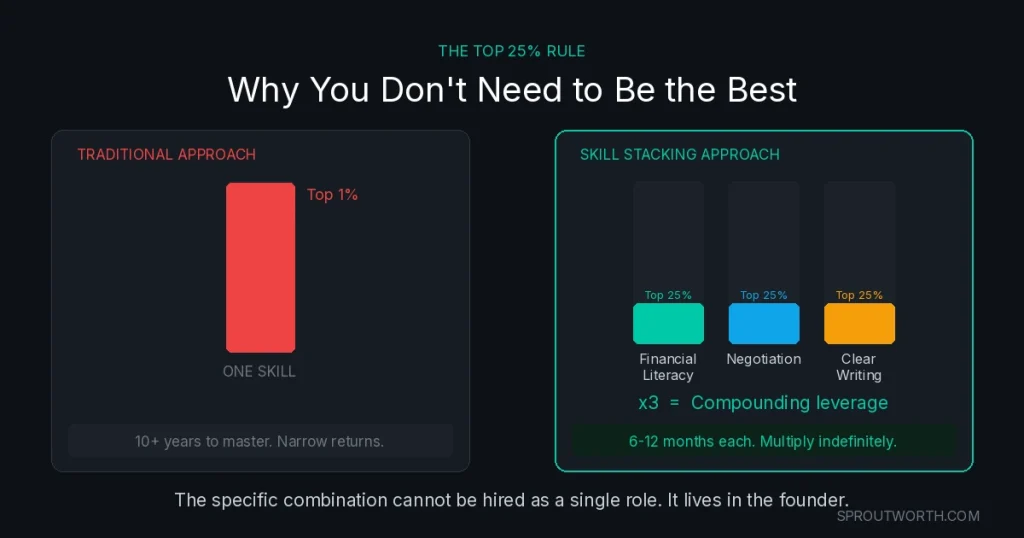
The most useful framing for skill stacking for entrepreneurs comes from a simple rule: aim to be in the top 25% of three to four complementary skills rather than the top 1% of one.
Top 1% mastery in any domain takes years, often a decade. The returns on that investment are real but narrow. Top 25% competence in a skill can often be reached in six to twelve months of deliberate practice.
The leverage comes from the combination.
A founder who is in the top 25% for:
- Financial literacy (reading and using financial statements with confidence)
- Negotiation (principled, outcome-focused deal-making)
- Written communication (clear, concise, persuasive)
- AI-assisted execution (knowing how to leverage tools as a force multiplier)
…is almost impossible to replicate. That specific combination does not exist in a job posting. It cannot be hired as a single role. It lives in the founder, and it compounds each year as they further develop it.
According to McKinsey, companies in the 75th percentile for productivity deliver 95% more revenue per employee than median performers (source). The differentiator is rarely a single capability. It is a combination of them, operated by people who know how to integrate them.
The Four Skills That Actually Compound for B2B Tech Founders
John is direct about which skills founders most often undervalue. He has observed thousands of students through MBA ASAP and sees the same blind spots across markets.
1. Financial Literacy
“Understanding the numbers side of business is something people tend to gloss over,” John said. “The sexy subjects are strategy, marketing, deal-making. Getting into bookkeeping and financial statements can seem dry. And then that gap limits how far they can go.”
He frames it as a four-part progression: bookkeeping, accounting, financial statements, and then corporate finance. The first three look backwards, a rear-view mirror of what happened. Corporate finance is the windshield, forecasting where you are going.
Nearly 42% of small business owners admitted they had limited or no financial literacy before starting their businesses, according to QuickBooks research (source). For funded B2B tech founders, the stakes are higher. Misreading your cash position or mispricing your product does not just hurt growth. It can trigger a downround.
When I help cleantech founders develop content around their financial strategy, the starting point is almost always the same: they can build a product and pitch investors, but they cannot read their own income statement with the fluency needed to defend their decisions in a board meeting. That gap is visible to every investor in the room. Understanding how financial acumen drives revenue growth is not optional at Series A and beyond.
2. Negotiation
“We don’t get what we want in life,” John said plainly. “We get what we negotiate.”
He frames negotiation not as a combative skill but as a collaborative one. The goal is not to win at the expense of the other side. It is to grow the pie, find complementary interests, and craft agreements that hold. Deals made under pressure or through coercion rarely get enforced with enthusiasm.
For B2B tech founders, negotiation applies everywhere: vendor contracts, investor terms, enterprise deals, hiring offers, and partnership structures. Each is an opportunity to leave significant value on the table if the skill is underdeveloped.
3. Sales and Clear Written Communication
Naval Ravikant’s line is worth repeating: if you can build and sell, you are unstoppable. John echoes this. Understanding how to communicate value, how to build trust before the pitch, and how to position a product for the right buyer are not the marketing department’s responsibilities. They are founder-level skills that directly impact revenue.
Writing is the companion skill that compounds fastest. It forces clarity. Most founders who struggle to communicate in investor decks, LinkedIn posts, email outreach, or sales conversations are not bad writers. They are unclear thinkers who have not yet done the work of putting ideas on paper repeatedly until they sharpen. Writing is where clarity gets built and then scaled.
A Series B company I recently worked with had a strong product but a weak narrative. Their founder could explain the technology precisely but struggled to articulate the business outcome their buyers actually cared about. The fix was not a new product. It was applying clearer B2B buyer psychology to their messaging and then building a content strategy that established that message in the market before the sales conversation started.
4. AI Literacy
This was not in the original MBA ASAP curriculum. It is now foundational. John is building an AI-assisted business video game using Claude and ChatGPT, in a coding language he does not formally know. He describes using AI as having co-founders who are always available, always energetic, and never argumentative.
The skill is not technical. It is prompting discipline, workflow integration, and judgment in knowing when AI output is good enough and when it needs human refinement. That judgment is learnable in months, not years.
Beyond T-Shaped: What Modern Founders Actually Need
For years, the dominant model for professional development was T-shaped: deep expertise in one area, broad awareness of adjacent domains.
It was a good model for employees in large organizations. It is increasingly insufficient for B2B tech founders operating in high-velocity, resource-constrained environments.
The reason: T-shaped development still centers on one primary skill. Every other skill is secondary, supporting the core. For a founder who needs to raise a Series B round while closing enterprise deals, managing a growing team, and building board trust, the T-shape creates a hierarchy that does not align with the role’s reality.
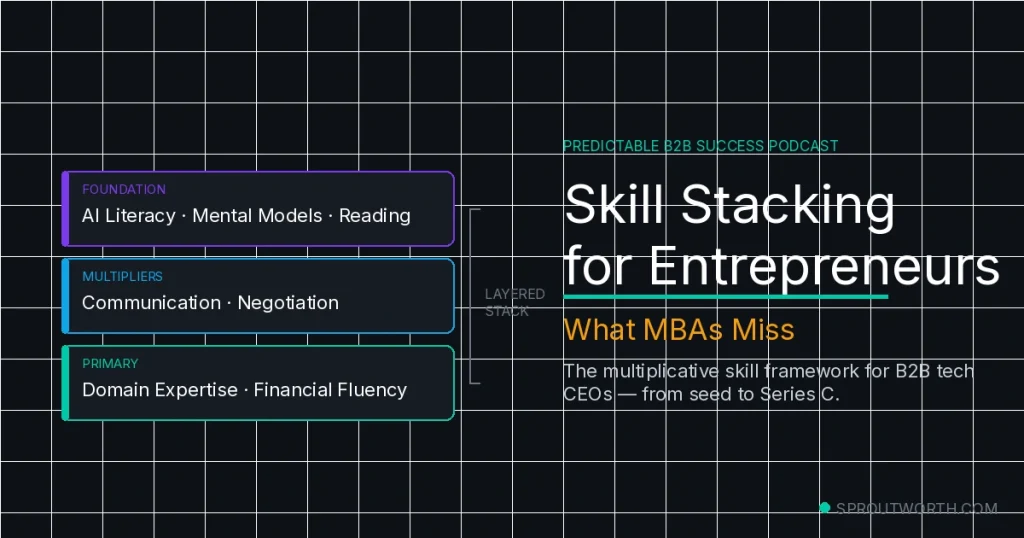
What founders actually need is what might be called a layered stack: two to three primary skills of roughly equal weight that interact with each other, supported by a set of foundation skills that enable them.
For a B2B tech CEO, that might look like this:
| Layer | Skills |
|---|---|
| Primary | Domain expertise + financial fluency |
| Multipliers | Clear communication + negotiation |
| Foundation | AI literacy + mental models + reading habit |
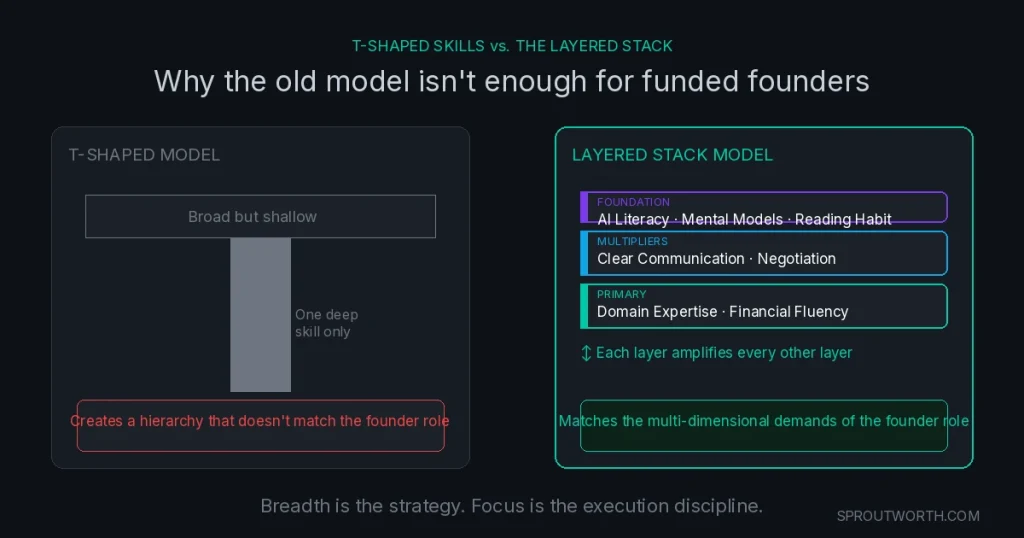
The T-shaped model says: be excellent at one thing, decent at the rest. The layered stack model says: be genuinely capable at the three to four things that interact in your specific role, and build the foundation skills that make each one more effective.
The Skill Audit: How to Identify Your Bottleneck Skill First
The mistake most founders make when thinking about skill development is trying to build every skill at once. The result is shallow competence across too many domains, and no meaningful compounding.
The smarter move is to identify your bottleneck skill first. Your bottleneck skill is the single capability gap that is most limiting your current revenue growth or operational effectiveness.
Here is a practical audit process:
Step 1: List your current stack. Write down every skill you use regularly in your business role. Include both technical and operational skills. Be honest about current level: beginner, competent, or strong.
Step 2: Map skills to revenue outcomes. For each skill, ask: where does this skill directly affect revenue generation, retention, or efficiency? Rank each skill by its current revenue impact.
Step 3: Identify the constraint. Where is the largest gap between your skill level and the level needed to drive your next stage of growth? That gap is your bottleneck skill.
Step 4: Validate through AI. John suggests using a tool like Claude or ChatGPT with targeted follow-up prompts to refine your analysis. “Most people query AI and accept the first output,” he notes. “The real insight comes from the third or fourth follow-up, when the conversation has been refined enough to surface something non-obvious.”
Step 5: Build before you hire. If the bottleneck skill is something you should understand at a strategic level, even if you eventually delegate the execution, build it first. Then hire.
In ghostwriting educational email courses for B2B tech founders, I see this most clearly in how founders explain their own products. The founders who have done the writing work, who have stacked written communication on top of their domain expertise, consistently build more engaged audiences and have cleaner sales conversations. The skill compounds into a distribution and closing advantage.
Skill Stacking by Stage: Seed to Series C
This is the section no competitor covers. What skills to prioritize for skill stacking for entrepreneurs changes meaningfully at each funding stage.
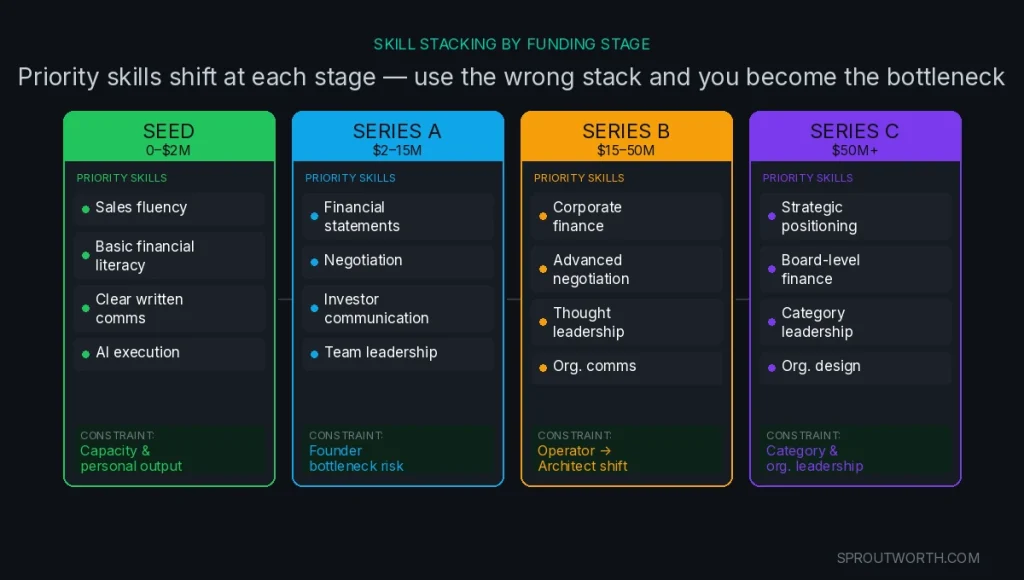
Seed Stage (0 to $2M Raised)
At seed, the founder IS the company. You will touch everything: product, sales, finance, hiring, and investor relations. The priority here is not depth in any one area. It is functional fluency across all of them, so you can make fast, defensible decisions and talk credibly to everyone who matters.
Priority skills: sales fluency, basic financial literacy, clear written communication, and AI-assisted execution.
The constraint at the seed stage is rarely a strategy. It is capacity. Skill stacking here is about multiplying your personal output, not optimizing a system.
Series A ($2M to $15M Raised)
At Series A, you have money and a small team. The failure mode shifts from “not enough activity” to “founder as bottleneck.” The skills that matter most are the ones that let you build systems, delegate effectively, and communicate your vision clearly to people who are not you.
Priority skills: financial statement fluency, negotiation (vendor and hiring), written communication (for internal alignment and investor updates), and early-stage team leadership.
This is also the stage where investor communication becomes a distinct skill stack layer. You are now reporting to a board. You need to present financial performance, strategic decisions, and risk assessments in a way that builds confidence rather than concern. This skill is almost never taught in MBA programs and is consistently underestimated by first-time founders.
Series B ($15M to $50M Raised)
At Series B, you are building a machine. The founder role transitions from operator to architect. The skills that compound here are the ones that help you build and communicate strategic direction, manage a larger leadership team, and position the company credibly in the market.
Priority skills: corporate finance (budgeting, forecasting, understanding unit economics), advanced negotiation (enterprise deals, partnership structures), thought leadership and market positioning, organizational communication.
A pattern I notice across Series B companies I work with on content strategy: the founders who are hardest to compete against are the ones who have deliberately built writing and communication into their skill stack. Their LinkedIn content generates a qualified pipeline. Their investor updates build board confidence. Their sales conversations are already half-won before the demo, because the market has been educated. That is what compound skill stacking looks like in practice.
Series C ($50M+)
At Series C, the founder has typically transitioned to a full CEO role. The skills that matter most are the ones that help you build category leadership, manage a complex organization, and attract top talent. The bottleneck is almost never the product. It is usually organizational clarity and external authority.
Priority skills: strategic positioning, board-level financial fluency, executive communication, organizational design, market thought leadership.
The Learn It vs. Hire It Decision Framework
This is the practical question every funded founder faces: when do you build a skill yourself, and when do you hire someone to own it?
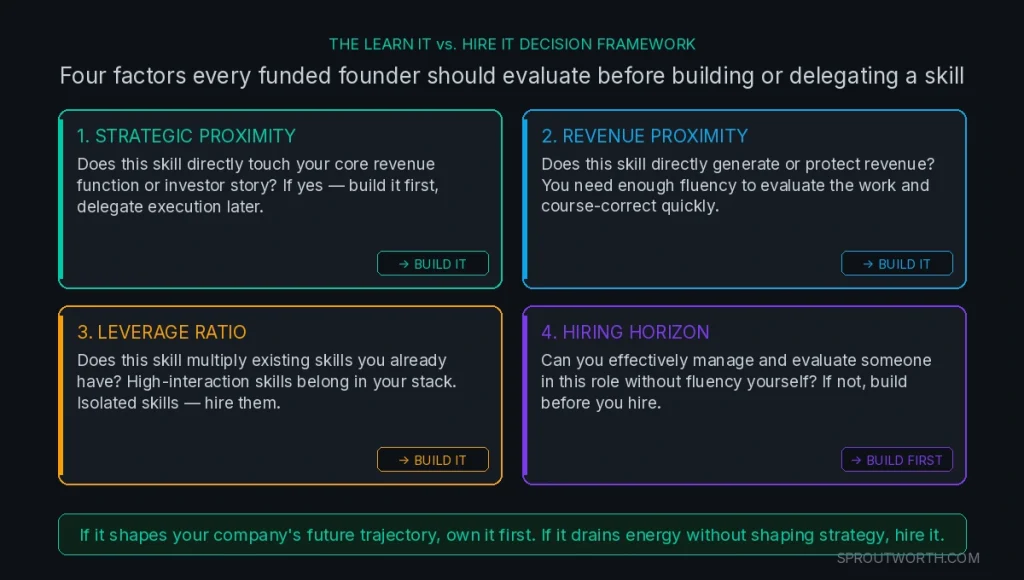
The answer depends on four factors:
1. Strategic Proximity
If the skill is directly adjacent to your core domain, you should understand it even if you eventually delegate execution. A CEO who does not understand their own unit economics cannot defend a growth strategy in a board meeting. A CEO who does not understand how marketing attribution works cannot evaluate a CMO’s performance.
2. Revenue Proximity
If the skill directly impacts your ability to generate or retain revenue, build at least functional competence before hiring. You need enough fluency to evaluate the work and course-correct quickly.
3. Leverage Ratio
If the skill multiplies the effects of other skills you already have, build it. If it stands on its own, with no interaction with your existing stack, hire it.
4. Hiring Horizon
Marc Andreessen has noted that nearly every founder prices their product too low. The same is true of skill investment. Founders who hire too quickly before building fluency in adjacent skills are often unable to manage or evaluate the people they hire.
Fred Wilson of Union Square Ventures summarizes the evolution well: at scale, a CEO should focus on three things: setting vision and strategy, recruiting and retaining great people, and keeping the company funded. Everything else gets delegated. But at the seed stage, a founder who delegates before they understand what they are delegating is building a dependency, not a team.
The practical rule: if it shapes your company’s future trajectory, own it at a strategic level first. If it drains energy without shaping strategy, hire it as soon as you can afford to.
Mental Models: The Connective Tissue of Your Stack
Skills without a framework for applying them are just a list.
This is where Charlie Munger’s concept of a “lattice work of mental models” becomes practically relevant for skill stacking for entrepreneurs. John has written an entire book on the subject. The idea is simple: different situations call for different frameworks. Having a diverse toolkit means you can match the right model to the right problem faster and with more confidence.
For revenue challenges specifically, John points to the Pareto principle as a starting point. Identify the 20% of actions that will produce 80% of the results you are seeking. For founders dealing with growth plateaus, the instinct is often to add more: more channels, more features, more headcount. The Pareto principle cuts through that noise.
For decision-making under uncertainty, John draws on Bayesian thinking: updating your probability estimates when new information arrives, rather than defending a prior position. This is the antidote to what he calls “resulting,” judging a decision by its outcome rather than by the quality of the reasoning at the time it was made.
For prioritizing skill development itself, the bottleneck principle applies directly: the weakest link in your skill stack limits the performance of the entire stack, regardless of how strong the other links are. Fix the constraint, not the strength.
These are not abstract concepts. They are operational tools for the kind of decisions funded founders face weekly.
AI Literacy Is Now Non-Negotiable
John is building a video game using AI tools in a coding language he has never formally learned. He describes the experience as remarkable and says it would not have been possible six months prior to our conversation.
“There’s this whole new realm called vibe coding,” he noted. “People code computers by the vibe. They don’t know all the languages. And it’s remarkable how interactive the tools have gotten.”
The threat he sees for incumbents is structural. Companies built around large teams performing tasks that AI can now automate are exposed. Not in a decade. Now.
For B2B tech founders, AI literacy is not a technical skill in isolation. It is a force multiplier for every other skill in your stack. According to research, 80% of organizations using machine learning report it has helped increase business revenue (source). The founders who integrate AI fluency into their skill stack are not just more efficient. They are building a compounding advantage that widens every quarter.
A founder with strong financial literacy and basic AI prompting skills can now do the modeling and analysis that once required a team. A founder with writing skills and AI tooling can produce strategic content at a volume that would have been cost-prohibitive two years ago. The skill compounds the stack.
Common Skill Stacking Mistakes Founders Make
Most skill stacking failures are not failures of ambition. They are failures of sequencing.
Mistake 1: Stacking Without Auditing
Building new skills without first identifying your bottleneck skill means adding capacity where you do not have a constraint. The throughput of your stack is determined by its weakest link, not its strongest.
Mistake 2: Stacking Skills That Do Not Interact
Skills compound when they are complementary. A deep technical skill and a deep legal skill can both be valuable, but they interact weakly for most founders. Financial literacy and negotiation, by contrast, interact constantly. Choose skills that create cross-functional leverage.
Mistake 3: Over-Indexing on “Sexy” Skills Early
John notes this directly: strategy, marketing, and deal-making get more attention than finance, communication, and negotiation. But the unsexy skills have higher compound returns over time. The founder who can read a P&L, negotiate a vendor contract, and write a clear investor update has more durable leverage than the founder who can pitch to a room but cannot defend the numbers behind the pitch.
Mistake 4: Delegating Before Reaching Fluency
Hiring a CFO before you understand your own unit economics means you cannot evaluate their work. Outsourcing content strategy before you understand your own positioning means you cannot give useful direction. Build functional fluency in high-proximity skills before delegating their execution.
Mistake 5: Treating Skill Stacking as a One-Time Exercise
Skill stacking is not a snapshot. It is an ongoing practice that should evolve with your stage, your role, and your market. The stack that serves a seed-stage founder is different from the stack that serves a Series C CEO. Revisit your audit annually.
Skill Stacking and Thought Leadership Are the Same Game
Here is the insight that does not make it into most MBA curricula, and that no competitor in the top 10 for this keyword addresses directly.
The skills that make you a better operator, financial fluency, clear writing, sales precision, negotiating discipline, are the same skills that make you a credible thought leader in your market. They are not separate tracks.
When I develop LinkedIn content strategies for Series A and B tech executives, the founders who build the fastest, most qualified following are not the ones with the biggest budgets or the most posts. They are the ones who have a genuinely distinctive skill stack and can communicate it clearly. Their content is specific. It reflects real operational experience. It says things a non-practitioner cannot say because they have not done the work.
A Series B cleantech founder I work with had deep expertise in environmental compliance but struggled to position it in a way that resonated with enterprise buyers. The fix was not more marketing spend. It was building a cleaner price positioning strategy grounded in the financial outcomes their buyers actually cared about, and then expressing that through consistent, strategic content. The skill stack and the content strategy became the same asset.
John’s observation about reading is worth closing on here. Reading widely is what gives you more to say. Founders who read across domains, not just their own industry, develop better frameworks, better analogies, and better questions. That is what makes content worth sharing and what makes a founder worth listening to.
The companies building real market authority are not producing more content. They are producing clearer, more specific content anchored in a skill stack that competitors cannot easily replicate. Whether you build these capabilities internally or work with specialists in executive content and digital PR, the foundation is the same: a skill stack distinctive enough to generate insights that others cannot produce. Learn more about how Sproutworth helps funded B2B tech founders build that kind of authority.
FAQ: Skill Stacking for Entrepreneurs
What is skill stacking for entrepreneurs? Skill stacking for entrepreneurs is the deliberate practice of combining three to five complementary skills to multiply their value. Rather than achieving top-1 % mastery in a single domain, the goal is to reach the top 25% across several skills that interact to create a unique capability profile. The combination produces leverage and market distinctiveness that no single mastered skill can generate on its own.
What is the “top 25% rule” in skill stacking? The top 25% rule holds that reaching the top quarter of competence in three to four complementary skills creates more career and business leverage than reaching the top 1% of a single skill. Top 1% mastery often takes a decade of focused effort. Top 25% competence in a complementary skill can typically be reached in six to twelve months. The compounding effect comes from the interaction among skills, not from the depth of any individual skill.
Which skills should B2B tech founders prioritize when skill stacking? Based on patterns across hundreds of conversations with founders and executives, the highest-leverage skills for B2B tech founders are: financial literacy (including reading financial statements and understanding unit economics), negotiation, clear written communication, and AI literacy. These four skills apply across every stage of company growth and interact with each other in ways that compound directly into revenue outcomes.
How does skill stacking change from seed stage to Series C? Skill priorities shift meaningfully at each stage. At seed, the priority is functional fluency across sales, finance, and communication because the founder IS the company. At Series A, the priority shifts to financial statement confidence, delegation, and investor communication. At Series B, corporate finance, strategic positioning, and thought leadership become critical. At Series C, organizational communication and category leadership take precedence. The mistake is applying a seed-stage skill stack at Series B.
When should a founder learn a skill versus hire someone to own it? The decision depends on four factors: how close the skill is to your core revenue-generating function, how much it multiplies your existing skills, how much strategic oversight the role requires, and how quickly you can reach functional fluency. As a general rule: if the skill directly shapes your company’s future trajectory, build functional competence before hiring. If it requires deep technical execution with minimal strategic overlay, hire it as soon as resources allow.
How is skill stacking different from T-shaped skill development? T-shaped development builds deep expertise in one area and broad awareness across others. Skill stacking for entrepreneurs goes further: it deliberately cultivates two to four skills of comparable depth that interact directly. For a B2B tech founder managing investor relations, enterprise sales, team growth, and market positioning simultaneously, a single deep skill with broad shallow awareness is structurally insufficient. The layered stack model is better suited to the multi-dimensional demands of the role.
Glossary: Key Skill Stacking Terms
Skill stacking — The practice of combining three to five complementary skills so that each amplifies the others, creating a unique capability profile worth more than the sum of its parts.
Bottleneck skill — The single capability gap in a founder’s stack that most constrains revenue growth or operational effectiveness. Identifying and resolving the bottleneck produces more leverage than adding new skills to existing strengths.
Complementary skills — Skills that interact directly and reinforce each other in practice. Financial literacy and negotiation are complementary. Financial literacy and graphic design typically are not.
T-shaped skills — A professional development model that builds deep expertise in one domain with broad but shallow awareness across others. Increasingly insufficient for funded founders who must operate across multiple high-stakes functions simultaneously.
Skill audit — A structured self-assessment that maps current skill levels to revenue outcomes, identifies the bottleneck skill, and sequences skill development priorities for the next growth stage.
Layered stack — An alternative to T-shaped development in which two to three primary skills of roughly equal weight interact with each other, supported by a set of foundation skills that enable all of them.
Related Resources
- How to Master Financial Acumen to Drive Revenue Growth
- Entrepreneurial Skills and Characteristics for Business Growth
- B2B Buyer Psychology: What Fortune 100 Companies Know
- How to Use Price Positioning Strategy to Grow Your Business
- B2B Growth Marketing: Building High-Performing Tech Brands
Related Links
- John Cousins: LinkedIn Profile
- MBA ASAP: mba-asap.com
- John’s Udemy courses: Udemy Profile
Some topics we explore in this episode include:
Listen to the episode.
Subscribe to & Review the Predictable B2B Success Podcast
Thanks for tuning into this week’s Predictable B2B Podcast episode! If the information from our interviews has helped your business journey, please visit Apple Podcasts, subscribe to the show, and leave us an honest review.
Your reviews and feedback will not only help me continue to deliver great, helpful content but also help me reach even more amazing founders and executives like you!
