
Most B2B founders treat thought leadership like a solo sport. They write articles, publish LinkedIn posts, and send newsletters to an audience that grows slowly and painfully.
The smartest ones treat it like a team game.
88% of marketers believe in B2B partner marketing. Only 56% say their programs produced measurable results last year. (Foundry/IDG Partner Marketing Report) The gap between believing in it and executing it well is where most programs fail.
Ashley McManus closed that gap at Affectiva. As Senior Director of Global Marketing at Smart Eye, she helped build a partner marketing engine that became a core driver of brand authority in the emotion AI space. Affectiva was acquired by Smart Eye in 2021 for $76.5 million. Partner marketing was not a footnote in that story. It was a chapter.
This post breaks down the framework she used, the principles behind it, and what it takes to go from idea to a program that actually compounds.
About Ashley McManus
Ashley McManus is the Senior Director of Global Marketing at Smart Eye, the global leader in eye-tracking software solutions. With over a decade of B2B tech marketing experience, she was part of the Affectiva branding team that led the company through its successful exit. She hosts her own podcast and has spoken at multiple events and industry conferences. Ashley guest lectures in the entrepreneurship marketing program at Tufts University, the same program where she first discovered her passion for marketing.
Watch The Episode
Key Takeaways
- B2B partner marketing is a collaborative strategy where complementary companies co-create and co-promote content to share audiences and build credibility jointly.
- It is distinct from channel marketing, which focuses on distribution and reselling rather than co-creating demand.
- The six most effective types include content partnerships, co-branded events, technology integrations, referral programs, affiliate partnerships, and joint PR.
- Start your partner search with existing clients, vendors, and internal experts before looking outward.
- A structured prep call and packaged promotional assets separate active programs from partnerships that stall after the first meeting.
- Category creation is the highest-leverage long-term outcome of a consistent B2B partner marketing strategy.
What Is B2B Partner Marketing?
B2B partner marketing is a collaborative strategy where complementary companies co-create content and co-promote it to each other’s audiences to expand reach and build shared credibility.
That definition draws a hard line around what B2B partner marketing is not. It is not a referral commission arrangement. It is not affiliate marketing. It is not a reseller program.
“It’s a little less transactional,” Ashley McManus explains. “We’re coming together, we’re collaborating, and we’re just getting the word out about both of our cool businesses.”
The currency is credibility, not commission. Both parties bring expertise. Both parties promote. Both parties grow.
According to the Edelman 2024 B2B Thought Leadership Impact Report, 55% of decision-makers use thought leadership to vet organizations they are considering working with. (Edelman, 2024) That number climbs when the thought leadership is produced in collaboration with a partner your buyers already trust. You are not just borrowing an audience. You are borrowing trust.
In my work developing content strategies for B2B tech CEOs, this is the gap I see most consistently. Founders understand they need thought leadership. They do not always understand that they do not have to build it alone.
Partner Marketing vs. Channel Marketing: The Difference That Matters
Partner marketing focuses on co-creating demand. Channel marketing focuses on distributing and selling through intermediaries. Both are legitimate strategies. Conflating them leads to building the wrong program at the wrong stage.
| Partner Marketing | Channel Marketing | |
|---|---|---|
| Primary goal | Co-create demand and build shared authority | Distribute and sell through intermediaries |
| Typical activities | Co-authored content, joint events, podcasts, webinars | Reseller programs, distributor enablement, co-selling |
| Revenue model | Earned through shared audience growth and trust | Commission-based, revenue share, or margin |
| Funnel stage | Top and mid-funnel: awareness, authority, pipeline | Mid and bottom-funnel: qualified leads, closed deals |
| Relationship type | Peer collaboration between equals | Vendor-to-partner hierarchy |
| Best for | Funded B2B tech startups building category authority | Established products with proven PMF needing distribution scale |

For seed-to-Series C founders, partner marketing is the more relevant starting point. Channel marketing becomes relevant once you have a repeatable sales motion and want to scale it through indirect channels.
The 6 Types of B2B Partner Marketing
The six most common types of B2B partner marketing are content partnerships, co-branded events, technology integrations, referral partnerships, affiliate partnerships, and joint PR. The right type depends on your stage, your partner’s strengths, and the audience you are trying to reach.
1. Content partnerships
Two companies co-author a piece of content, each contributing expertise and promoting to their own audience. HubSpot and LinkedIn have run this model at scale, co-producing joint marketing webinars distributed to both companies’ audiences. (HubSpot co-marketing guide)
2. Co-branded events and summits
Joint events where both brands contribute speakers, marketing, and promotion. Affectiva’s Emotion AI Summit is the clearest B2B example: one annual event with 50 speakers generated six to seven months of derivative content and positioned Affectiva as the definitive category leader.
3. Technology integrations
Two software companies integrate their products and co-market the combined value to each other’s user bases. Microsoft and Adobe’s integration of Dynamics 365 with Adobe Marketing Cloud, and Synthesis AI’s collaboration with Affectiva, both demonstrate this model.
4. Referral partnerships
A partner recommends your product or service to their network, typically in exchange for a reciprocal recommendation. This is lighter-weight than a formal program and works well as a low-commitment entry point into co-marketing.
5. Affiliate partnerships
A more structured version of referral marketing with tracked links and agreed-upon incentives. Relevant for companies with established products and measurable conversion events.
6. Joint PR and co-authored bylines
Two company leaders co-author an opinion piece for a trade publication or issue a joint press release on a shared initiative. This is an underused entry point for founders who are not yet ready to run a joint event.
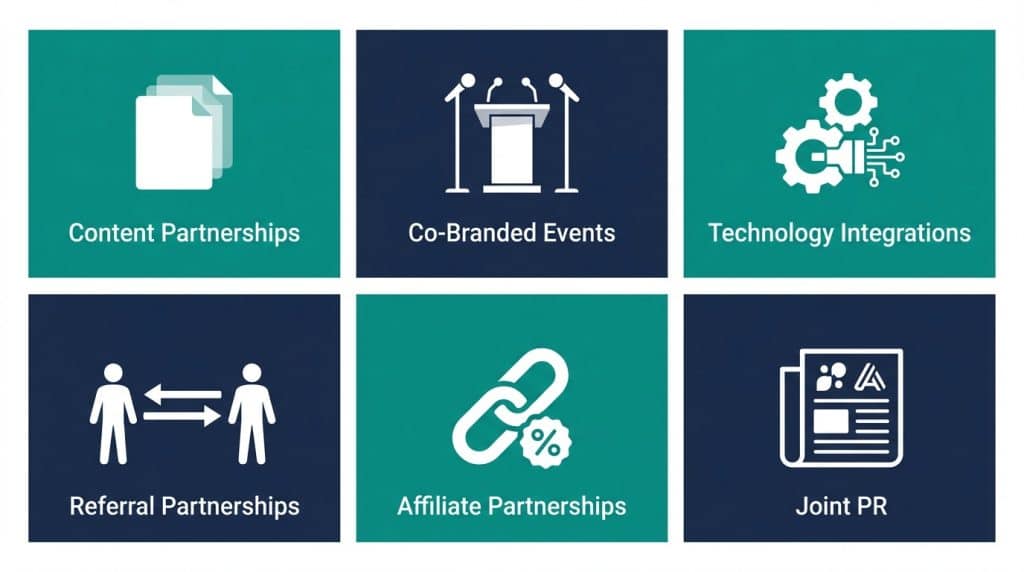
For most funded B2B tech founders, content partnerships and co-branded events are the highest-leverage starting points. They cost the least to initiate and compound the fastest.
The Real Reason B2B Partner Marketing Doubles Your Reach
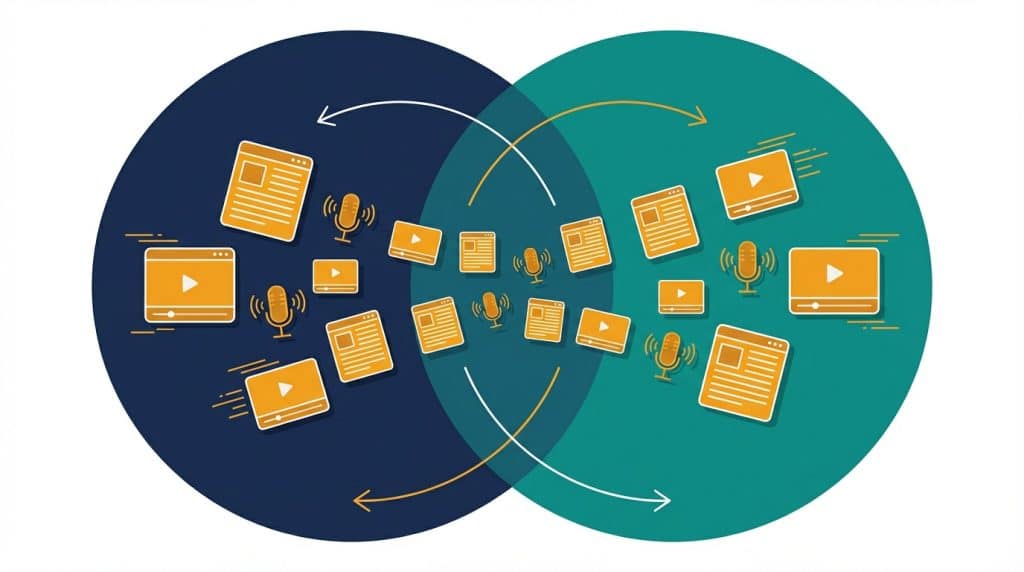
Partner marketing doubles reach by having both companies simultaneously promote co-created content to their separate audiences. Every partner you activate multiplies your distribution without multiplying your budget.
When you produce content on your own, you promote it to your own audience. That audience is finite. Your LinkedIn followers, your email list, your podcast subscribers. Every piece of content is bound by the same ceiling.
When you co-create content with a partner, the calculus changes. You promote to your audience. They promote to theirs. You are both telling your networks how great the other party is. The overlap is small in most cases. The incremental reach is large.
“You’ve all of a sudden doubled your reach,” Ashley says. “You have access to their networks. They have access to mine. We’re both promoting and talking about how great the other one is.”
This is not a theoretical gain. Ashley’s team at Affectiva ran an annual Emotion AI Summit with up to 50 speakers. A single one-day event generated six to seven months of repurposable content. Every speaker promoted their participation to their own network.
B2B buyers consume an average of 13 pieces of content before contacting a sales representative. (FocusVision, via SellersCommerce)
Most of that research happens before they ever engage with your brand directly. Partner-created content ensures your positioning is present during that invisible buying phase, not just at the moment of outreach.
Research from the Content Marketing Institute confirms the underlying logic: B2B brands that co-create content with industry partners report significantly higher content distribution efficiency than those publishing solo. (Content Marketing Institute, 2024)
How Do You Find the Right B2B Partners?
Start with an Ideal Partner Profile before approaching anyone. Score every prospective partner across five criteria: audience overlap, complementarity, brand alignment, activation ability, and mutual benefit. Then work through your existing network before searching outward.
Your Ideal Partner Profile (IPP) is the partner equivalent of your Ideal Customer Profile. It defines the structural criteria that make a collaboration genuinely valuable, rather than just appealing on a slide deck.
Audience overlap. Does your prospective partner serve the same buyers you serve? Without audience overlap, co-promotion generates noise, not reach.
Complementary, not competing. The partner’s product or service should add value to your buyer without competing for the same dollar. Affectiva and Synthesis AI were a natural fit: one company’s AI output was the other’s training data input.
Shared values and brand positioning. If your brand is known for original research and precise claims, partnering with a company that publishes hyperbolic marketing content undermines your credibility.
Activation ability. A partner with 50,000 LinkedIn followers who never posts is worth less than a partner with 5,000 followers who consistently promotes.
Mutual benefit clarity. Both parties should be able to answer: “What do we each get from this?” before a single piece of content is produced.
| Criterion | 1 — Poor fit | 3 — Moderate fit | 5 — Strong fit |
|---|---|---|---|
| Audience overlap | Different buyers entirely | Adjacent buyers | Same ICP, different solution |
| Product complementarity | Competing products | Loosely related | Direct workflow integration |
| Brand alignment | Conflicting positioning | Neutral | Shared values and voice |
| Activation ability | Rarely posts; no owned list | Moderate social activity | Consistent posting; active email list |
| Mutual benefit clarity | Unclear what partner gains | Some shared benefit | Both parties gain specific, named value |
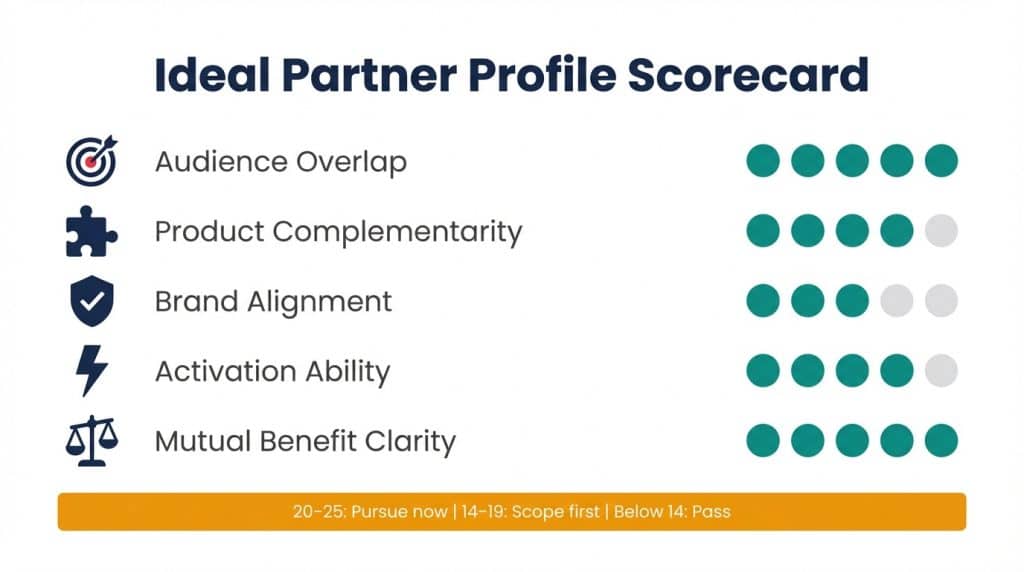
Scoring: A partner who scores 20–25 is worth pursuing immediately. A score of 14–19 warrants a scoping conversation. Below 14, pass.
- Clients with documented success stories and active LinkedIn presences
- Vendors whose technology complements yours and whose buyers overlap
- Internal experts whose subject matter knowledge needs a bigger platform
- Adjacent thought leaders who are not direct competitors
In my work on B2B growth marketing strategies with funded startups, the best partnership candidates are nearly always in the existing network. They are in your CRM, on your vendor invoices, and inside your building. The IPP makes them easy to identify.
The Prep Call Framework: From Idea to Live Collaboration
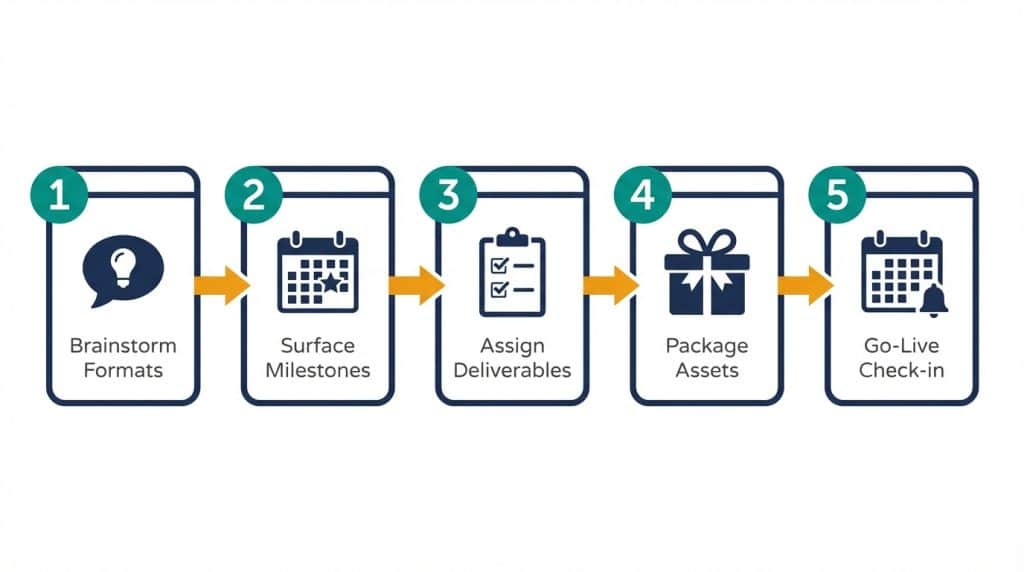
A prep call converts partnership enthusiasm into a written action plan with named owners and deadlines. Without one, most partnership ideas stall in the gap between the first enthusiastic conversation and the first piece of content.
Ashley’s solution is the prep call: a structured conversation that turns a partnership idea into a clear action plan before anyone starts creating.
Step 1: Brainstorm format options together.
Present the full menu of partnership possibilities: PR coverage, co-authored blog posts, podcast appearances, live streams, webinars, speaking opportunities, or joint events. Getting the partner’s genuine reaction to each format early reveals what they are actually willing to invest in, versus what sounds good in theory.
Step 2: Ask about upcoming milestones.
“Do you have any upcoming announcements, product releases, or events?” Connecting a collaboration to something the partner already plans to promote increases their motivation to activate their network. A joint blog post that lands the same week as a partner’s product launch travels much further.
Step 3: Agree on deliverables and divide responsibilities.
Both parties leave the prep call with specific, named tasks, clear deadlines, and mutual accountability. Without this, follow-up becomes a game of vague check-ins rather than concrete deliverable tracking.
Step 4: Package the promotional assets in advance.
Before the content goes live, prepare a partner kit: sample social posts with pre-written copy, social handles, hashtags, and branded graphics. The easier it is for a partner to promote, the more likely they are to do so. Every additional step between “this is ready” and “I’ve shared it” is a drop-off point.
Step 5: Set a specific go-live check-in.
Schedule a brief follow-up call or message thread for the day the content publishes. This keeps the promotion window open and creates a natural moment to coordinate amplification timing across both audiences.
“It keeps the line of communication open,” Ashley notes. “Once you have an action plan in place, you have something to go back to and touch base with.”
When I help founders develop customer-driven marketing strategies, the prep call principle applies equally, whether collaborating with a partner brand or producing a case study with a client. Structure prevents momentum from dying.
Partner Enablement: Making It Easy for Partners to Promote You
Partner enablement, making it easy for partners to promote you, is the most overlooked driver of program performance.
One reason the 88%/56% execution gap exists is partner enablement, or the absence of it. Giving partners everything they need to promote the content as soon as it’s ready is what separates active programs from partnerships that fade after the first meeting.
- A one-page partner brief covering the collaboration’s key messages, target audience, and talking points.
- Pre-written promotional copy in multiple formats: LinkedIn posts, email copy, and short quote blocks for social. The partner should be able to promote with zero writing effort if they choose.
- Clear timelines and windows. A specific promotional window (72 hours or one week) focuses on activation rather than letting it diffuse.
- A feedback loop. After the collaboration, share what worked. If the partner’s audience drove 40% of the content’s traffic, tell them. Data builds a stronger case for future collaboration than goodwill alone.
A pattern I notice when ghostwriting LinkedIn content for B2B tech executives is how directly applicable it is. A Series B SaaS founder I work with runs a quarterly co-author series with three complementary vendors. Each partner receives a content brief, two ready-to-post LinkedIn variations, and a suggested posting window before any content goes live. Partner activation rate: over 80%.
Quick-Start Checklist: Your First B2B Partner Marketing Prep Call
Before the call:
- Identify three prospective partners from your client, vendor, or internal network
- Score each against the IPP scorecard (target 20+)
- Research each partner’s recent content and upcoming announcements
- Prepare five or six collaboration format options to discuss
During the call:
- Present format options and note genuine enthusiasm vs. polite interest
- Ask about upcoming milestones to anchor the collaboration timing
- Agree on specific deliverables with named owners and deadlines
- Set a go-live date and a promotional window
After the call:
- Package promotional assets: social copy, graphics, hashtags
- Send a written summary of agreed deliverables to the partner
- Add the partner to your CRM with follow-up dates
- Add the go-live check-in to both calendars
How B2B Partner Marketing Builds Category Authority
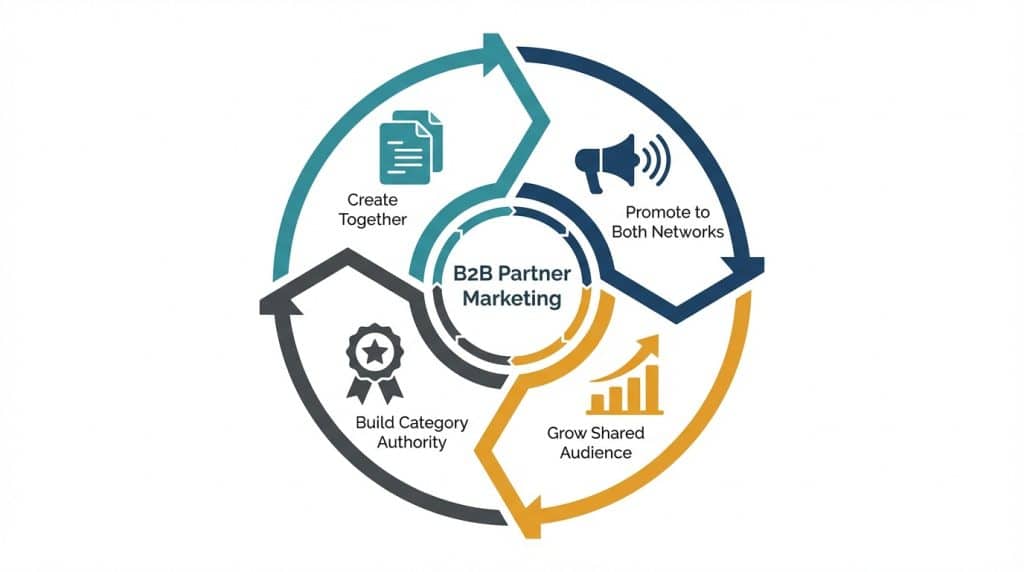
Partner marketing builds category authority by convening communities around your positioning before competitors can establish theirs. Affectiva did not just market emotion AI — they created the category, largely through partnerships.
Affectiva coined the term “emotion AI.” They convened the community around it with the Emotion AI Summit. They curated podcast guests who would legitimize and expand the conversation. By the time other companies arrived in the space, Affectiva was already the definitive reference point.
“We put a stake in the ground and we were right,” Ashley says. “We were like, we’re going to be the first and definitive leaders in emotion AI, because we have this conference called the Emotion AI Summit.”
This is category creation through partnership. The summit brought speakers who endorsed the category by participating. It brought the press who covered the category because there was now an event worth covering. It brought academic voices who added scientific credibility. None of those outcomes happens when you publish alone.
Research by LinkedIn and Edelman found that thought leadership demonstrating category expertise is significantly more influential on purchase decisions than generic brand content. (LinkedIn Marketing Solutions, 2024) When your partners help build the category, every piece of content you produce together reinforces your authority as its originator.
For seed-to-Series C founders, this is a competitive moat. It builds incrementally, one partnership at a time. It cannot be replicated quickly.
How to Build Brand Voice Across a Team of Thought Leaders
Brand voice consistency is the challenge no one plans for. It surfaces once partners and employees start creating content under your brand simultaneously. One engineer posts technically dense copy. A salesperson writes in a different register. A partner writes something accurate but tonally off.
Ashley’s approach at Affectiva was to simplify first. Their website had been written by PhD researchers and was nearly incomprehensible to buyers. The first editorial task was stripping it down. Get to the point. Use accessible language.
“Go to these websites and they have just like three sentences of just all the buzzwords you could possibly imagine,” she observes. “And then you’re still like, but I don’t actually understand what you do.”
The second task was differentiation through visual identity. Affectiva rebranded from blue (the default color of nearly every B2B tech company) to pink. At a trade show six months later, a customer success team member summed up the effect: “Do you see any other companies that are pink?”
Distinctive brand assets, consistent message architecture, and a shared vocabulary are not cosmetic concerns. They are a recall infrastructure. According to research on how unconscious brand associations drive B2B buying decisions, buyers make instinctive vendor choices based on accumulated associations long before they consciously evaluate options.
- Define your messaging in plain language before distributing it
- Give employees talking points that are accessible, not just accurate
- Provide media training for anyone engaging with the press
- Package brand assets for partners (colors, copy, hashtags) so they represent you consistently
- Celebrate employees who develop their own thought leadership voice within your brand parameters
How to Measure B2B Partner Marketing ROI
Measure B2B partner marketing ROI across five dimensions: partner activation rate, incremental reach, content longevity, category citation, and pipeline influence. Attribution is harder than paid search, but the metrics are measurable.
Only 17% of the B2B buying process now involves direct interaction with a sales representative. (Marketing LTB, 2025)
Partner-created content primarily influences buyers during the 83% of the journey that happens before a sales conversation. Last-touch models miss this entirely.
Ashley tracks two categories of outcomes: content performance and relationship development.
Content performance is the measurement of the actual reach of co-created content. How many views did the live stream generate? What percentage of article shares came from the partner’s network? How many podcast downloads arrived the week the partner promoted the episode?
Relationship development means staying organized about who you know, what you have done together, and when to follow up. Ashley uses Airtable as a personal CRM for her partner network. She tracks conversation status, sets follow-up reminders, and notes each partner’s content preferences and upcoming milestones.
The editorial calendar is the connective tissue between both categories. A summit anchors one quarter. Partner podcasts run throughout the year. Joint bylines appear in target publications during key industry moments.
- Partner activation rate. What percentage of partners do you prep-call to produce and promote content? A score below 60% signals an enablement gap.
- Incremental reach. New audience members who arrived via a partner’s network, not your own.
- Content longevity. How many months did a single collaboration generate derivative content?
- Category citation. Are third parties referencing your co-created content as a source?
- Pipeline influence. How many inbound leads can be traced to partner-created content in the 30–90 days before contact?
Three Partner Marketing Mistakes That Kill Programs Early
Mistake 1: Activating before the brief is ready.
The partner agrees to co-promote, but there is no brief, no talking points, and no pre-written social copy. The fix: no activation without a partner kit in hand.
Mistake 2: Treating the prep call as the endpoint.
The prep call produces enthusiasm and a vague plan. No written summary is sent. No calendar invites go out. Momentum dies in the gap between the call and the next communication. The fix: send a written action plan within 24 hours of every prep call.
Mistake 3: Measuring the wrong things.
Tracking impressions and shares tells you nothing about pipeline impact. A co-authored post with 2,000 impressions that sourced three qualified conversations outperforms a live stream with 50,000 impressions that sourced none. The fix: track pipeline influence alongside reach, not instead of it.
FAQ: B2B Partner Marketing
What is B2B partner marketing?
B2B partner marketing is a collaborative strategy where complementary companies co-create content and co-promote it to each other’s audiences. The goal is to expand reach, build shared credibility, and generate warmer leads at lower cost than either company could achieve independently. It is built on earned trust, not commissions.
What is the difference between partner marketing and channel marketing?
Partner marketing co-creates demand through content, events, and thought leadership, on equal terms. Channel marketing distributes and sells through resellers, distributors, or agents. Partner marketing is a top-of-funnel authority play. Channel marketing is a mid-to-bottom-funnel distribution play. For early-stage B2B tech founders, partner marketing is typically the more relevant starting point.
What is the difference between partner marketing and affiliate marketing?
Affiliate marketing is performance-based: a partner earns a commission for driving a sale, lead, or click. B2B partner marketing is broader and strategic. It includes co-created thought leadership, joint events, and co-branded campaigns in which the value exchange is mutual access to and credibility with the audience, not a direct financial transaction.
How do I find the right B2B partners?
Build an Ideal Partner Profile first. Score prospective partners across five criteria: audience overlap, product complementarity, brand alignment, activation ability, and mutual benefit clarity. Start with existing clients, current vendors, and internal subject matter experts before searching externally.
How do I measure the ROI of B2B partner marketing?
Track five metrics: partner activation rate (what percentage of partners you prep-call produce and promote content), incremental reach from partner networks, content longevity (how many months a single collaboration generates derivative content), category citation by third parties, and pipeline influence (inbound conversations traced to partner content in the prior 30–90 days).
What types of content work best for B2B partner marketing?
Co-hosted summits generate the highest compounding effect because every speaker becomes a promoter, and a single event produces months of content. Co-authored blog posts and joint podcast episodes are the most accessible entry points. The format matters less than the mutual promotion that follows it.
What is the biggest mistake B2B founders make with partner marketing?
Activating before the brief is ready. The partner agrees to co-promote, but there is no brief, no talking points, and no pre-written social copy. Without a partner kit, activation becomes an afterthought. Partner enablement, making it easy for partners to promote you, is the most overlooked driver of program performance.
What are the benefits of B2B partner marketing?
The four core benefits are expanded reach (access to a partner’s existing audience), enhanced credibility (trust borrowed from a brand your buyers already know), reduced content production costs through shared effort, and reduced campaign risk through collaboration. For funded B2B startups building category authority, the credibility benefit is typically the most strategically valuable.
B2B partner marketing is not a shortcut. It is a compounding system. The first collaboration expands your reach. The second builds on the relationships the first created. After a year of consistent partnership activity, you are no longer just a content publisher. You are a company that convenes conversations, vouches for partners, and gets vouched for in return.
Ashley’s experience at Affectiva confirms this arc. The Emotion AI Summit started as an idea she pitched to her boss. It became the largest single content-generation initiative the company ever ran. It positioned Affectiva as the definitive category creator. And it built a network of speakers, press, and academic voices who continued amplifying the brand long after the event ended.
That kind of authority does not come from publishing volume. It comes from showing up as a connector, not just a broadcaster.
Whether you build your B2B partner marketing program in-house or work with specialists to develop the thought leadership content that makes partnerships worth having, the foundation is the same. Be useful to your partners. Make it easy for them to promote you. Measure relationships as carefully as you measure content. Learn more about content approaches built for funded B2B tech founders.
Related Resources
- How to Build a Thought Leadership Strategy That Compounds Growth — The foundational framework for B2B thought leadership, including how to align content with company goals.
- Maximizing the Impact of Your B2B Thought Leadership for Growth — A deep dive into measuring and scaling thought leadership at funded B2B companies.
- B2B Growth Marketing: Building High-Performing Tech Brands — How to build a B2B growth marketing system that connects brand narrative to revenue.
- B2B Buyer Psychology: The Strategy Behind $50B in Revenue — Why buyers make instinctive decisions and how consistent brand associations drive preference.
- How to Create a Thought Leadership Event That Drives Growth — The operational playbook for running events that generate months of content.
Related Links
- Ashley McManus on LinkedIn: Ashley Osgood McManus
- Smart Eye: smarteye.se
- Ashley McManus personal website: ashleymcmanis.com
Some topics we explore in this episode include:
Listen to the episode.
Subscribe to & Review the Predictable B2B Success Podcast
Thanks for tuning into this week’s Predictable B2B Podcast episode! If the information from our interviews has helped your business journey, please visit Apple Podcasts, subscribe to the show, and leave us an honest review.
