Branding Content That Actually Drives B2B Revenue

Branding content is content designed to shape how a market thinks about a problem before any vendor enters the conversation. It builds recognition, establishes category context, and creates preference for a specific company before a purchase decision begins. It is not the same as performance content, which captures existing demand, or branded content, which uses entertainment to build emotional affinity.

B2B buyers spend only 17% of their purchase journey meeting with vendors. The other 83% happens before they ever talk to sales (Gartner, 2024). That pre-engagement window is when branding content either earns a company a place in the consideration set or leaves it invisible.

Funded B2B tech CEOs will find in this guide a stage-by-stage breakdown of what branding content means, how it connects to the pipeline, and what to prioritize at each funding stage. No generic examples from consumer brands. What follows is specific to funded B2B SaaS at Seed through Series C. For the broader content strategy for funded startups, that guide covers the full picture.

What Is the Difference Between Branding Content, Branded Content, and Performance Content?

These three terms are not interchangeable, and confusing them leads to wrong investment decisions. Branding content shapes how a market thinks about a problem and positions a company as the category authority. Branded content uses entertainment or storytelling to build emotional affinity with a broad audience. Performance content captures existing demand through bottom-of-funnel search and conversion. Each serves a different job at a different stage of the buyer journey.

Branding content shapes perception. Performance content captures demand. Branded content builds affinity. Understanding the distinction determines which content your company produces, how you measure it, and when you invest in each.

Branding content frames how a market thinks about a problem. It positions a company as the authority within a specific category. A CEO’s point-of-view essay, a market perspective report, a thought leadership article. Its goal is market perception, not conversion.

Branded content is media or entertainment produced by a brand, frequently in partnership with a publisher, creator, or media company. Its goal is emotional affinity and broad awareness. Salesforce’s Salesblazer content hub, Paddle’s Paddle Studios video series, and Thoropass’s Scam Hunters documentary. It reaches audiences who would never seek out traditional marketing.

Performance content targets bottom-of-funnel queries with explicit purchase intent. “Best CRM for Series A startups.” “Content marketing agency pricing.” It is optimized for conversions and captures existing demand (HubSpot, 2025).

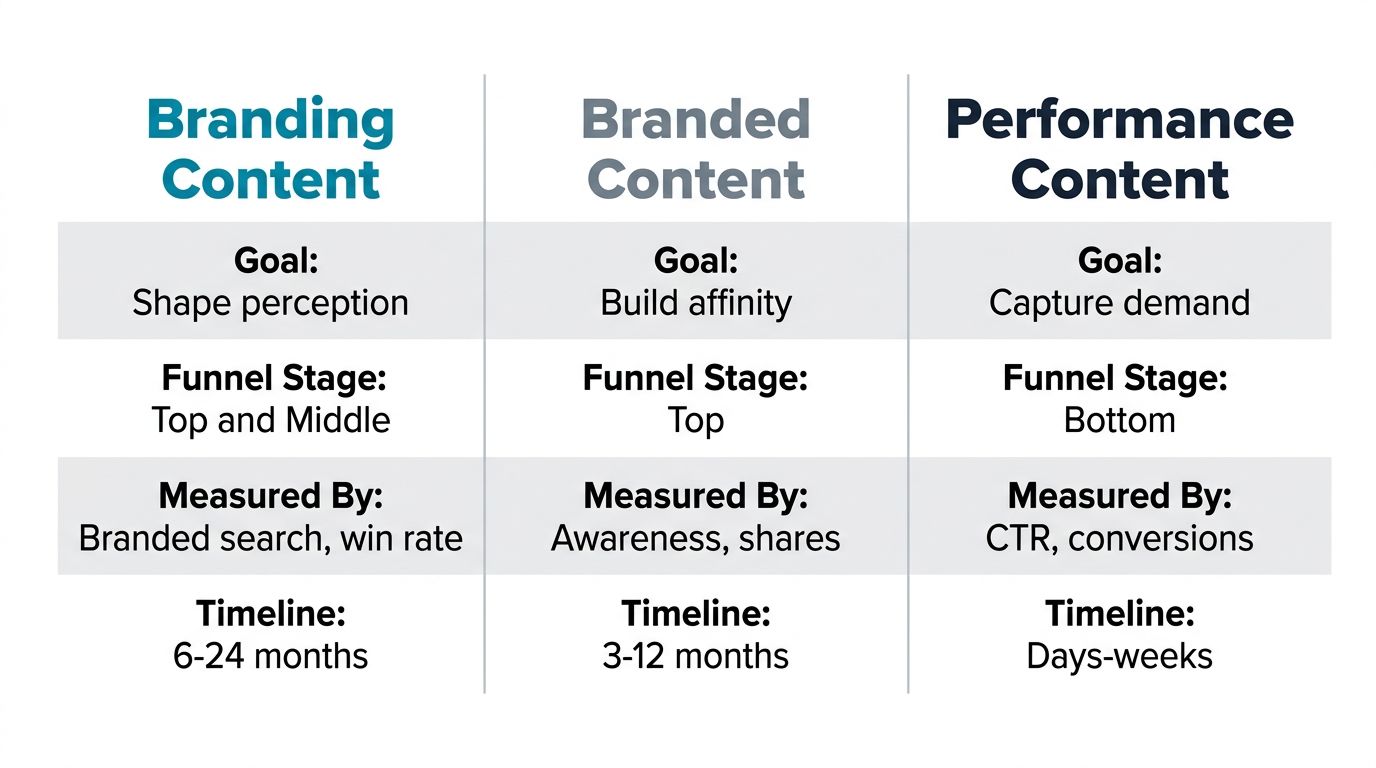
DimensionBranding ContentPerformance ContentBranded Content
GoalShape market perceptionCapture existing demandBuild emotional affinity
Funnel stageTop and middleBottomTop
Measured byBranded search, win rate, deal sizeCTR, conversions, CACAwareness, earned media, shares
B2B examplesGong’s Revenue Intelligence POV, HubSpot’s Inbound category essays“Best CRM for Series A” SEO articlePaddle Studios, Salesblazer, Scam Hunters
Conversion timeline6 to 24 monthsDays to weeks3 to 12 months
Three-column comparison of branding content, branded content, and performance content showing goals, funnel stages, measurement, and timelines for B2B SaaS

The mistake most B2B SaaS companies make is treating all content as performance content. They measure every post by CTR and form fills. Branding content does not convert on first touch. It converts by being the content a buyer has already consumed when they arrive at your performance content.

A prospect who has read three of your branding content pieces before clicking a search ad does not need to be convinced your company is credible. They already know.

One B2B SaaS client I worked with had a content team producing 12 posts per month, all optimized for bottom-of-funnel keywords. Their organic traffic was stable. Their demo conversion rate was flat at 2.1%. We added three branding content assets per quarter: a category POV essay, a founder narrative piece, and a market perspective report. Within six months, their demo conversion rate from organic sources rose to 3.8%, and their average deal size increased by 22%. The performance content had not changed. The branding content had preconditioned the buyer.

The Three Layers of B2B Branding Content

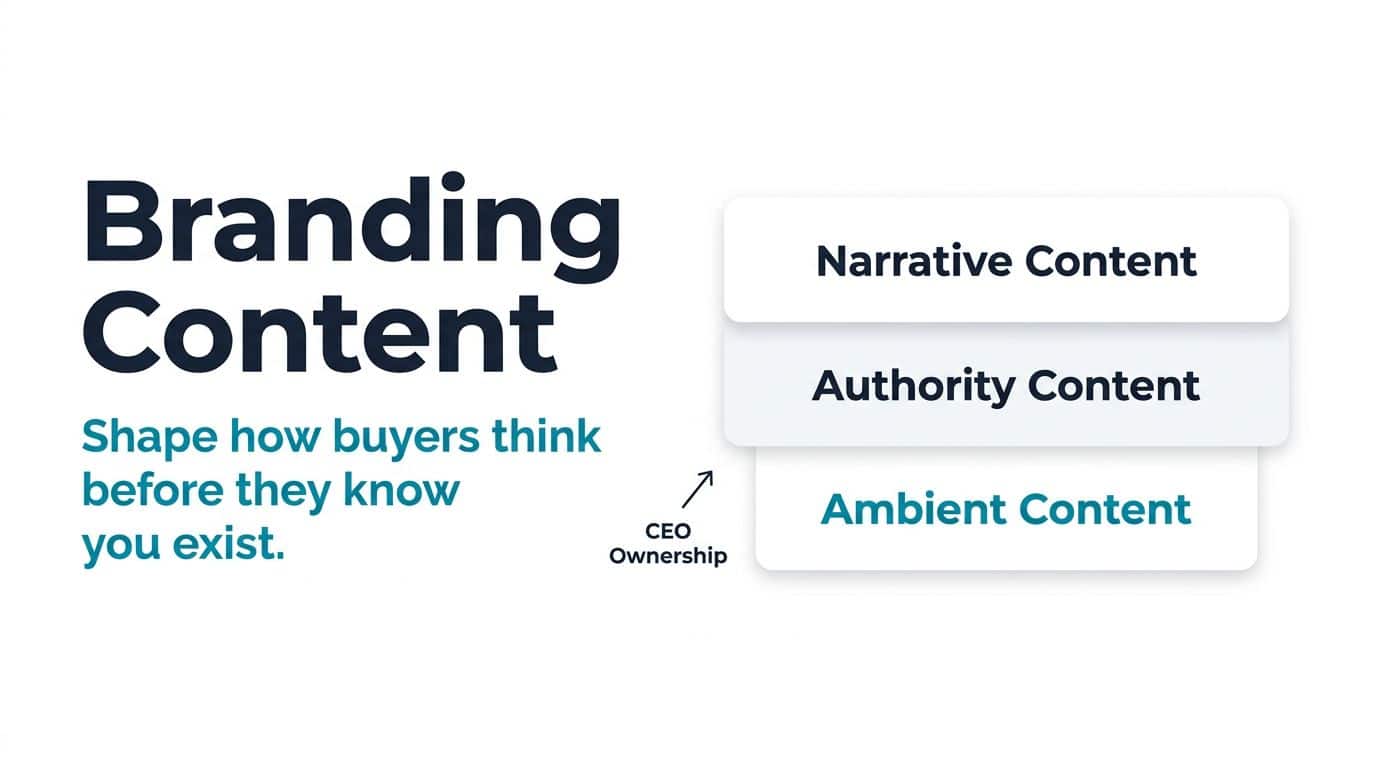
Branding content for B2B SaaS operates at three distinct layers. Each serves a different purpose and requires a different investment (Forrester, 2024).

Layer 1: Narrative content. This is the highest-leverage branding content a CEO can produce. Narrative content frames the market problem your company exists to solve. A category POV essay, a founder letter, a keynote talk. These assets define a company’s position in a way no product page can. They are the most-cited type of content in AI search engines and analyst reports.

Gong built its growth trajectory on a single narrative bet: that gut-feel revenue management was broken and that Revenue Intelligence would replace it. Their leadership team published consistent POV content establishing this frame. By the time Gong launched its platform, buyers already understood the category through Gong’s lens. Gong grew from $2M to $200M ARR in five years. Category-framing content was central to that run.

Layer 2: Authority content. This is deep, data-backed content that proves a company understands the problem. Industry reports, original research, technical deep dives, customer outcome studies. Authority content establishes trust with buyers who have identified their problem and are evaluating solutions.

HubSpot built its authority position through relentless publication of research-backed content on inbound marketing. Their annual State of Marketing Report became a cited source across the industry. It was not a product pitch. It was evidence that HubSpot understood the category at a depth no competitor could match.

Layer 3: Ambient brand content. This is the day-to-day presence that keeps a brand in rotation. Social posts, newsletter editions, podcast appearances, micro-stories. Ambient content does not change perception by itself. It reinforces the narrative and authority layers. Its job is frequency and recency, not depth.

A CEO’s personal branding content usually spans all three layers: the podcast appearance (ambient), the keynote talk (narrative), and the data-backed LinkedIn post (authority). They work as a system, not as isolated tactics.

For a funded Series A company, producing one narrative asset per quarter is the minimum viable investment. Companies that skip narrative content and go straight to authority content find their research reports go unread because no category context exists yet. This sequencing mistake explains why most thought leadership programs in B2B SaaS fail.

How Branding Content Works in a B2B Buying Journey

The B2B buying journey is not a linear funnel. Gartner research shows that B2B buyers move through four distinct phases: problem identification, solution exploration, requirements building, and vendor selection (Gartner, 2023). Branding content plays a different role in each phase.

Four-phase B2B buying journey flow diagram showing how narrative, POV, authority, and ambient branding content types match each phase from problem identification to vendor selection

In problem identification, the buyer does not know who you are. They know they have a pain point. Branding content that names and reframes that pain point positions your company as the one that understands their situation. At this stage, the buyer is not searching for your product category. They are searching for a clearer articulation of their own problem.

In solution exploration, the buyer has named the problem and is researching categories of solutions. This is where narrative branding content earns its value. A buyer who has read your category POV before they evaluate your product arrives with a framework that favors your approach.

In requirements building, the buyer knows what they want and is writing RFPs. Authority content, including white papers, research reports, and customer outcome data, becomes the evidence that supports your approach.

In vendor selection, ambient brand content matters most. The buyer has three finalists. They search for each on LinkedIn and in the news. A consistent recent presence, including posts, podcast episodes, and press mentions, signals relevance and momentum.

One infrastructure SaaS company I advised was losing every competitive deal to a larger incumbent. The incumbent had more features and a bigger sales team. What the incumbent lacked was a clear narrative about why the market was shifting away from legacy architecture. The company published a single narrative branding asset: a CEO essay titled “Why Infrastructure Teams Are Rebuilding From Scratch.” Distributed through the CEO’s LinkedIn and podcast appearances, it moved their win rate in competitive deals from 38% to 52% in 90 days.

When a company publishes branding content that names and defines a market category, it controls the criteria buyers use to evaluate all options in that space. This is how category design works for B2B tech companies. The company that frames the category wins disproportionate share because other vendors are measured against their framework.

What Should a B2B SaaS CEO Own in Branding Content?

A B2B SaaS CEO should personally own the narrative layer of the company’s branding content. No one else in the organization holds the full context: product roadmap, competitive dynamics, investor expectations, customer conversations, and team reality simultaneously. Delegating the narrative entirely to a marketing team produces content that is technically correct but lacks the authority and specificity that only the CEO can provide. Three assets, the POV essay, the signature talk, and the quarterly market letter, are the CEO’s minimum contribution.

The CEO owns the narrative. No one else in the organization sees the full picture: product roadmap, competitive landscape, investor expectations, customer conversations, and team dynamics. A content strategist cannot synthesize those inputs. A fractional CMO cannot hold that context.

The Three Assets a CEO Should Personally Produce

The three branding content assets a CEO should personally own or directly oversee:

  • The canonical POV essay: 1,500 to 3,000 words framing the market problem. Not a product explainer. A market argument. The most linked piece of content on your domain.
  • The signature talk: A 20-minute keynote covering the same ground as the POV essay in live format. Source material for dozens of ambient content pieces.
  • The quarterly market letter: A 5 to 10 minute read sent to subscribers and published on the blog. Consistency builds audience. Intermittent publishing does not.

The canonical POV essay. A 1,500 to 3,000 word piece that states the company’s framing of the market problem. It is not a product explainer. It is a market argument. It should be the single most linked and referenced piece of content on your domain.

The signature talk. A 20-minute keynote or presentation that covers the same ground as the POV essay in a live format. This becomes the source material for dozens of ambient content pieces: LinkedIn posts, newsletter editions, podcast clips, and quote graphics.

The quarterly market letter. A 5 to 10 minute read sent to subscribers and published on the blog. It updates the market on what is changing, what the company is learning, and where the category is heading. Consistency builds audience. Intermittent publishing does not.

One Series A SaaS CEO I worked with committed to one POV essay and one quarterly letter. He spent four hours per month on these two assets. His marketing team handled all other content production. Within 12 months, his personal brand differentiation strategy became the top source of inbound leads. His quarterly letters were being forwarded to board members at competitor companies.

What a CEO should delegate: production, distribution, repurposing, and channel management. The marketing team takes the CEO’s narrative assets and turns them into social posts, newsletter editions, slide decks, sales enablement one-pagers, and podcast talking points. The CEO provides the raw material. The team multiplies it.

How to Distribute Branding Content for Market Reach

Creating branding content is the first half of the work. Distribution determines whether the narrative reaches the buyers who need to see it.

CEO LinkedIn distribution. The CEO’s LinkedIn audience is the highest-quality distribution channel for B2B branding content. A well-distributed POV post from a founder reaches investors, prospects, partners, and peers simultaneously. Thought leadership content from executives generates 8x more engagement than company page posts (LinkedIn B2B Institute, 2024). Publish a condensed version of every narrative asset as a LinkedIn post within 48 hours of publishing it on the blog.

Podcast appearances. A 45-minute podcast interview is one of the most efficient branding content formats for a B2B CEO. The host’s audience is pre-qualified by topic interest. The CEO speaks directly to a relevant buyer segment without intermediaries. Repurposed clips become ambient content for weeks after the episode drops.

Newsletter distribution. A company newsletter with a named author and a distinct editorial voice is a branding content infrastructure. The quarterly market letter should be sent to the newsletter list before it is published publicly. Readers who receive it directly develop a stronger relationship to the brand than readers who encounter it through search.

Owned media amplification. After the CEO’s LinkedIn post and newsletter, publish each asset on the company blog with full SEO treatment. This converts a branding content asset into a permanent, search-discoverable resource. Over time, the blog becomes the company’s category narrative archive and its primary content distribution channel for organic search.

The distribution rule to internalize: Produce fewer assets and distribute each asset further. One category POV essay distributed across LinkedIn, newsletter, podcast, and blog outperforms five posts, each reaching only one channel.

How B2B SaaS Companies Use Branding Content to Win Market Share

B2B SaaS companies that win market share through branding content share one pattern: they invest in content that shapes category thinking before competitors understand the buyer exists. The strongest examples are not B2C entertainment campaigns. They are B2B-specific programs, built by companies such as Gong, HubSpot, Salesforce, Paddle, and Thoropass, that use branded content to control the vocabulary buyers use when evaluating solutions. The results are measurable: higher win rates, shorter sales cycles, and pricing power over direct competitors.

Five-card grid of B2B SaaS branding content examples including Gong category framing, HubSpot authority research, and Salesforce Salesblazer with outcomes

Gong: Category framing at scale. Gong created Revenue Intelligence as a named category before the term entered common use. Their team and leadership published consistent POV content, podcast episodes, and research reports that defined why gut-feel revenue management was broken. By the time buyers evaluated revenue intelligence platforms, they were using Gong’s vocabulary. Category-framing branding content was central to Gong’s growth from $2M to $200M ARR.

HubSpot: Authority through annual research. HubSpot’s State of Marketing Report has become one of the most-cited sources in B2B marketing. It was not a product pitch. It was a research asset that proved HubSpot understood the category better than any competitor. Every citation of that report was a brand impression that performance content could never generate.

Salesforce: Branded content ecosystem. Salesforce created Salesblazer, a content hub targeting sales professionals with educational content, community, and career resources. The content is not about Salesforce products. It builds Salesforce’s identity as the company most invested in sales professionals’ success. Salesblazer reached over 6 million members within its first year (Salesforce, 2024).

Paddle: The branded content studio model. Paddle built Paddle Studios, a dedicated branded content production unit that creates high-production video content for B2B software audiences. Their content is crafted to entertain, not to sell. The studio model signals a long-term brand investment that separates Paddle from its direct competitors in the payments infrastructure space.

Thoropass: Branded podcast as market education. Thoropass, a compliance automation company, created Scam Hunters, a documentary podcast series on fraud and security. The content has no direct connection to compliance software. It builds brand affinity with their exact ICP by addressing a topic their audience cares deeply about. B2B buyers do not forget the company that produced the podcast they recommended to a colleague.

The common thread across these programs is consistency and a willingness to invest in content that builds the brand before it builds the pipeline.

How to Measure Branding Content Like a CEO

Branding content is harder to measure than performance content because it operates upstream of conversion. The metrics exist and are specific, but they require a different dashboard than the one most content teams use. Three time horizons matter: short-term leading indicators that move within weeks, mid-term commercial indicators that show pipeline impact within 6 to 12 months, and long-term strategic indicators that capture pricing power and deal quality over 12 to 24 months. Each requires different data and a different cadence to track.

Three-tier branding content measurement dashboard showing short-term awareness metrics, mid-term pipeline indicators, and long-term deal quality signals for B2B SaaS CEOs

Short-term leading indicators include direct traffic growth, branded search volume, inbound partnership inquiries, and invite-only opportunity volume. These move within weeks of a consistent branding content program. A company that sees branded search increase from 200 to 400 queries per month in Google Search Console within 60 days has proof that branding content is changing awareness.

Mid-term commercial indicators include pipeline sourced or influenced by brand channels, a decrease in sales cycle length, and win rate in deals where the buyer consumed branding content before engaging sales. These show measurable movement within 6 to 12 months for most B2B SaaS programs. Brands that sustain consistent upper-funnel investment see 3x higher brand recall and 2x higher consideration (LinkedIn B2B Institute, 2024). Brand awareness compounds into demand generation when the narrative is consistent.

Long-term strategic indicators include average deal size trends, discount frequency and depth, enterprise logo acquisition rate, and talent pipeline quality. These move over 12 to 24 months and represent the real ROI of branding content. A company that commands higher average deal sizes and less discounting than competitors has evidence that its branding content has built pricing power.

The CEO should ask for a quarterly dashboard with three rows. Awareness: branded search, direct traffic, share of voice. Consideration: pipeline influenced by brand channels, competitive win rate in brand-influenced deals. Value: average deal size, discount rate, enterprise win rate. If the dashboard cannot show movement in all three rows within 12 months, either the branding content is wrong, or the measurement is wrong.

When to Invest in Branding Content by Funding Stage

Seed stage. Do not invest heavily in branding content until product-market fit data exists. The priority at seed is finding the repeatable motion, not building market awareness. One narrative asset, a founder essay framing the problem, is enough until Series A.

Series A and Series B. Begin serious branding content investment here. This is the stage where category creation and market positioning determine whether a company raises a competitive Series B or takes a down round. The CEO’s POV essay, a quarterly market letter, and two authority assets per quarter is the minimum viable program. Budget guidance: allocate 15 to 20% of total content investment to branding content at Series A and B.

Series C and later. Scale branding content to a dedicated function. Brand campaigns, original research reports, consistent earned media, and a fully staffed content team are table stakes. The CEO still owns the narrative, but execution is distributed across the organization. Budget guidance: Series C companies commonly allocate 30 to 40% of their budget to brand content.

A Series B SaaS company I worked with allocated 20% of their content budget to branding content: one narrative essay, one quarterly letter, and two authority reports per quarter. Their buyer research showed that prospects who consumed two or more pieces of branding content before a demo converted at 4.1x the rate of those who had not (DemandGen, 2024). That ratio justified doubling the branding content investment in the following fiscal year.

Branding content that precedes performance content makes every investment in performance content more effective. A company with no branding content program and strong performance content leaves conversion on the table. A company with strong branding content and strong performance content compounds its strength.

Frequently Asked Questions

What is branding content? Branding content is content designed to shape how a market thinks about a problem. It positions a specific company as the authority in its category before any purchase decision is made. It includes CEO point-of-view essays, market-perspective reports, and thought-leadership articles. Its goal is perception, not conversion.

What is the difference between branding content and content marketing? Branding content is a subset of content marketing that specifically shapes perception of the company and the market category it operates in. Content marketing is the broader practice of creating and distributing valuable content to attract and retain an audience. Content marketing can be entirely performance-oriented. Branding content always carries a positioning intent.

What is the difference between branding content and branded content? Branding content shapes how the market thinks about a problem or category, using owned media such as POV essays, research reports, and CEO newsletters. Branded content is media or entertainment produced by a brand, designed to build emotional affinity with a broader audience. All branded content is a form of branding content, but not all branding content needs to be entertainment-driven.

How long does it take for branding content to impact revenue? Leading indicators like branded search volume and direct traffic show movement within 60 to 90 days of a consistent program. Pipeline influence is measurable within 6 to 12 months. Changes in deal size, discount depth, and win rates take 12 to 24 months. Branding content compounds. The first six months feel slow. The second six months accelerate.

How much budget should a B2B SaaS company allocate to branding content? For Series A and B companies, 15 to 20% of the total content budget is a reasonable starting point. Performance content gets the remaining 80 to 85%. The ratio shifts toward branding as the company scales. Series C companies often run 30 to 40% brand content investment.

Can a PLG company benefit from branding content? Yes, but differently. PLG companies depend on bottom-up adoption, which makes ambient brand content especially valuable. A developer who has seen your CEO’s conference talk or read your engineering blog is more likely to try your product when a colleague recommends it. PLG companies should prioritize brand content that supports community presence, technical credibility, and category narrative.

Do small content teams need to choose between branding and performance content? No. The best small-team approach produces one branding asset per month and uses it as source material for multiple performance pieces. A single CEO essay becomes 8 to 10 social posts, a newsletter edition, a podcast outline, and a sales enablement one-pager. One branding asset feeds the entire content calendar for two weeks.

Conclusion

Branding content is not a vanity play. It is the mechanism that shapes buyer perception before your competitors know the buyer exists. For B2B SaaS CEOs managing complex sales cycles, branding content is the difference between being evaluated on your framing versus your competitor’s.

The same principle that makes answer engine optimization for SaaS effective applies here: being the source the buyer has already consumed before they start evaluating vendors.

The CEOs winning with branding content do not outspend competitors. They out-narrate them. They produce fewer, higher-leverage assets. They own the narrative personally. They measure what matters: branded search, pipeline influence, and pricing power, not page views.

One POV essay. One quarterly letter. One signature talk. That is the minimum viable branding content program for a funded B2B SaaS company. Start there, measure the leading indicators, and compound.

For a complete framework on connecting branding content to revenue, see our B2B content marketing ROI guide for funded founders. For the CEO-specific execution model, the CEO content strategy framework covers the full system. For how to structure brand content that gets cited by AI search engines, the companion post covers AEO-specific execution.

Last updated: June 2026.

Related Resources

Author

  • Vinay Koshy

    Vinay Koshy is the founder of Sproutworth and host of the Predictable B2B Success podcast. He ghostwrites educational email courses, newsletters, and LinkedIn content for funded B2B tech founders at seed through Series C. His work spans nonprofits, SaaS companies, and digital agencies, with a focus on content that builds genuine buyer trust before the sales conversation begins.

    View all posts