

Last Updated: April 2026. Refreshed to include the 2025 Edelman-LinkedIn B2B Thought Leadership Impact Report findings and beehiiv’s 2026 State of Newsletters benchmark data.
The funded B2B tech founders who consistently close enterprise deals share one habit their competitors overlook: a weekly newsletter their buyers actually read. Not because they’re prolific writers, but because they have a ghostwriter turning their thinking into published content while they run the company. B2B newsletter ghostwriting has become the quiet infrastructure behind some of the most credible founder voices in cleantech, SaaS, and B2B tech.
The data makes the case:
58% of C-suite decision-makers choose vendors based on the quality of their thought leadership before a sales conversation begins. Source: 2025 Edelman-LinkedIn B2B Thought Leadership Impact Report
A newsletter is the most direct vehicle for that influence. Ghostwriting is what makes it consistent enough to actually work.
If your newsletter has been “coming soon” for the past year, this guide covers everything you need to make a decision.

Table of Contents
- What Is B2B Newsletter Ghostwriting?
- Why Funded B2B Founders Need Newsletter Ghostwriting Now
- How B2B Newsletter Ghostwriting Works: The Process Step by Step
- What Makes a B2B Newsletter Actually Drive Pipeline?
- What Should Each B2B Newsletter Issue Actually Contain?
- How to Choose a B2B Newsletter Ghostwriting Service
- Should You Disclose That Your Newsletter Is Ghostwritten?
- What Most B2B CEOs Get Wrong About Newsletter Ghostwriting
- AI vs. Human B2B Newsletter Ghostwriting: Which Gets Results?
- B2B Newsletter Ghostwriting Results: What to Realistically Expect
- Frequently Asked Questions
What Is B2B Newsletter Ghostwriting?
B2B newsletter ghostwriting is a service that has a professional writer capture a founder’s voice, expertise, and ideas. The resulting newsletter is published under the executive’s name. It requires a deep understanding of the executive’s ICP, strategic positioning, and business goals. Done well, the output is indistinguishable from content the founder wrote themselves.
A typical engagement involves a weekly or bi-weekly briefing with the founder, followed by drafting, editing, and publishing a newsletter issue on schedule. The newsletter ghostwriter handles the production entirely. The founder provides the thinking.
The ideas and experience belong to the CEO. The writing belongs to the ghostwriter. The authority belongs to the newsletter.
This model is built on a simple insight: the bottleneck isn’t a lack of expertise. It’s the absence of infrastructure to turn that expertise into consistent, published output. Executive content ghostwriting solves that infrastructure problem at the founder level.
B2B newsletter ghostwriting turns a 20-minute founder briefing into a published newsletter issue every week.
“The value a CEO newsletter creates isn’t in the writing itself. It’s in the consistency and specificity of the expertise behind it.” Vinay Koshy, Founder, Sproutworth
Who Needs B2B Newsletter Ghostwriting?
B2B newsletter ghostwriting is most valuable for founders and executives who have a clear point of view on their market, a subscriber list filled with buyers or investors worth building trust with, and approximately zero hours per week to write. That describes most funded B2B tech founders between seed and Series C.
It also describes CROs and VP Marketing roles in cleantech, climate tech, and enterprise SaaS who face pressure to build personal authority alongside the company brand.
On a week-to-week basis, a newsletter ghostwriter briefs the founder for 15 to 20 minutes, extracts the core insight, drafts the issue, revises based on founder feedback, and publishes on schedule. The founder’s total involvement is a single brief conversation. Everything else is the ghostwriter’s responsibility.
A thought leadership newsletter built around the founder’s voice produces fundamentally different results than a company blog. The newsletter arrives in an inbox, carries the founder’s name, and builds a one-to-many relationship that compounds over months.
Why Funded B2B Founders Need Newsletter Ghostwriting Now
B2B tech founders need newsletter ghostwriting because they have the expertise their buyers want to read, but not the time to publish it consistently. Email newsletters are now the highest-trust format for building influence with enterprise buyers before the first sales conversation.
According to the 2025 Edelman-LinkedIn B2B Thought Leadership Impact Report, 58% of C-suite decision-makers say they choose vendors based on thought leadership quality before a sales conversation even begins. A well-executed newsletter strategy is now one of the highest-trust formats for building that influence.
But there’s a gap. Most funded B2B tech founders have 10 or more hours of strategic insight to share per week and approximately zero hours to write it down. They also have subscriber lists filled with exactly the people they want to close enterprise deals with.
In my work with Series B and Series C founders, the SaaS newsletter is almost always the content format they wish they’d started sooner. Not because it’s easy to produce, but because an email inbox is the last channel competitors haven’t colonized with generic AI content.
The benefit is sharpest for cleantech and B2B SaaS founders. Enterprise buyers in those sectors evaluate vendors over 6 to 18-month buying cycles. A newsletter that educates and builds trust throughout that cycle shortens the time from first contact to qualified conversation in ways cold outreach never can.
According to the 2025 Edelman-LinkedIn B2B Thought Leadership Impact Report, 79% of hidden buyers say they are more likely to advocate for a vendor’s proposal when that vendor consistently produces high-quality thought leadership. The newsletter is the delivery mechanism. Ghostwriting is what makes it consistent.
The newsletter audience is there, and it’s engaged. According to Beehiiv’s 2026 State of Newsletters report, based on 28 billion emails sent in 2025, the global newsletter open rate reached 41.24%, and 46.67% of newsletter creators publish weekly. The channel works. The bottleneck is consistent production, not audience readiness.
Your buyers are already reading newsletters from founders in your space. The only question is whether yours is one of them.
How B2B Newsletter Ghostwriting Works: The Process Step by Step
B2B newsletter ghostwriting works in four steps: the ghostwriter builds a voice guide, sets an editorial calendar, extracts content through a weekly founder briefing, and then drafts and publishes on schedule. The founder’s total time investment is 20-30 minutes per week.
The biggest concern with ghostwriting is authenticity. Once you understand the process, that concern disappears. Mailchimp’s overview of ghostwriting captures this well: authenticity comes from the ideas and experience, not the act of writing.
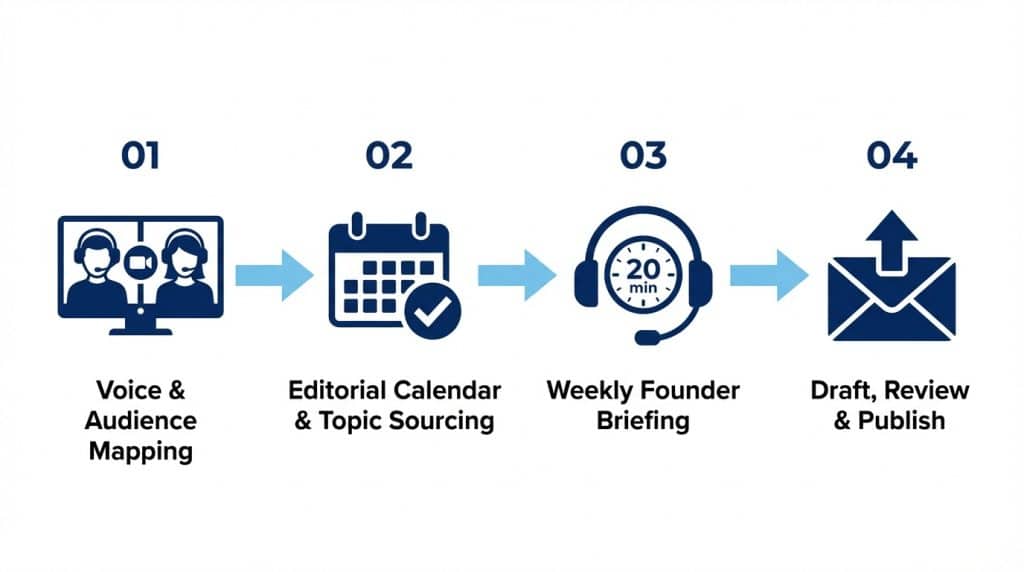
Step 1: Voice and Audience Mapping (Weeks 1 to 2)
The ghostwriter conducts deep interviews with the founder, reviews past content, LinkedIn posts, and podcast appearances, and builds a voice guide. This document captures tone, vocabulary, preferred frameworks, and recurring opinions. Done well, readers can’t tell the founder didn’t write it themselves.
Step 2: Topic Sourcing and Editorial Calendar
Each week, the founder and ghostwriter agree on one or two topics. These typically come from deals won or lost, industry news the founder has a contrarian view on, a framework the founder uses internally that their ICP would find valuable, or observations from sales calls and investor meetings. The best editorial calendars are built on the founder’s actual strategic thinking, not trending topics.
Step 3: The Weekly Briefing
The founder gives a 15-20-minute briefing, either verbally or via voice note. No writing required. The ghostwriter extracts the key insight, identifies the angle, and converts the briefing into a structured draft.

A strong briefing covers five elements:
- The core insight or observation
- What prompted it
- Why it matters specifically to your ICP
- One example or story that makes it concrete
- The one thing readers should think or do differently after reading
A ghostwriter who probes for all five in every briefing call produces issues that consistently outperform those built from looser briefs.
Step 4: Draft, Review, and Publish
The ghostwriter produces the draft. The founder reviews and approves, often with minimal edits. Turnaround is typically 24 to 48 hours. The newsletter goes out on schedule, every time.
Consistency matters more than any single issue being perfect. The compounding effect only works if the newsletter keeps showing up.
Founders who commit to a consistent newsletter cadence for 90 days see the clearest results. The pattern holds across funded B2B tech companies regardless of sector.
What Makes a B2B Newsletter Actually Drive Pipeline?
A B2B newsletter drives pipeline when it has a specific point of view, reaches a precisely defined audience, and publishes on a consistent editorial rhythm. All three must be present. A newsletter with any one of these missing will grow an audience without growing a pipeline.
Most B2B newsletters fail to generate a pipeline for one of three reasons. They’re too broad (industry roundups no one asked for). They’re too promotional (reads like a sales deck). Or they’re inconsistent, disappearing for weeks after the first few issues.
A specific point of view. The best B2B newsletters don’t report the news. They interpret it. A CEO who writes “here’s why the recent funding freeze will accelerate B2B SaaS consolidation in cleantech and how I’d position for it” is far more valuable to their ICP than one who recaps industry headlines.
Tight audience alignment. The newsletter should read like it was written for one person. Not “B2B marketers” but “Series A SaaS founders with enterprise deals stalled in legal review.” The more specific the lens, the more the right buyers feel seen.
A clear editorial rhythm. Buyers who read your newsletter for six months before booking a call aren’t a coincidence. They made a decision about you over time. That decision requires consistency to build. Consistent founder authority is what separates founders who close on authority from those who close on price.
“A B2B newsletter without a point of view is just noise. The ones that create pipeline have opinions that specific buyers either love or strongly agree with.” Vinay Koshy, Sproutworth
According to the Content Marketing Institute’s B2B Content Marketing 2024 report, 73% of B2B marketers use email newsletters for content distribution — one of the highest adoption rates of any format. Yet, in my experience working with funded founders, most of those newsletters drive audience growth without contributing to the pipeline. That gap is a strategy and execution problem, not a format problem.
A newsletter that ships once and stops is a brochure. A newsletter that ships every week for two years is a business asset.
What Should Each B2B Newsletter Issue Actually Contain?
Each B2B newsletter issue should follow one of five formats: a hot take, a tactical how-to, an anonymized case study, a data breakdown, or a reader question riff. Format shapes the briefing questions, the structure, and the call to action.
In my experience building newsletter content systems for funded B2B tech founders, these five formats produce the strongest results with B2B ICP audiences. One thing almost no resource on B2B newsletter ghostwriting covers: the format is not a cosmetic choice. It determines what the ghostwriter extracts from the briefing and how the issue performs.
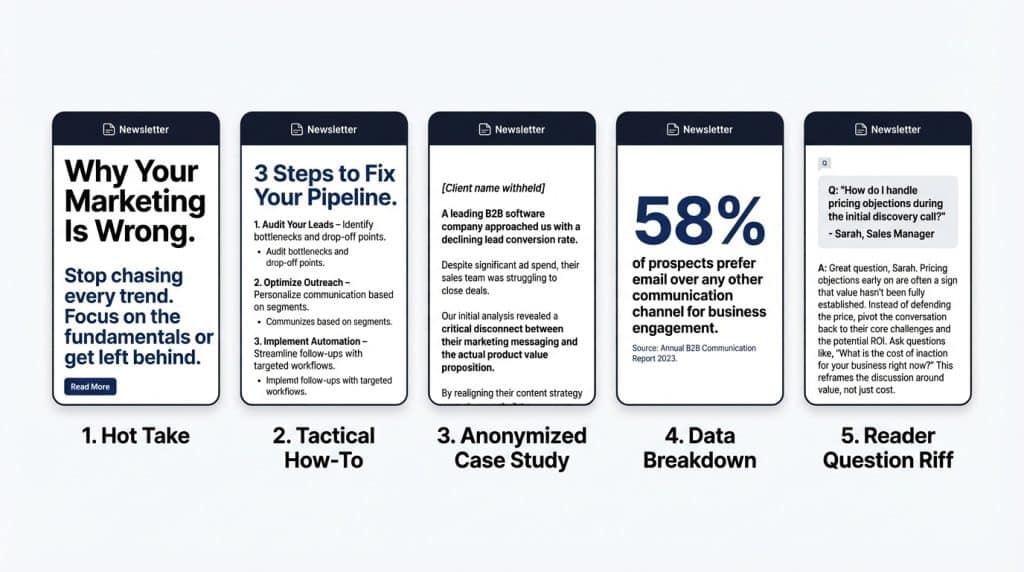
The 5 Newsletter Formats That Work Best for B2B Founders
1. The Hot Take. One contrarian or non-obvious view on something that happened in the founder’s industry this week. 150 to 300 words. This format drives the most direct replies because it invites readers to agree, disagree, or extend the thinking. It’s also the highest-performing format for repurposing on LinkedIn. Example framing: “Everyone is saying X. Here’s why I think that misses Y.”
2. The Tactical How-To. One framework, checklist, or process the founder uses internally that their ICP would find immediately applicable. 300 to 500 words. This is the highest-share format because readers forward it to colleagues. Works best when the content is genuinely insider knowledge rather than a repackaged blog post.
3. The Anonymized Case Study. What happened in a recent deal, client engagement, or internal situation, and what the founder learned. 300 to 400 words. This format builds the most trust over time because it demonstrates real-world expertise rather than theoretical knowledge. Names are removed; the specifics of the situation are preserved.
4. The Data Breakdown. One recent stat or research finding, plus the founder’s interpretation of what it means for their ICP. 200 to 300 words. This format positions the founder as analytically rigorous and signals that they are actively tracking the field. Always include the source, the number, and the “so what?” in the founder’s voice.
5. The Reader Question Riff. Answering a real question from a subscriber, prospect, or ICP that keeps surfacing. 300 to 500 words. This format signals responsiveness and deepens community. A Series A SaaS founder I work with generates some of her strongest issues from questions raised during sales calls, anonymizes them, and answers them for the whole audience. The result: prospects feel heard before they’ve even become clients.
Rotating formats across issues prevents the thought leadership newsletter from feeling repetitive over time, which is a common reason subscribers disengage after the first 2 to 3 months. A skilled B2B newsletter ghostwriting service briefs each issue with one of these formats in mind from the start.
B2B Newsletter Cadence: Which Frequency Is Right for Your Stage?
| Cadence | Authority building speed | Founder time per week | Best for |
|---|---|---|---|
| Weekly | Fastest | 20 to 30 minutes | Founders with an active buyer pipeline and a 90-day commitment to consistency |
| Bi-weekly | Moderate | 15 to 20 minutes | Early-stage founders building the habit; the strongest starting cadence for most |
| Monthly | Slow | 10 to 15 minutes | Limited use cases. Rarely builds the presence needed to shorten sales cycles |
The right newsletter cadence depends less on ambition and more on what you can sustain for at least 90 consecutive days. A bi-weekly newsletter you publish consistently for six months outperforms a weekly newsletter you abandon after eight issues.
How to Choose a B2B Newsletter Ghostwriting Service
Choose a B2B newsletter ghostwriter based on four criteria: relevant ICP experience, voice-matching capability, interview-based content extraction, and a signed NDA. Generic writers produce generic newsletters regardless of how good their portfolio looks.
Not all ghostwriting services are built for B2B tech founders. 3 Aspens Media’s look at B2B ghostwriting in practice highlights the most common friction point: founders who hire generic writers and get generic output. Here’s what to evaluate before signing anything.
Relevant ICP experience. Has the ghostwriter worked with B2B tech, SaaS, or funded startups before? Ghostwriters with enterprise software backgrounds understand deal cycles, buyer psychology, and B2B language in ways that general writers don’t replicate. Ask for samples from similar industries.
Voice matching capability. The test is simple: read a ghostwritten sample and ask whether you’d know it wasn’t written by the founder. If the voice feels generic, the ghostwriter doesn’t have a strong extraction process. Move on.
Interview-based content extraction. The best B2B newsletter ghostwriters extract content through conversation, not questionnaires. A 20-minute weekly call should produce most of the raw material for each issue. If the process relies on written briefs from the founder, the time savings disappear quickly.
Strategic positioning awareness. Your newsletter should reinforce your market positioning, not just share general B2B wisdom. The ghostwriter needs to understand your ICP’s actual problems and how your company solves them better than competitors.
NDA and confidentiality standards. Reputable newsletter ghostwriting services sign a non-disclosure agreement covering both the working relationship and the content itself. A ghostwriter should never attribute your newsletter to themselves publicly or use your issues as portfolio samples without explicit permission. Ask about this before signing.
When I evaluate ghostwriting engagements for newsletter work, I always ask for an editorial brief example. How a ghostwriter briefs a topic tells you almost everything about how well they understand the audience and the founder’s goals. A strong brief takes 10 minutes to produce and saves 2 hours of revision later.
- Freelance entry level: $500 to $1,000 per month. Limited B2B-specific experience, minimal strategy layer
- Specialist B2B ghostwriter: $1,500 to $3,000 per month. SaaS or tech industry experience, voice extraction process included
- Full-service newsletter agency: $3,000 to $5,000 per month. Strategy, writing, distribution, and performance reporting
Most funded B2B tech founders find the $1,500 to $3,000 range produces the clearest ROI: specialist experience without the overhead of a full agency model.
B2B Newsletter Ghostwriter: 5 Non-Negotiables
- A voice guide built from interviews with the founder, not a generic questionnaire
- Demonstrated B2B tech or SaaS industry experience; ask for samples from similar sectors
- Interview-based content extraction: a 20-minute weekly call should drive the brief, not a written form you fill out
- A signed NDA covering both the relationship and the newsletter content itself
- Demonstrated understanding of your ICP, not just general content marketing fluency
Should You Disclose That Your B2B Newsletter Is Ghostwritten?
No. Disclosure is not required or expected in B2B contexts. The ethical line in ghostwriting is whether the ideas are genuinely the founder’s own, not whether a professional writer shaped the prose.
Ghostwriting has a centuries-long history across journalism, business, politics, and media. In B2B specifically, Radix Communications’ analysis of B2B ghostwriting ethics makes the key point well: the ethical line isn’t about who writes the words. It’s about whether the expertise and ideas behind the content are genuinely the founder’s own.
Your subscribers aren’t subscribing to your writing ability. They’re subscribing to your thinking, your perspective on their world, and the access to your expertise.
The ideas must be yours. The sentences don’t have to be. That is the ethical foundation of every legitimate ghostwriting engagement.
A practical scenario worth understanding: a Series B cleantech founder I work with was approached by a prospective enterprise client who asked, during their evaluation process, whether the newsletter reflected the founder’s own views. The answer was straightforwardly yes, because the ghostwriting process is built entirely around extracting the founder’s real thinking. The professional writer shaped the prose. The founder provided every opinion, observation, and strategic position in it.
The founders who get tangled in the disclosure question are usually asking the wrong question. The right question is: are the ideas, observations, and opinions in this newsletter genuinely yours? If yes, you have nothing to disclose and nothing to worry about.
What Most B2B CEOs Get Wrong About Newsletter Ghostwriting
Three mistakes keep coming up in conversations with founders who’ve tried newsletter ghostwriting and either abandoned it or never saw results.
Mistake 1: Starting with the tool rather than the strategy. Many founders hire a ghostwriter before deciding what the newsletter is actually for. Is it to build awareness among future enterprise buyers? Re-engage dormant sales prospects? Build credibility with investors ahead of a round? The answer shapes every editorial decision. Without it, the newsletter drifts and eventually stops.
Mistake 2: Over-editing every issue. Some founders review each draft so thoroughly that a single issue can take 10 days to resolve. This kills the consistency that makes newsletters work. Trust the ghostwriter’s process. Approve quickly and course-correct over 3 to 4 issues, not one. Speed of iteration beats perfection in every issue.
Mistake 3: Treating it as a marketing tactic rather than IP. Your newsletter is a repository of your strategic thinking. Every issue published builds an asset that compounds. Founders who view their newsletter as the written record of their expertise treat it fundamentally differently from those who see it as a “content marketing activity.”
A Series B cleantech founder I work with avoided starting a newsletter for two years because she assumed ghostwriting would make it sound inauthentic. After six months with a ghostwriter, three enterprise buyers referenced specific newsletter issues during procurement conversations. That’s what intellectual property compounding looks like in practice. A clear founder content strategy makes this kind of outcome repeatable.
AI vs. Human B2B Newsletter Ghostwriting: Which Gets Results?
The question I get asked more than any other in 2025: Can you replace a human newsletter ghostwriter with an AI tool and get equivalent results? The answer is more nuanced than most guides admit.
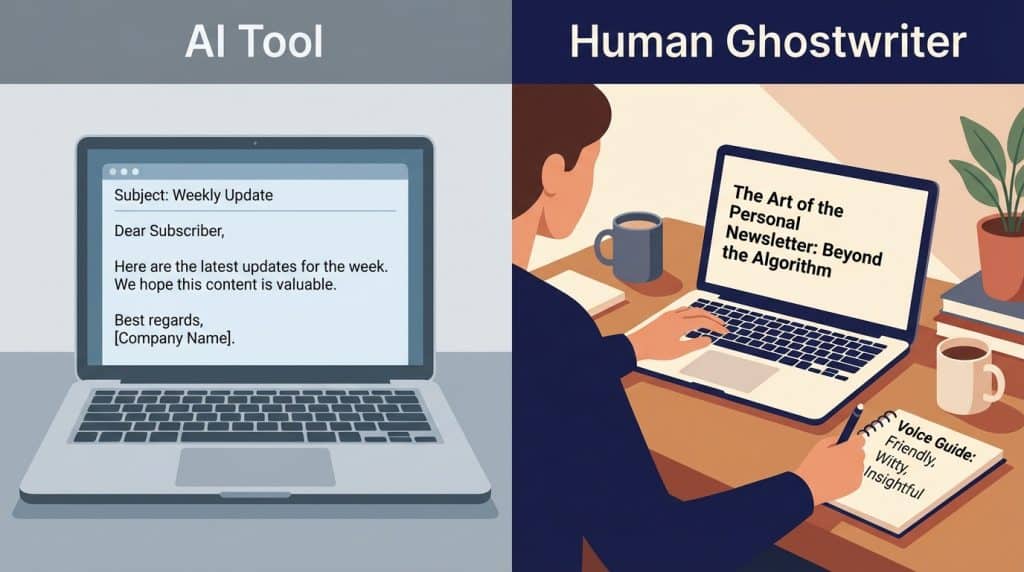
Where AI Falls Short for B2B Newsletter Ghostwriting
AI tools can draft sentences. They cannot interview a founder. That is the gap that matters for B2B newsletter ghostwriting.
The value in B2B newsletter ghostwriting doesn’t come from the drafting itself. It comes from the briefing process. A skilled human ghostwriter listens to how you talk about a problem, identifies the buried insight in your explanation that you almost glossed over, and builds an issue around that. AI tools need the insight to be already structured before they can do anything useful with it.
The second gap is voice saturation. Your ICP receives AI-generated content all day. Enterprise buyers in B2B tech have become fluent at recognizing AI-generated prose without consciously knowing why it reads flat. A newsletter ghostwritten by a human who understands the founder’s voice reads differently in an inbox. The difference is subtle but measurable in reply rates, forwarding behavior, and the density of inbound references over time.
Where AI Fits in the Process
AI has a legitimate role in email newsletter ghostwriting workflows. Just not the role most founders assume. The best human-led ghostwriting operations use AI as a tool within a human-directed process, not as a replacement for it.
| Task | Human ghostwriter | AI tool |
|---|---|---|
| Voice extraction and founder briefing | Essential: cannot be automated | Not effective alone |
| First draft from structured brief | High quality, on-voice | Adequate with a detailed brief |
| Strategic framing and editorial judgment | Strong, with pattern recognition across issues | Weak without rich context |
| Subject line and preview text variants | Good | Good, useful for A/B testing |
| Research and source synthesis | Good | Good, faster for desk research |
| Voice consistency across 12+ issues | Strong if the ghostwriter reads the archive | Weak without fine-tuning on past issues |
A pattern I see in the most effective newsletter ghostwriting engagements: the human ghostwriter uses AI to accelerate research and generate initial draft language from a structured brief, then rewrites for voice, strategic intent, and editorial quality. AI handles commodity tasks. The human handles the judgment calls that make a B2B newsletter worth forwarding.
Use AI where it accelerates. Use human judgment where it matters. The newsletters that build enterprise-level trust require both, in that order.
B2B Newsletter Ghostwriting Results: What to Realistically Expect
The ROI of B2B newsletter ghostwriting compounds over time. Founders typically see shortened sales cycles, inbound meeting requests citing specific issues, and enterprise buyers referencing the newsletter in procurement conversations by month five or six.
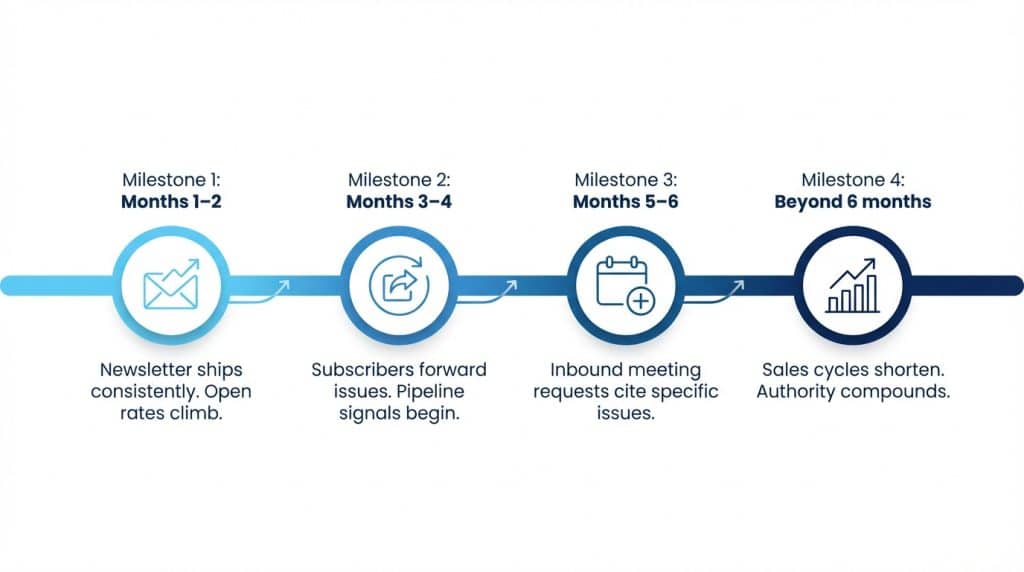
Here’s what the timeline looks like in practice.
Months 1 to 2: The newsletter exists and goes out consistently. Subscriber numbers are small, typically 50 to 200, but open rates are high because the audience is curated. The primary value in this phase is discipline. A weekly newsletter lays the foundation for everything else.
Months 3 to 4: Subscribers start forwarding issues. The founder’s name comes up in sales calls as a reference. LinkedIn connections grow because the newsletter is referenced in profile content and posts. Prospects who’ve been reading start replying directly to issues with questions or comments. These replies are early pipeline signals.
Months 5 to 6: Inbound meeting requests start citing the newsletter. Sales cycles shorten for prospects who’ve been reading for 90-plus days. The newsletter becomes a reference point in proposals, investor decks, and partnership conversations.
Beyond 6 months: The newsletter archives become a searchable library of the founder’s expertise. AI engines begin citing issues when prospects research the company’s space. Investors reference the newsletter in due diligence conversations. The ROI compounds in ways that are difficult to attribute directly but impossible to ignore.
The email channel itself supports this. According to the Litmus 2025 State of Email report:
Email marketing delivers an average ROI of $42 for every $1 spent.
B2B newsletters with a professional ghostwriting partner achieve this not through volume, but through consistent quality. That’s something most executive teams can’t produce in-house. Combining newsletter content with digital PR compounds returns even more by placing the founder’s ideas in front of audiences beyond the existing subscriber list.
The founders who see the clearest results commit before the ROI is obvious and stay consistent long after it is.
CEO Takeaway
- Define what your newsletter is for before hiring a ghostwriter. Pipeline, awareness, or investor credibility each require a different editorial approach. Clarity upfront prevents drift later.
- Insist on a voice guide before the first issue goes out. This single document protects the authenticity of your newsletter over time and makes handoffs between ghostwriters seamless.
- Commit to 90 days before judging results. Newsletter ghostwriting compounds with consistency. Three issues don’t tell you anything meaningful. Twelve do.
- Budget 20 to 30 minutes per week for briefing your ghostwriter. That’s the minimum time investment for a newsletter that sounds like you and drives real outcomes.
- Track inbound references, not just open rates. When prospects mention a specific issue during a sales call, that’s the metric that actually tells you the newsletter is working.
Frequently Asked Questions
B2B newsletter ghostwriting is a service where a professional writer creates a regular email newsletter on behalf of a B2B founder or executive, matching their voice and expertise. The content is published under the executive’s name. It helps busy founders maintain consistent thought leadership without writing every issue themselves, freeing time for strategic work while keeping their audience engaged.
B2B newsletter ghostwriting typically ranges from $3,500 to $10,000 per month depending on frequency, ghostwriter experience, and the level of strategy included. Entry-level freelancers start around $500 per month, while specialist B2B ghostwriters with deep SaaS or tech industry experience command higher rates that reflect the quality and strategic depth they bring to each issue.
Not when it’s done well. Skilled B2B newsletter ghostwriters use a detailed voice guide built from interviews, past writing samples, and the founder’s podcast or LinkedIn content. When the extraction and briefing process is thorough, readers typically cannot distinguish a professionally ghostwritten newsletter from one the founder wrote themselves. Authenticity comes from the ideas, not the writing process.
Most B2B founders see the best results with a weekly or bi-weekly cadence. Weekly newsletters build familiarity faster and compound authority more quickly, but require a reliable briefing and production process. Bi-weekly is a strong starting cadence if the founder’s input time is limited. Monthly newsletters rarely build the consistent presence needed to shorten sales cycles. Choose the frequency you can sustain for at least 90 days before evaluating results.
Most B2B founders see the first measurable pipeline signals between months three and six. Prospects start mentioning the newsletter in sales calls, deal cycles shorten for buyers who have been reading for 90 or more days, and inbound meeting requests begin citing specific issues as a reason for reaching out. The compounding effect accelerates significantly after the six-month mark.
AI tools can accelerate parts of the newsletter production process, particularly research and first-draft generation from a structured brief. But AI cannot replace the briefing and voice extraction process that makes a B2B newsletter sound like the founder rather than a language model. The best newsletter ghostwriting workflows use AI as a tool within a human-led process. Using AI as the primary writer typically produces content your ICP will recognize as generic within 3 to 6 months.
A good B2B newsletter ghostwriter needs to understand your ICP’s specific pain points, buying triggers, and the language of your industry. They should also understand your company’s positioning, competitive differentiation, and the primary problem your product or service solves. Without this context, the newsletter produces volume without pipeline, which is the most common reason ghostwriting engagements fail to deliver ROI.
Each week, a B2B newsletter ghostwriter runs a 15 to 20-minute briefing call with the founder to extract the core insight, then drafts the full issue, incorporates feedback, and publishes on schedule. The ghostwriter also manages the editorial calendar, formats the email, and tracks performance. The founder’s total involvement is a single briefing conversation per issue.
An effective newsletter ghostwriter briefing covers five elements: the core insight or observation, what prompted it, why it matters specifically to your ICP, one concrete example or story, and the one thing you want readers to think or do differently after reading. A ghostwriter who consistently extracts all five elements will produce issues that outperform those built from looser or written-only briefs.
The ROI of B2B newsletter ghostwriting compounds over time rather than arriving immediately. Most founders see measurable pipeline signals between months three and six: shorter sales cycles for prospects who’ve been reading, inbound meeting requests citing specific issues, and enterprise buyers referencing the newsletter in procurement conversations. Email marketing as a channel delivers $42 in return for every $1 spent, according to Litmus 2025.
Conclusion
B2B newsletter ghostwriting isn’t a shortcut. It’s a system. The founders who use it well don’t just get their newsletter written. They build a compounding asset that shortens sales cycles, builds investor credibility, and establishes their thinking in a format that enterprise buyers trust above almost everything else.
The bottleneck for most funded B2B tech founders isn’t ideas. It’s the infrastructure to turn expertise into consistent, published output, week after week, without that work falling entirely on the CEO’s calendar. A well-run newsletter ghostwriting engagement solves that problem entirely. The founder shows up for a 20-minute briefing. Everything else gets handled.
The founders who wait on this are usually waiting for the “right time” to start. There isn’t one. Compounding begins when the first issue ships. Every week without a newsletter is a week your ICP is reading someone else’s thinking instead of yours.
At Sproutworth, I help funded B2B tech founders build the content infrastructure that generates inbound, shortens sales cycles, and builds the kind of authority that holds up in due diligence. If B2B newsletter ghostwriting, educational email courses, or a digital PR strategy are on your list for this year, the about page is the place to start.
Related Resources
- How to Generate B2B Leads Through Content
- B2B Growth Marketing Strategies for Funded Startups
- What Is Thought Leadership? An Evidence-Based Answer for B2B Founders
- B2B Digital Marketing Strategy: 7 Key Steps to Drive Growth
- How to Write Content That Drives Sustained B2B Growth
