
Nathan Barry’s SaaS revenue growth story took ConvertKit from $1,207 to $125,000 in monthly recurring revenue in just 15 months. He got there through direct sales webinars, a free concierge migration service that eliminated switching friction, and hard niche focus on professional bloggers rather than everyone with an audience. This case study breaks down the seven specific tactics behind ConvertKit’s SaaS revenue growth and what B2B tech founders can apply today.
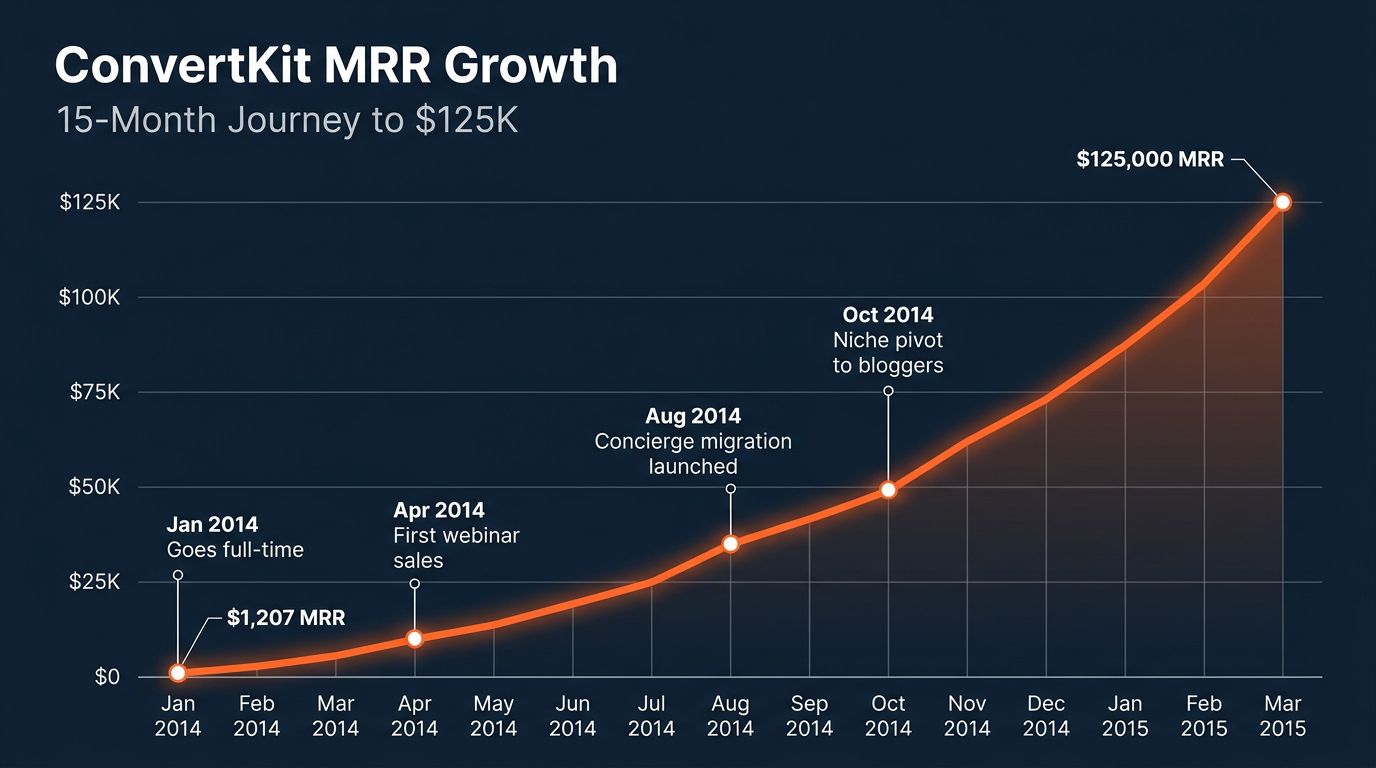
ConvertKit reached $125,000 MRR in 15 months by going full-time, running direct sales webinars, offering free concierge migration to remove switching costs, and repositioning to “email marketing for professional bloggers.” Nathan Barry’s most impactful single move was personalized cold outreach to the top 100 bloggers in his target category.
In October 2014, ConvertKit’s monthly recurring revenue had dropped to $1,207. Nathan Barry had spent two years treating it as a side project, and the results showed it. His friend Hiten Shah gave him a direct choice: go all-in, or shut it down.
Nathan chose to go all-in. He stopped all freelance work, invested $50,000 of his own money, and committed to ConvertKit full-time. Fifteen months later, ConvertKit crossed $125,000 in monthly recurring revenue.
This is Part 2 of the ConvertKit growth story. Part 1 covers the founding and early product decisions. This post covers the 15-month sprint from near-zero to $125K MRR and the specific tactics that drove it.
1. The Decision That Changed Everything: Going All-In
When Nathan went full-time in October 2014, ConvertKit was generating $1,207 per month. His B2B go-to-market strategy shifted overnight from part-time experimentation to disciplined execution. He had been splitting his attention between freelance projects and the SaaS business for two years. The moment he committed fully and invested personal capital to back it up, the trajectory changed.
Going all-in on ConvertKit meant Nathan Barry stopped all freelance work and invested $50,000 of personal capital in October 2014. Within 15 months, that commitment produced $125,000 in monthly recurring revenue. The commitment preceded the growth; it did not follow from it. For B2B SaaS founders, divided attention is often the primary reason a product with genuine demand fails to scale.
The lesson here is not about risk tolerance; it is about what sufficient attention produces. Side-project SaaS companies fail not because of bad ideas but because half-attention produces half-results.
2. Direct Sales via Webinars Beat Passive Marketing Early On
Nathan did not wait for inbound traffic to grow ConvertKit. He ran direct sales webinars, presenting ConvertKit live to small groups of professional bloggers, walking through the product in real time, handling objections on the call, and closing customers directly. This began in earnest in June 2015 and produced consistent growth through the second half of the year.
Nathan Barry ran direct sales webinars throughout ConvertKit’s growth phase. The format let him present live demos, handle objections in real time, and close customers on the call. Webinars shortened the sales cycle and produced immediate feedback on which objections were blocking conversion. For early-stage SaaS products, direct selling consistently outperforms passive inbound in the first 12 to 18 months.
The pattern repeats across most successful SaaS growth stories. The fastest-growing founders sold directly and manually in the early stage. They used those conversations to sharpen messaging and remove friction before investing in scalable acquisition channels.
3. The Concierge Migration That Removed Every Switching Objection
The objection Nathan heard most often from prospects who liked ConvertKit but hadn’t switched: “Switching sounds like a huge amount of work.” His answer was not better product messaging; it was to make switching require zero work from the customer.
ConvertKit offered a free concierge migration: Nathan’s team would log into the customer’s existing email platform (AWeber, MailChimp, Keap), transfer all subscribers, copy all autoresponders, and swap out opt-in forms, all at no cost to the customer.
ConvertKit’s free concierge migration service eliminated the most common objection to switching email platforms. Nathan Barry’s team handled the complete migration, subscribers, autoresponders, and opt-in forms at zero cost. This turned a high-friction barrier into a frictionless decision. Removing switching costs is one of the most widely used tactics for SaaS revenue growth, particularly when targeting customers already committed to a competing platform.
This is worth pausing on. Most SaaS products compete on features. ConvertKit competed on friction. By making the switch cost nothing in time or effort, Nathan removed the primary reason a qualified prospect would stay with a competing platform.
4. Niching Down to “Email Marketing for Professional Bloggers”
ConvertKit’s original positioning targeted “authors”, people building an audience around writing. But when Nathan analyzed his best customers, most of them weren’t identifying as authors. They were bloggers, course creators, and podcast hosts: professional bloggers in the broadest sense of the term.
In March 2015, he stripped every mention of “authors” from the site and repositioned entirely around “email marketing for professional bloggers.” Growth accelerated.
Nathan Barry’s repositioning of ConvertKit from “email marketing for authors” to “email marketing for professional bloggers” in March 2015 was the positioning shift that accelerated growth. Targeting a specific, well-defined audience made every sales conversation immediately relevant. Broad positioning in a competitive category produces weak conversion. Specific positioning for a clearly named buyer drives growth, because prospects can instantly answer, “Is this for me?”
The counterintuitive truth: narrowing the audience expands conversion. When prospects see messaging that speaks precisely to their situation, they engage. When messaging tries to include everyone, it persuades no one.
5. Cold Outreach to the Top 100 Customers in the Category
Nathan built a list of the 100 most prominent professional bloggers in his target market and contacted each one personally. This remains one of the most efficient SaaS revenue growth moves available to founders with below-$200 K MRR: not a form email, but a researched, specific message about their content and their particular email marketing situation. This outreach brought in credibility-building early adopters that changed ConvertKit’s reputation in the market.
Leo Babauta of Zen Habits switched to ConvertKit in April 2015. That single conversion became a social proof reference that opened doors to subsequent conversations. Pat Flynn switched in July 2015, triggering a 48% revenue increase that month.
Nathan Barry’s “top 100 bloggers” outreach campaign targeted the most credible names in professional blogging with personalized direct messages. When Leo Babauta of Zen Habits switched in April 2015, and Pat Flynn followed in July, these names became social proof that closed future deals. Strategic early adopters create a credibility flywheel: each prominent customer reduces resistance in every subsequent sale by making the product safer to choose.
6. The Full Timeline: $1,207 to $125,000 in 15 Months
The growth was not linear. There were months where expenses exceeded revenue and team members had to be temporarily laid off. Barry documented this journey publicly, and the transparency itself became a growth signal; readers of his blog became ConvertKit trial users. The trajectory from $1,207 to $125,000 MRR included a genuine near-failure in May 2015, when ConvertKit was burning $13,000 per month while generating only $8,500 in revenue.
- October 2014: $1,207 MRR. Nathan goes all-in. Invests $50,000 of personal capital.
- November 2014 – February 2015: Direct sales to bloggers. Slow but consistent growth.
- March 2015: Drops “authors” positioning entirely. Repositions to “professional bloggers.”
- April 2015: Leo Babauta (Zen Habits) switches, major credibility boost in sales conversations.
- May 2015: $8,500 MRR but burning $13,000/month. Team temporarily reduced to preserve runway.
- June 2015: Webinars begin producing consistent results. Crosses $10,000 MRR.
- July 2015: Pat Flynn switches. 48% revenue increase. Full team returns.
- August–December 2015: Consistent double-digit monthly growth continues.
- January 2016: $125,000+ MRR.
The May 2015 moment is worth noting. Many founders read growth stories and assume the trajectory was smooth. It was not. Nathan reached a point where he had to reduce his team to avoid running out of the $50,000 he had invested. The willingness to make that call, and to survive the lean period, is what kept ConvertKit alive long enough for the webinar and positioning changes to compound.
7. Seven SaaS Revenue Growth Lessons for B2B Founders
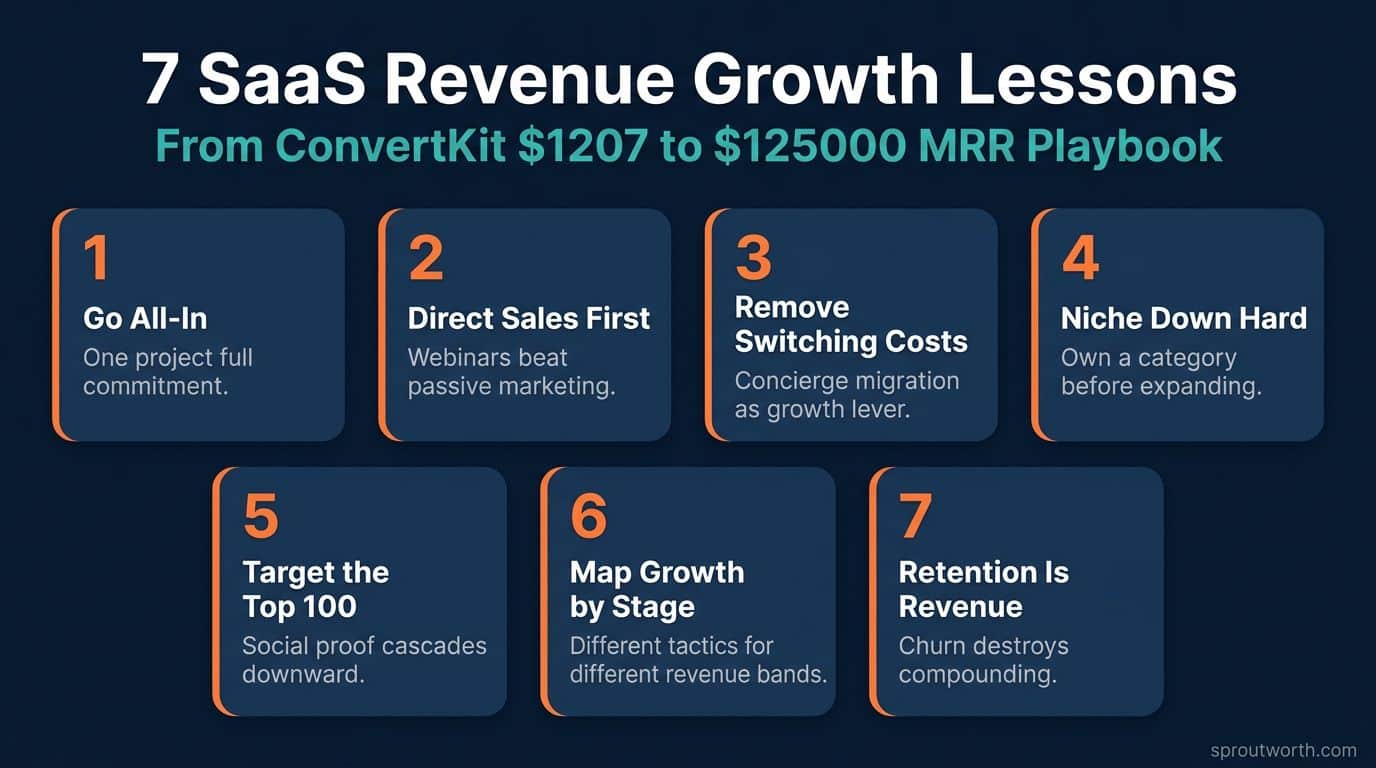
ConvertKit’s growth from $1,207 to $125,000 MRR in 15 months produced seven repeatable lessons for B2B SaaS founders: commit fully before expecting results, sell directly before investing in passive acquisition, eliminate switching costs rather than competing on features alone, narrow your positioning to a specific named buyer, pursue credibility-building early adopters strategically, manage runway aggressively during lean periods, and let personal investment create personal accountability.
- Divided attention kills SaaS. Treating a SaaS product as a side project produces side-project results. ConvertKit only turned around when Nathan committed completely, with time, capital, and focus.
- Direct sales beat passive inbound in the early stage. Webinars, cold outreach, and one-on-one conversations generate revenue faster than SEO and content in the first 12 to 18 months. Do the unscalable work first.
- Remove switching costs before they become objections. Friction kills conversion. Offering to handle the migration entirely turned ConvertKit’s biggest objection into a non-issue. Find the friction in your customer’s switching decision and eliminate it.
- Specific positioning beats broad positioning every time. “Email marketing for professional bloggers” outperformed “email marketing for creators” because it gave prospects an instant answer to “is this for me?” Broad positioning in a competitive market produces weak conversion.
- Credibility-building early adopters compound. Getting the right early customers requires direct effort, but the reputational return compounds across every subsequent sales conversation. Target the names that others in your category will recognize.
- Be willing to shrink before you grow. Nathan temporarily laid off team members to preserve the runway ConvertKit needed to compound. The willingness to make hard calls, rather than running out of money, gave the business time to work.
- Personal investment creates personal accountability. Putting in $50,000 of his own money changed how Nathan approached every decision. Skin in the game sharpens judgment in ways that external capital alone does not.
SaaS Revenue Growth by Stage: What Works When
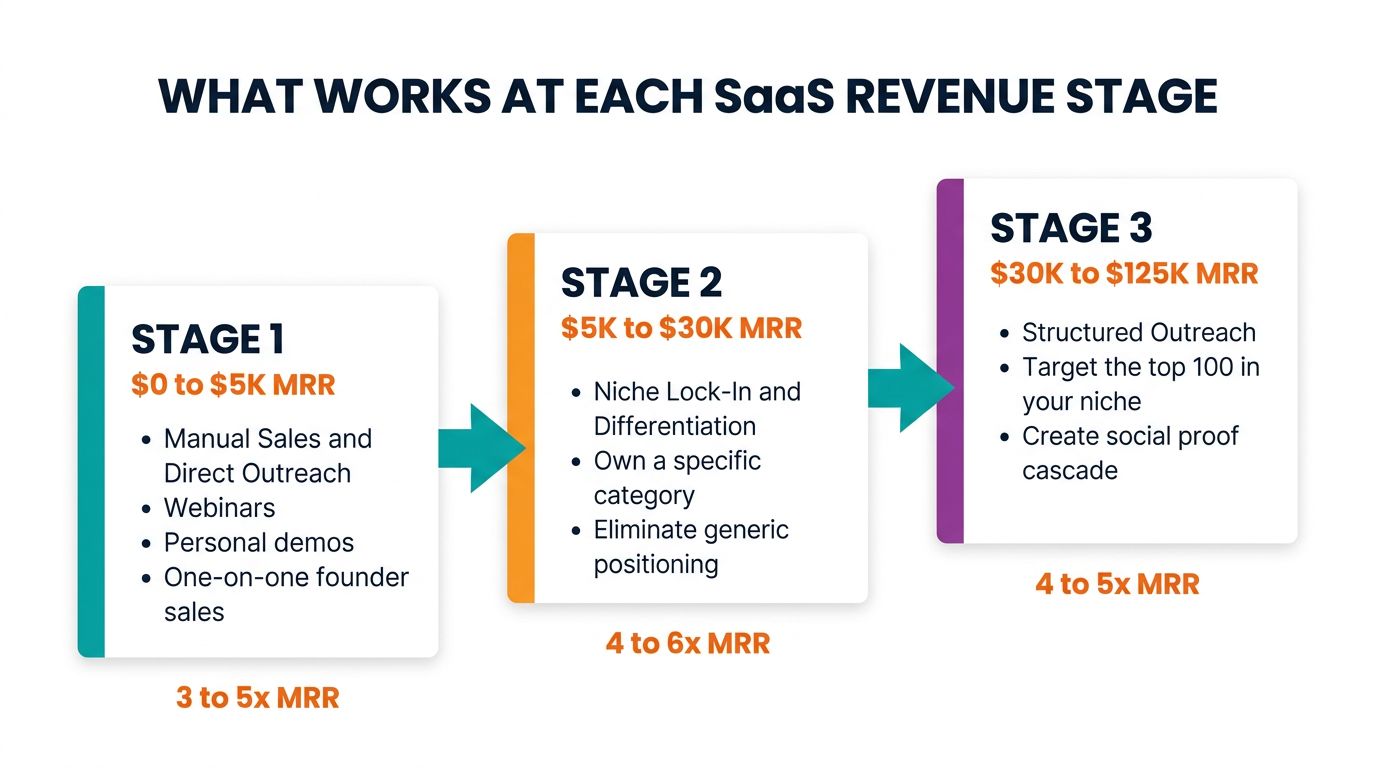
SaaS revenue growth strategies that work at $10K MRR fail at $100K MRR consistently. The tactics Nathan Barry used to reach $125K MRR follow a clear stage pattern: manual sales at the start, niche domination in the middle, and scalable outreach only after product-market fit is confirmed.
Most B2B founders chasing SaaS revenue growth make the mistake of jumping straight to paid acquisition or content marketing before their sales motion is proven. OpenView Partners’ SaaS benchmark data consistently shows that companies with a defined sales motion grow 30-50% faster than those relying on product-led growth alone before $1M ARR. ConvertKit’s trajectory follows a different sequence and matches the pattern seen across dozens of successful SaaS businesses.
Stage 1: $0 to $5K MRR, Manual Sales and Direct Outreach
At this stage, the goal is not efficiency; it is learning. Barry spent hours on webinars, direct outreach, and one-on-one demos. He talked to every customer personally. This is the fastest way to find out whether your positioning resonates and whether your churn is structural or fixable. Automated funnels at this stage hide the signal you need most.
Stage 2: $5K to $30K MRR, Niche Lock-In and Differentiation
Barry pivoted ConvertKit’s positioning twice in this range before landing on “email marketing for professional bloggers.” The pivot opened up faster growth because it made the ICP self-select. When your positioning is specific enough that your ideal customer immediately recognizes themselves in it, your sales cycle shortens, and your referral rate climbs. This is where ConvertKit’s concierge migration removed the last switching objection and accelerated the niche lock-in.
Stage 3: $30K to $125K MRR, Structured Outreach to the Top of the Niche
Only after confirming niche positioning did Barry deploy a systematic approach to targeting the top 100 bloggers in his category. This is a repeatable playbook: identify the 100 most influential customers in your niche, reach out personally, and convert them. Each conversion becomes a public credibility signal that makes the next conversion easier. Barry’s results, $125K MRR in 15 months, came from compressing this three-stage sequence rather than skipping it.
Retention: The Revenue Growth Lever Most Founders Underweight
SaaS revenue growth compounds when retention is strong. ConvertKit’s growth from $1,207 to $125,000 MRR depended as much on keeping customers as acquiring them. At sub-10% monthly churn, every new customer compounds. At 15% monthly churn, you are running to stand still.
Barry has been transparent about ConvertKit’s early retention numbers. In the $10K to $50K MRR range, the businesses that grow fastest are almost always the ones with monthly churn below 2%. ConvertKit achieved this through a combination of product stickiness and deliberate onboarding.
The concierge migration strategy did double duty. It removed the switching cost on the way in, and it created deep activation on day one. Customers who migrate their entire email list with hands-on help are far more likely to actively use the product in the first 30 days. Active usage in the first 30 days is the strongest predictor of 12-month retention in B2B SaaS. ProfitWell’s 2023 SaaS retention benchmark report confirms that products with guided onboarding experience 30-40% lower churn in the first 90 days than self-serve onboarding.
For B2B founders targeting the $10K to $100K MRR range, the implication is direct. A strong customer engagement strategy extends this thinking into ongoing retention. Before optimizing your acquisition funnel, model the impact of a 3-percentage-point reduction in monthly churn. At $50K MRR with 5% monthly churn, fixing churn to 2% adds roughly $18K in retained revenue per month within 12 months, without acquiring a single new customer. That is a higher-return investment than most paid acquisition channels at this stage.
Other B2B Founders Who Used the Same Playbook
The ConvertKit playbook- manual sales, niche positioning, concierge onboarding, and top-100 outreach- is not unique to email marketing software. Multiple B2B SaaS founders have used the same sequence to reach $1M ARR and beyond.
Patrick McKenzie, founder of Appointment Reminder, used direct outreach to local businesses before building any marketing infrastructure, reaching initial traction entirely through personalized sales. His 2010 post on getting the first 100 customers describes the same manual-first approach Barry later used at scale.
Ruben Gamez, founder of Bidsketch and later Docsketch (now SignNow), grew past $10K MRR by targeting freelancers specifically, a niche narrow enough to dominate, before expanding. The niche-first-then-expand approach is a recurring pattern in bootstrapped and early-stage SaaS growth.
Hiten Shah and Neil Patel’s work at Crazy Egg followed a similar pattern: the initial growth came from their existing audience (a narrow niche of digital marketers who trusted them), not from broad paid acquisition. Credibility within a niche compounds faster than awareness across a market. ConvertKit’s blogger niche was narrow enough to penetrate quickly and large enough to sustain $125K MRR before needing to expand.
For B2B tech founders today, the takeaway is to resist premature expansion. The B2B lead gen tactics that work in 2026 follow this same niche-first logic. Find the one category of customer who most acutely needs what you offer, dominate that segment, and use the revenue and credibility from that niche to fund the next market entry. This is how Nathan Barry built ConvertKit, and it is how most durable SaaS businesses grow through the first $1M ARR.
Frequently Asked Questions
How long did it take ConvertKit to reach $125,000 MRR?
ConvertKit reached $125,000 in monthly recurring revenue in January 2016, approximately 15 months after Nathan Barry went full-time on the business in October 2014. The growth was not linear. There were months where expenses significantly exceeded revenue, and the team was temporarily reduced to preserve runway.
What was ConvertKit’s primary SaaS revenue growth strategy?
ConvertKit’s growth came from a combination of direct sales webinars, personalized outreach to top professional bloggers, a free concierge migration service that eliminated switching friction, and focused positioning around “email marketing for professional bloggers.” No single tactic produced the growth; the combination of removing friction, targeting precisely, and selling directly compounded over 15 months.
How did Nathan Barry use webinars to grow ConvertKit?
Nathan Barry ran live webinars presenting ConvertKit to small groups of professional bloggers. The format allowed him to demonstrate the product, handle objections in real time, and close customers on the call. Webinars became a consistent growth channel from June 2015 onward and contributed to the acceleration through the second half of the year.
What was ConvertKit’s concierge migration service?
ConvertKit’s concierge migration service handled the complete email platform migration for new customers at no cost. Nathan Barry’s team would log into the customer’s existing provider (AWeber, MailChimp, Keap), transfer all subscribers, copy all autoresponders, and replace opt-in forms. This eliminated “switching is too much work”, the most common objection from interested but unconverted prospects.
Why did ConvertKit rebrand away from “email marketing for authors”?
Nathan Barry realized that most of ConvertKit’s best customers did not identify as authors; they identified as bloggers, course creators, or podcast hosts. The “authors” positioning created unnecessary friction in sales conversations. By repositioning to “email marketing for professional bloggers” in March 2015, every message became immediately relevant to the people ConvertKit was actually serving, and conversion improved.
What This Means for B2B Tech Founders Today
The ConvertKit story from 2014 to 2016 is not primarily a story about email marketing software. What happens when a founder stops treating a SaaS product as optional? The founder commits capital and attention, makes deliberate decisions about positioning and customer acquisition, and stops waiting for a better product to sell itself. Educational email courses offer a scalable alternative to the personalized outreach that ConvertKit used at stage 3.
The same levers Nathan Barry used are available to B2B tech founders today: go direct before going broad, remove friction before competing on features, name your customer precisely, and pursue the early adopters who will make every subsequent conversation easier.
If you’re building the content system that makes this kind of authority compound for your SaaS business, talk to Sproutworth about how B2B tech companies use strategic content to accelerate pipeline and build the kind of credibility that closes enterprise deals.
