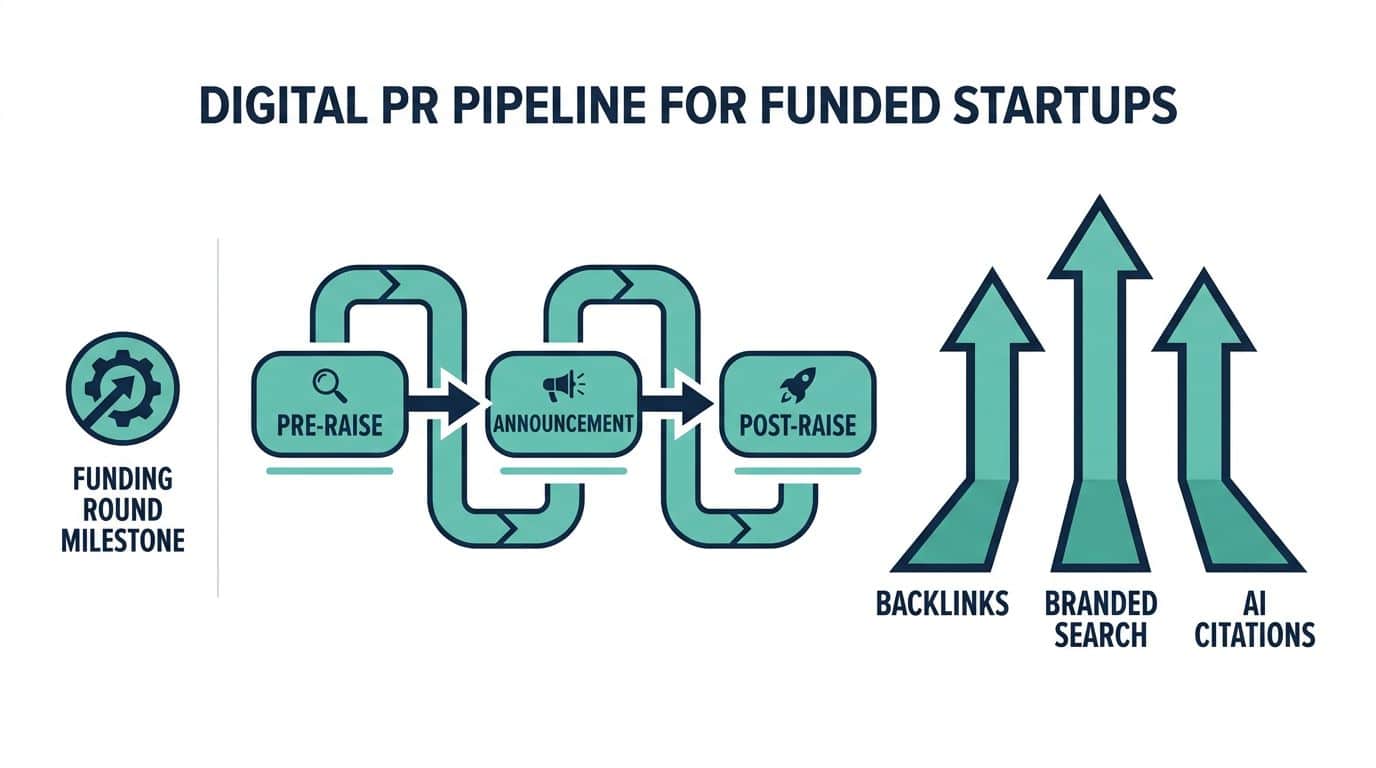
Digital PR for funded startups is the practice of using earned media, data campaigns, and founder-led content to convert funding momentum into lasting search visibility. Companies that raise seed or Series A capital spend $5,000 to $10,000 per month on digital PR programs. Reboot Online’s analysis of 371,631 news articles confirms this range. Funded CEOs who treat digital PR as a system, not a press release, build authority and branded search volume that compounds.
What Digital PR for Funded Startups Actually Means
Digital PR for funded startups combines media outreach, link-building campaigns, and thought leadership content to earn coverage and backlinks from authoritative publications. Unlike traditional startup PR, which focuses solely on press placements, digital PR ties every placement to a measurable search outcome. A backlink. A brand mention. A referral traffic spike. A citation in an AI answer engine.
Funded startups need this approach because they face a specific visibility problem. After raising capital, they have momentum and a story. They lack the domain authority, backlink profile, and branded search volume of established competitors. Digital PR bridges that gap by earning links from high-authority publications that signal trust to Google and AI search engines.
Here is the key distinction for digital PR for funded startups. Digital PR measures links and authority. Traditional PR measures impressions and placements. Traditional PR firms measure success in impressions and placement counts. Digital PR for funded startups measures success differently. Track domain authority, branded search, referral traffic, and AI citation frequency. These metrics compound. A single link from a DR-80 publication can move organic rankings for months. A founder quoted in a trade publication can get cited by AI answer engines for years.
The digital PR for funded startups playbook covers three phases. Pre-raise positioning. Funding announcement execution. Post-raise amplification. Each phase has specific tactics, tools, and metrics that funded CEOs can use to turn a one-time funding event into lasting visibility.
How to Build a Pre-Raise Digital PR for Funded Startups Foundation
Digital PR for funded startups starts 60 to 90 days before the raise closes.
Pre-raise digital PR for funded startups positions the company and its founders as credible sources before the funding announcement lands. This phase typically starts 60 to 90 days before the raise closes. It focuses on three assets. Founder authority on LinkedIn. A content footprint journalists can reference. Relationships with reporters who cover the sector.
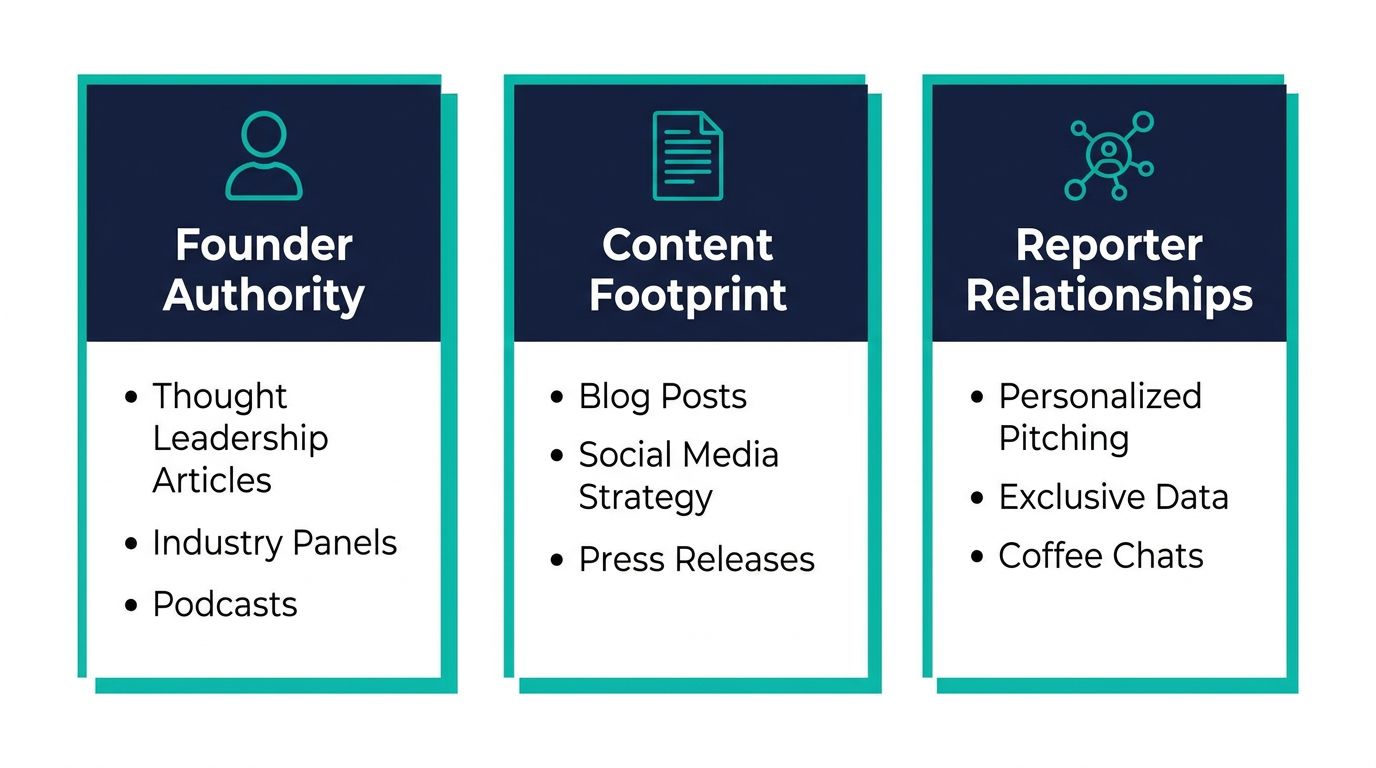
Start with founder-led content on LinkedIn. Posts that share original data, contrarian takes, or behind-the-scenes build logs attract journalist attention. Reporters search LinkedIn for sources when writing industry trend pieces. A founder with 50 to 100 substantive posts in their sector becomes visible when reporters search for expert quotes. According to Dux-Soup’s 2025 B2B Lead Generation Report, LinkedIn is the top channel for B2B social leads, with 80% originating from the platform.
Digital PR for funded startups also requires a content footprint on the company blog. Three to five substantive posts on the startup’s core topic give journalists something to reference when they write about the company. These posts also serve as linkable assets. A data-driven post with original research can earn backlinks for months after publication, especially when reporters cite it as a source.
Digital PR for funded startups means identifying and engaging reporters before you need them. Use Twitter or LinkedIn to follow journalists who cover the startup’s sector. Share their work. Reply thoughtfully to their posts. When the funding announcement is ready, the relationship already exists. A warm pitch to a reporter who recognizes the founder’s name lands better. A cold press release to an inbox with 200 unread emails gets ignored.
For a structured approach to building this content foundation, the content strategy for funded startups playbook covers how to stage content production across funding rounds.
How to Execute a Funding Announcement With Digital PR for Funded Startups
The funding announcement is the highest-leverage digital PR moment for any funded startup.
The funding announcement is the single highest-leverage digital PR moment for a funded startup. Done well, it earns tier-one coverage and 15 to 30 backlinks. The content asset can be repurposed for months. Done poorly, it generates a press release that nobody reads.
The announcement package needs four components. First, a funding narrative that goes beyond “we raised money.” Frame the story around the problem being solved, the market opportunity, and what the capital enables. Second, original data or a proprietary insight that gives reporters something to cite beyond the raise itself. Third, a founder quote that sounds human, not like a press release template. Fourth, customer or partner testimonials that prove the product works.

Digital PR for funded startups distributes the announcement across three channels. Pitch reporters directly at publications that cover the startup’s sector. Use a press release distribution service for broad pickup and SEO backlinks. Publish the announcement on the company blog with structured data markup, so AI answer engines can extract the facts.
Time the digital PR for funded startups announcement for maximum coverage. Tuesday through Thursday mornings, avoiding holidays and major tech event weeks, produce the highest pickup rates. Give exclusive or embargoed access to one tier-one reporter 48 hours before the broader announcement. This secures anchor coverage that smaller outlets will cite.
Measure the announcement against three metrics. Number of publications that covered the raise. Backlinks earned within 30 days. Branded search volume spike in two weeks. These metrics become the baseline for evaluating ongoing digital PR for funded startups.
Why Digital PR and SEO Work Together for Funded Startups
Digital PR and SEO are two halves of one visibility engine for funded startups.
Digital PR and SEO are not separate disciplines for funded startups. In digital PR for funded startups, these two channels function as a single visibility engine. Every backlink earned through digital PR signals authority to Google. Every brand mention in a publication increases branded search volume. Every founder quote in a trade journal creates an entity association. AI answer engines use these when generating responses about the sector.

SEO Sherpa’s analysis found that digital PR campaigns produce branded search lifts of 20-40%. This happens in the months following major coverage. This is not a coincidence. When people read about a company in a trusted publication, they search for that company by name. Google interprets branded search volume as an authority signal and ranks the company higher for non-branded terms in the same topical cluster.
The AI search dimension makes digital PR for funded startups more important. LLM-referred traffic grew 527 percent year over year according to Semrush’s 2025 AI search traffic study. AI answer engines like ChatGPT and Perplexity cite sources based on entity recognition and content authority. A startup consistently mentioned in authoritative publications becomes an entity that AI engines recognize and cite.
This is where most funded startups miss the digital PR for funded startups opportunity. They treat digital PR as a brand awareness exercise and SEO as a separate technical function. The companies that win connect the two. Every PR placement is a link-building opportunity. Every founder quote is an entity signal. Every media mention is a catalyst for branded search. For a deeper look at how AI citation works, the LLMSEO guide for B2B tech companies breaks down the mechanics of getting cited by ChatGPT and Perplexity.
What Digital PR Costs for a Funded Startup
Digital PR for funded startups costs $3,000 to $15,000 per month depending on scope.
Digital PR for funded startups costs between $3,000 and $15,000 per month depending on scope, agency expertise, and campaign complexity. Reboot Online’s report found that $5,000 to $10,000 per month is the most common spending range for startups and small companies.
The pricing tiers break down into three models. Retainer-based agencies charge $5,000 to $15,000 per month for ongoing media outreach, content creation, and link-building campaigns. Project-based digital PR, such as a single data campaign or funding announcement push, costs $8,000 to $20,000 as a one-time fee. In-house digital PR for funded startups, where a company hires a PR manager, costs $60,000 to $90,000 per year in salary plus tools.
The ROI question for digital PR for funded startups is where most founders stall. A Reddit thread on r/startups captured the debate. Founders questioned whether digital PR at $10,000 per month beats alternatives like HARO and in-house content. The answer depends on what the startup measures. If the only metric is impressions, digital PR underperforms paid social. If the metric is domain authority, backlink quality, branded search, and AI citations, digital PR outperforms. The effects compound.
Funded startups should budget for digital PR with a minimum commitment of 6 months. The first two months build the foundation: reporter relationships, content assets, and campaign strategy. Months three and four produce the first coverage and backlinks. Months five and six show compounding. Branded search rises. Organic rankings improve. AI answer engines are starting to cite the startup by name. Digital PR for funded startups rarely shows results in 30 days. Companies that commit to six months see the compounding returns that make digital PR for funded startups worth the investment.
How to Measure Digital PR for Funded Startups With Metrics CEOs Care About
Most digital PR reports measure impressions. Funded CEOs need metrics that connect to pipeline.
Most digital PR reports are useless for CEOs. They show impression counts, placement logos, and vanity metrics that do not connect to pipeline. Funded CEOs need metrics that tie digital PR for funded startups to business outcomes like domain authority, branded search, and pipeline contribution. The five metrics below do that.

Digital PR for funded startups comes down to five metrics. First, domain authority growth. Use Ahrefs or Semrush to measure domain rating at the start and every 30 days. A well-executed digital PR program should increase a new startup’s domain rating by 5 to 15 points over six months. Second, branded search volume. Google Trends and Google Search Console show how many people search for the startup by name. A 20 to 40 percent spike in branded search following major coverage is a reliable signal that the PR is reaching the right audience.
Third, referral traffic from digital PR for funded startups earned media. Track the quality of this traffic: time on page, pages per session, and conversion rate. A tier-one link sending 500 visitors at 3 percent conversion beats a low-authority link sending 2,000 visitors who bounce. Fourth, backlink quality. Track the domain rating of referring sites, the relevance of the linking page, and whether the link is dofollow. Five links from DR-80 publications outweigh 50 links from DR-20 sites.
Fifth, AI citation frequency for digital PR for funded startups. Search ChatGPT and Perplexity for queries related to the startup’s sector and check whether the company is mentioned. Use tools like Profound or Conductor to track the presence of AI citations over time. According to Seer Interactive’s case study, ChatGPT-referred traffic converts at 15.9 percent. Google organic converts at 1.76 percent. Companies cited by AI answer engines capture high-intent traffic that converts at nearly 10x the rate of standard organic search.
For funded startups running a demand generation strategy alongside digital PR for funded startups, these metrics connect directly to pipeline. Branded search volume correlates with direct traffic, which converts at higher rates than any other channel. AI citations drive referral traffic from high-intent buyers researching solutions. Domain authority growth lifts organic rankings for commercial keywords that drive pipeline.
When to Hire a Digital PR Agency vs Build In-House
The decision for digital PR for funded startups, between hiring an agency and building in-house, depends on three factors. The funding stage determines the budget and narrative complexity. Internal bandwidth affects the team’s ability to manage PR alongside product work. Sector complexity shapes the reporter relationships needed for meaningful coverage.
Seed-stage startups should start with a project-based digital PR engagement focused on the funding announcement and the first 90 days of post-raise amplification. Spending $8,000 to $15,000 on a focused campaign yields better returns than a $ 5,000-per-month retainer with no clear strategy. Seed-stage founders should also invest in founder-led content on LinkedIn, which costs nothing but time and builds the personal authority that makes every PR placement more credible.
Series A and Series B startups running digital PR for funded startups should move to a retainer-based agency engagement model. At this stage, the startup has a story beyond the raise. Product launches. Customer case studies. Category-defining points of view. A retainer agency that specializes in B2B tech runs media outreach, data campaigns, and thought-leadership placements. Budget $8,000 to $15,000 per month. The key criteria: does the agency know reporters in the startup’s sector? Do they measure backlinks and domain authority, not impressions?
Series C and later startups should build an in-house digital PR function. The startup has enough narrative complexity, reporter relationships, and content production needs to justify a dedicated hire. A PR manager who understands digital PR for funded startups can coordinate with the content team, SEO team, and agency partners to run an integrated visibility program.
| Approach | Best For | Monthly Cost | Time to Results | Key Advantage |
|---|---|---|---|---|
| Project-based agency | Seed-stage, funding announcement | $8K-$20K one-time | 4-8 weeks | Focused push, no retainer lock-in |
| Retainer agency | Series A-B, ongoing visibility | $8K-$15K/month | 3-6 months | Continuous media outreach and link-building |
| In-house hire | Series C+, complex narrative | $5K-$7.5K/month salary | 6-12 months | Full control, deep company knowledge |
| Founder-led PR | Pre-seed, building authority | $0 (time only) | 6+ months | Authentic voice, no agency fees |
Every digital PR for funded startups stage benefits from connecting PR to the broader content engine. The brand content that gets cited by AI search engines approach shows how to structure content. Earned media, blog posts, and founder content all reinforce the same entity signals.
Common Digital PR Mistakes Funded Startups Make
Funded startups make five predictable mistakes that waste digital PR budget and delay compounding visibility.
Funded startups make five predictable mistakes with digital PR for funded startups. Each one wastes budget and delays the compounding of visibility that makes digital PR worth the investment.
Mistake one in digital PR for funded startups: treating the funding announcement as a one-time event. The digital PR for funded startups press release goes out. Coverage lands. Then nothing. No follow-up pitches. No data campaigns. No thought leadership. The coverage spike fades in two weeks. Digital PR for funded startups works when the announcement is the start of a campaign. The announcement is the start of a campaign, not the end of one.
Mistake two: measuring impressions instead of links. A placement in TechCrunch with 100,000 impressions but no backlink is a brand awareness win, not a digital PR win. Digital PR measures backlinks, domain authority, branded search, and AI citations. If the agency reports impressions and placement logos but not link count or domain rating growth, they are doing traditional PR, not digital PR for funded startups.
Mistake three: pitching generic stories to generic reporters. A funding announcement pitched to 200 reporters on a generic media list gets 3 responses. The same announcement pitched to 15 reporters who cover the startup’s specific sector, with a personalized angle for each, gets 8 responses. Volume does not win in digital PR for funded startups. Relevance does.
Mistake four: ignoring AI search. Funded startups that focus solely on Google rankings miss out on the fastest-growing traffic source. LLM-referred traffic grew 527 percent year over year. Companies cited by AI answer engines capture high-intent traffic that converts at nearly 10x the rate of standard organic search. Digital PR for funded startups must include AI citation as a tracked metric.
Mistake five: switching agencies every three months. Digital PR compounds over six months. Switching agencies at month three because results are not showing yet resets the clock. The reporter relationships, the content assets, the campaign momentum all start from zero. Companies that commit to six months see compounding returns in digital PR for funded startups. Companies that switch do not.
Frequently Asked Questions
What is digital PR for startups?
Digital PR for startups is the practice of earning media coverage, backlinks, and brand mentions from authoritative publications to build domain authority and search visibility. Unlike traditional PR, which measures success in impressions, digital PR measures success in backlinks, branded search volume, referral traffic, and AI citation frequency. Digital PR for funded startups converts funding momentum into lasting search authority rather than one-time press.
How do you launch a PR campaign for a funding announcement?
Launch a funding announcement PR campaign by building a narrative package that includes the funding story, original data, founder quotes, and customer testimonials. Pitch reporters directly at sector-specific publications. Distribute via a press release service for broad pickup. Publish on the company blog with structured data markup. Time the announcement for Tuesday through Thursday and give one tier-one reporter embargoed access 48 hours before the broader launch.
How does digital PR help SEO for startups?
Digital PR helps SEO three ways. It earns high-authority backlinks that signal trust to Google. It increases branded search when readers search for the company. It creates entity associations that AI answer engines use. SEO Sherpa found that digital PR for funded startups consistently produces 20 to 40 percent branded search lifts in the months following major coverage.
How much does digital PR cost for a startup?
Digital PR costs for startups range from $3,000 to $15,000 per month. Reboot Online’s analysis of 371,631 news articles found that $5,000 to $10,000 per month is the most common range. Project-based campaigns cost $8,000 to $20,000 as a one-time fee. Digital PR for funded startups requires a minimum six-month commitment to see compounding returns.
Should startups hire a PR agency or do PR in-house?
Seed-stage startups should use project-based agency engagements or founder-led PR. Series A and B startups should engage a retainer-based agency specializing in B2B tech. Series C and later startups should build an in-house digital PR function. The decision depends on funding stage, internal bandwidth, and sector complexity. At every stage, digital PR for funded startups should integrate with SEO and content efforts rather than operate as a standalone function.
Conclusion
Digital PR for funded startups is not a press release. It is a system for converting funding momentum into domain authority, branded search volume, and AI citation presence. The startups that treat it this way build visibility that compounds for months after the announcement cycle. The ones that treat it as a one-time press blast get a spike of coverage that fades in two weeks and leaves nothing behind.
Start with the pre-raise foundation: founder-led content, a content footprint, and reporter relationships. Execute the funding announcement with a narrative package that gives reporters something to cite. Amplify digital PR for funded startups post-raise with data campaigns, thought leadership, and ongoing media outreach. Measure against domain authority, branded search, referral traffic, backlink quality, and AI citation frequency. Commit to six months minimum. The compounding returns are what make digital PR for funded startups worth the investment. Startup PR without this system is just press. With it, PR becomes a visibility engine that drives pipeline long after the funding announcement fades from the news cycle.
Related Resources
- AI Overview Optimization: How to Get Cited by Google: getting cited by Google AI Overviews in 2026
- GEO SEO: How to Run Both Without Splitting Your Authority: balancing GEO and SEO without cannibalization
- B2B LinkedIn Marketing With AI: 7 tools that build pipeline on LinkedIn in 2026
- Branding Content That Drives B2B Revenue: how branding content connects to pipeline
- How to Rank in ChatGPT: The B2B Founder’s Playbook: ranking in AI answer engines for B2B founders